

Yes, in the Netherlands we speak of broadcasting organisations (omroepen), plural. The Dutch broadcasting system is based on worldviews (levensbeschouwingen). At one time there was a separate Catholic broadcaster (KRO), a Protestant one (NCRV), a 'liberal Protestant' (VPRO), a 'socialist' one (VARA), and a general one not based on any specific worldview (AVRO). To these were added a broadcaster originally focused mainly on entertainment (TROS; for years "Vertrossing" was a commonly used term for vulgarisation, 'flattening'), and subsequently the EO (Evangelische Omroep) and Omroep MAX (aimed at the presumed interests of people over 50), as well as a number of smaller broadcasters that do not take part in the public broadcaster's classical channel. In addition there is the NTR, a 2011 merger product of three non-membership broadcasters, NPS, Teleac and RVU. The names no longer matter much; the tasks arising from those three broadcasters consist of information (apart from news), education, art, culture and diversity. The NTR also plays an important role in the programming of NPO Klassiek, including live recordings such as the Zondagmiddagconcert and five times a week the Avondconcert, the latter often live or earlier recordings, sometimes also taken over from foreign broadcasters, and its own, self-produced ZaterdagMatinee, live from the Amsterdam Concertgebouw, with the Radio Filharmonisch Orkest and/or the Groot Omroepkoor, but partly also with guest ensembles. One can imagine that this model entails quite a lot of meetings here and there. But the Netherlands is also famous for the 'polder model'. There are some smaller membership broadcasters, but they are not on NPO Klassiek. Furthermore, the NOS (Nederlandse Omroep Stichting) provides the news bulletins on the hour on NPO Klassiek — except when concerts are broadcast, and some 'records-with-chat' programmes are also exempt from broadcasting the news, although it is not really clear why they could not be interrupted. The whole is often called the 'pillar system' (zuilensysteem), with a 'pillar' for each worldview. For a time there was also a Muslim broadcaster, but it no longer exists, and there is a far-right channel, which I would call ultra-right, Ongehoord Nederland (ON), for the Dutch citizen who otherwise is not heard; ON may also disappear, because of possibly excessively extreme content, but ON was never on NPO Klassiek either. Beyond all this, there are also commercial broadcasters, just as in Belgium, such as various RTL channels and the channels of Talpa (John de Mol, the Rupert Murdoch of the Netherlands), such as SBS6, politically the Fox News of the Netherlands. These do nothing with classical music, and one should not even think that they would. **Mergers and finances** Spontaneously, due to declining membership numbers, and/or at the urging of the Ministry of OCW (Education, Culture and Science), several of the membership broadcasters have merged over the years. The survivors participating in NPO Klassiek are KRO-NCRV, AVROTROS and BNNVARA (BNN was a relatively young, successful 'popular' channel aimed at young people). Membership contributions of the individual broadcasting associations, incidentally, contribute only a fraction to the total budget of the public system, about 1% to 2%. The total budget of NPO is covered for just over three quarters by the State contribution (government subsidy from tax money) and for about 23% to 25% by other income, such as advertising. Advertisements are broadcast before and after the NOS news bulletins. The broadcasters have lost many members in recent years. In 2021 most had practically halved compared to 2014. Secularisation and also other forms of diminished social bonding play a role. The membership figures serve mainly as a remaining indicator of *social representation and pluriformity*, or at least the remaining interest to take the trouble each year to transfer an amount of about 10 euros. The largest broadcaster is now BNNVARA. But only MAX and a number of smaller broadcasters that do not broadcast on NPO Klassiek had grown. I would dare to bet, however, that among VPRO members there are more motivated people interested in classical music than among MAX members. Yet the VPRO has so far provided two hours a week of classical music, in Vrije Geluiden (a distinctive programme, now presented by composer Anne-Maartje Lemereis, which however is also being discontinued), while MAX fills four days a week with three hours of a records-with-chat programme, since the beginning of this year extended from two to three hours a day, at the expense of a truly distinctive programme of the NTR, Podium. That distribution also has a lot to do with the priorities broadcasters have. The VPRO was always known for its many quality television broadcasts, such as Zomergasten, various satirical programmes and good documentaries. Most satirical programmes have since been discontinued, and Zomergasten also stops after this past summer. For a broadcaster like MAX it is also difficult to make distinctive television programmes, and it remains with many game shows featuring older well-known Dutch people.
The activities of the member broadcasters on NPO Klassiek do not correspond to their membership numbers. Relative to their size, BNNVARA, the EO and even the VPRO contribute little, even though the latter for years prided itself on its cultural commitment. For years the VPRO programmed 'Vrije Geluiden' on the classical radio channel, with many live recordings, at a time when 'world music' still really mattered; there was De wandelende tak with the unique Fleming Walter Schlosse, a well-known Fleming, as well as Mundial by Stan Rijven on the pop channel NPO 3FM, and on television there was Reiziger in Muziek, with the equally unique Han Reiziger. But those days are over. Because of the budget cuts, the VPRO has also discontinued many other quality programmes on television, such as the Arjen Lubach Show and Plakshot by Roel Maalderink, with which the satire for which the VPRO was once known, with Wim T. Schippers, Koot & Bie, Theo en Thea and Jiskefet, has disappeared, and now the last programme that made room for long interviews, Zomergasten, is also disappearing. What remains are political discussion programmes and quality documentaries, on which the focus now lies. On the radio, the EO once a week broadcasts the programme Musica Religiosa, with CDs of religious music, where the label 'Evangelical' (that is, strictly Protestant) is not taken too literally; there is also Catholic music, but of the texts of religious classical music of Protestant origin, such as a Bach cantata, a translation is read aloud, so that the ecclesiastical dimension does not escape us. On television, the EO incidentally distinguishes itself through its support for quality documentaries and the impressive historical drama series De Joodse Raad.
The Top 400 and film music
The member broadcasters and the NTR have fixed blocks on this channel, and incidentally they have for a long time cooperated intensively without any problems. And the fixed arrangement of programmes and presenters is suspended, for example, during the Klassieke Top 400 and the Filmmuziek Top 400, chosen by listeners. In my view, the system in those programmes bites its own tail. Yes, one can argue vehemently about whether Joep Beving, Louis van Dijk, Ennio Morricone, Iris Hond, Ludovico Einaudi, Hans Zimmer, Karl Jenkins and Cor Bakker belong to the domain of classical music. (I think not.) And incidentally: if symphonic-sounding film music may pass for classical, I find it an outrage that Bernard Herrmann's music for Hitchcock's Vertigo and Psycho is not in the general Klassieke Top 400, and in the Filmmuziek Top 400 sits very low, somewhere between the 300s and 200s. Nothing by Franz Waxman appears in either list, for example not even his music for Hitchcock's Rebecca, in which Waxman anticipated Herrmann by 19 years in quoting the Liebestod music from Tristan und Isolde in a Hitchcock film. And nothing by Korngold appears in that Filmmuziek Top 400 either!
Besides radio broadcasts, NPO Klassiek also produces podcasts, and there is a website with information about the programmes, background material and links to earlier recordings.
Orchestras and choir
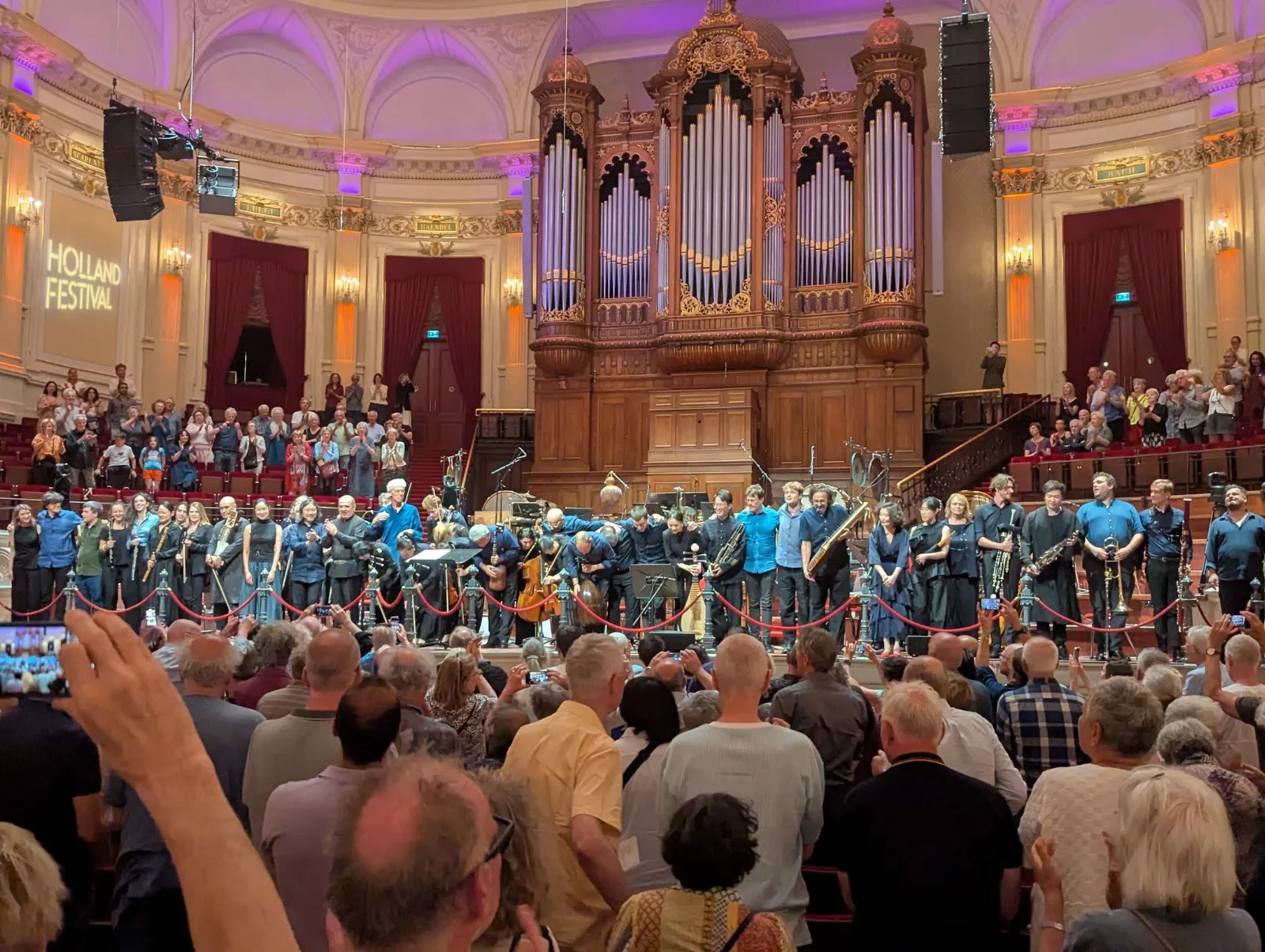
The broadcasting system also includes the Radio Filharmonisch Orkest and the Groot Omroepkoor, with 230 staff members, who are closely involved in the two major symphonic series on NPO Klassiek: the AVROTROS Vrijdagconcert from TivoliVredenburg in Utrecht and the NTR ZaterdagMatinee from the Concertgebouw in Amsterdam. The ZaterdagMatinee began in 1961 as the VARA-Matinee, or the Matinee op de Vrije Zaterdag, set up by the 'socialist' VARA as a musical-educational facility for the 'working-class' constituency, at the time when the five-day working week was officially introduced in the Netherlands. The AVROTROS Vrijdagconcert began in 1979, when the Muziekcentrum Vredenburg opened, under the auspices of the AVRO, at a time when the TROS did not yet really engage with classical music.
The Radio Filharmonisch Orkest is an absolutely top-class orchestra which, under its principal conductor Karina Canellakis, gives many high-quality performances of the major Wagner operas and Bruckner symphonies, but has also produced a splendid Janáček cycle, while with James Gaffigan it recorded one of the finest cycles of Prokofiev symphonies. The Groot Omroepkoor is likewise a top ensemble. Just listen to them in Verdi, Janáček or Ligeti. For years there were also the Radio Symfonie Orkest and the Radio Kamer Orkest; there was never enough, but so many radio orchestras in such a small country was a lot.
There is also the Metropole Orkest, a highly regarded, internationally recognised 'symphonic big band' ensemble that also performs crossovers with classical music, and additionally lends itself to commercial activities, such as crossovers; just recently, for example, a retrospective of Aretha Franklin's repertoire in Amsterdam's Ziggo Dome, and some time ago they recorded a magnificent double CD of big-band arrangements of Joni Mitchell's repertoire, in this case with the real Joni Mitchell herself.
Above the whole of NPO Klassiek stands the zendermanager, now Tim Moens, who allocates the airtime and budgets, so yet another management layer, and who now has the thankless task of distributing the imposed cuts across the broadcasters.
De Concertzender, Classic.nl and politics
Besides NPO Klassiek, the Dutch radio landscape also includes the Concertzender. It receives no structural subsidies and works with volunteers and further with donations from enthusiasts. The Concertzender is listened to mainly by connoisseurs.
The commercial broadcasters RTL and Talpa do nothing with classical music. Incidentally, the television channel RTL 4 does try to acquire a quality image, certainly in comparison with the other major commercial broadcaster, Talpa of John de Mol.
There is also a paid radio station for classical music, Classic.nl, where one can "enjoy the most beautiful music free of advertising for everyone" for 2.90 per month. Whether that is so, I do not know. The website announces quite a few concerts featuring neoclassical music by, for example, Joep Beving, so I suspect this station is not for me.
In this way a complicated system grew. Yet the member broadcasting organisations were sacred cows for years, but it worked. Now the entire public broadcasting sector is supposed to cut back. 'The right' has in any case for years had little time for the public broadcaster, which is portrayed as 'left'. In those circles the NOS and NTR are regularly dismissed as the 'state broadcaster'. Compare the (mostly right-wing) British who would like to restrict the role of the BBC; Rupert Murdoch's Sky has already sharpened its knives.
That the most recent Speech from the Throne, the annual policy statement delivered by the King, did not even mention culture is an ominous sign.
Four broadcasting houses
If it is up to the Minister, from 2029 the eleven member broadcasting organisations will be housed in four so-called 'broadcasting houses', applying to the entire broadcasting system, not only to the classical channel.
The new partnerships are not yet fixed, but KRO-NCRV, Omroep Max and WNL have indicated they wish to join forces, as do EO, VPRO and Human, AVROTROS and Powned (a broadcaster that emerged from a somewhat mischievous YouTube channel and so far certainly does not deal with classical music), and BNNVARA and the aspiring Omroep Zwart have also expressed that intention, should Omroep Zwart be granted access to the system. The plans also mean there will be no room for new broadcasters. Until now, admission was possible by collecting 50,000 signatures, but from 2029 that will no longer be possible, in order to prevent further fragmentation. The Council for Culture will then assess whether a sufficient diversity of voices is heard on the channels.
The so-called task broadcasters NOS and NTR, which have no members, will continue together under the name NOS.
The future of the typical NTR programmes
The classical music world is now worried about the programmes the NTR produces. The Minister considers the NTR too small to look after the Matinee alone and half of the choir and orchestra. But who will then feel responsible for the Matinee, the Sunday afternoon concert and the evening concerts? A representative of the Ministry says the NTR would have to place the relevant editorial departments with one of the broadcasting houses.
"They have the obligation to provide cultural programming. That is independent of constituencies. It is assessed beforehand and afterwards by the Council for Culture. The system is becoming completely different and does not start from the mission of broadcasters, but from the statutory task."
In 2023 Kees Vlaardingerbroek left as programmer of the Matinee. He too had long felt that the NTR could not continue to carry the Matinee alone. But he says he mainly left because of drastic cuts to the programming budget. "Yes, there are cost increases, but the NTR management made a mistake by automatically charging those extra costs to the programming budget." "Already in 2017 it had become clear that the NTR could not carry the Matinee alone. I knew - and many with me - that the Matinee had become far too vulnerable because of the NTR's Alleingang (termination of the cooperation with AVROTROS)." "The NTR is not a member broadcaster but a task broadcaster. A merger with the NOS therefore lies close at hand. Why culture may not come along to the NOS is not clear to me." "My proposal to look together with the NTR management for alternative solutions that would not come at the expense of the programming budget was rejected by the NTR management. For that reason I decided, in protest, to resign as artistic director of the Matinee per 1 April 2023." From an article by Vlaardingerbroek in 2025 on the OpusKlassiek website: "The Saturday Matinee is too large and too important to be carried by one broadcaster. First it appeared that the VARA was not able to keep the Matinee at its level in the long run, later the same proved to be the case with the NTR. The Saturday Matinee must, as a jewel in the crown of the Public Broadcaster, be carried by the entire Public Broadcaster. Second: in Hilversum it is arranged such that broadcasters subscribe to a particular time slot to which a budget is attached, which is determined by the Dutch Public Broadcaster (NPO). The future of the Saturday Matinee therefore does not depend on the survival of the NTR, but on the will and vision of those who have the say within the NPO, and that is to a large extent the channel manager, or whoever has great influence on the channel manager."
Which broadcaster suits the Matinee, or perhaps a better question, which broadcaster suits the Matinee?
Perhaps the NTR component of the NOS in its future form? But evidently the Ministry is not inclined towards that.
The question then is which of the member broadcasters, as part of which of the future broadcasting houses, has the greatest affinity, the most expertise and the hoped-for financial means to (partly) adopt the Matinee?
The Matinee once came from the VARA. BNNVARA is now the largest member broadcaster, but hardly does anything on NPO Klassiek (apart from a something-for-everyone music-with-chat programme of less than two hours on Sunday, Café Foyer, which descends from a programme called Keihard Klassiek, aimed exclusively at 'neo-classical' music), and the broadcaster no longer has any expertise in-house in the field of classical music.
From Omroep MAX, the second in membership, one cannot expect that it is waiting on behalf of its 50-plus members for the 'connoisseur' music of the Matinee.
Here, the KRO-NCRV is followed. In the weekday evening program Passagio Late Night and in the daily De Ochtend, this broadcaster shows enough spirit of adventure, partly thanks to some excellent music compilers, Carel den Hertog and Teun Faber, and presenter Anne-Maartje Lemereis.
The AVROTROS already organises the more popular Friday evening concert at TivoliVredenburg in Utrecht, but it is questionable whether the broadcaster would want and be able to take on quite different concert series as well. Kees Vlaardingerbroek also wonders about that.
With the hour-long Musica Religiosa, the EO has almost no organisational expertise in-house.
De Matinee would once have fitted perfectly with the VPRO; this broadcaster is now ending the still adventurous program Vrije Geluiden from next January.
Given the uncertainty that now prevails, there is a danger that the highest powers within the broadcasters will come up with very different plans. There will certainly be parties inside and outside the broadcasters that have their eye on the budgets for the Radio Filharmonisch Orkest and the Groot Omroepkoor.
The television program Podium Klassiek of the NTR will continue to exist. At least, "nothing changes in 2026. We are in discussion about the time slot from 2027", according to a spokesperson.
The current consequences of the cutbacks
AVROTROS also indicates that it will make cutbacks. The live concert program Spiegelzaal, two hours from the Amsterdam Concertgebouw on Sunday morning, had already disappeared by December 2023. In its place came the one-hour Zondagochtend Concert, a series from the Concertgebouw that was also very successful in terms of audience turnout. The other hour went to the religious program Tussen Hemel en Aarde of KRO-NCRV, which gained an hour. But as of December this year, the Zondagochtend Concert also disappears. In addition, AVROTROS is also scrapping Opium, a one-hour weekday evening program about literature or film.
However, in De Klassieken, De Muziekfabriek and Jets Vrijdagshow, young musicians are regularly invited for live performances in the studio. These are of course cheaper, but they do get a platform, and AVROTROS sends the members CDs of these guest performances, which is of course a good initiative.
Meanwhile, NPO Klassiek is giving an increasing share to interchangeable record-with-a-chat programs with more and more indifferent any-goes music, ranging from music from the Harry Potter films to sometimes Mozart's piano concerto in D minor and quite a lot of Arvo Pärt, whose music is nowadays also programmed as easy listening. The remaining differences sometimes seem mainly to lie in the names of the presenters, such as Muziekfabriek, Jets Vrijdagshow, De Klassieken (all three AVROTROS), Muziek Foyer (BNNVARA) and Maatwerk (MAX). On Saturdays the EO broadcasts a somewhat more Protestant variant of KRO-NCRV's one-hour Tussen Hemel en Aarde, Musica Religiosa.
As a result, De Ochtend (KRO-NCRV) suddenly stands out from the crowd, a program with essentially not a very different musical formula but with emphasis on the news of the day and more appeal to the listener's intellect, and also regularly surprising musical choices, partly because of the well-trained presenters and editors. That distinctive presenter is also present at the late-afternoon program Podium (NTR) when Hans Haffmans presents, with well-motivated musical choices, a look back at the ZaterdagMatinee, reviews and news from the music world. But this program has been shortened by an hour on weekdays, in favour of even more records with a chat from MAX's Maatwerk.
And you notice that for this kind of program the formula is becoming too thin and stretched. Compare it with what has just happened at Klara in the morning: the program that replaced Ampersand from the summer has the same flaw; three hours without a fixed concept is too long. (I just switched on Klara, and as if the devil were playing a part, just as happened to me once at De Muziekfabriek, they are playing Bruch's first violin concerto with the anecdote that Bruch himself was annoyed that people always wanted his first violin concerto and never his second or third; amai!, I think, then play that second or third one as well, instead of always only telling that worn-out anecdote. Also play Tchaikovsky's second piano concerto, or the reconstructed third, Youri Egorov's debut in the (then still VARA-) matinee in 1974, or at least also the first or fourth piano concerto of Rachmaninov, and more Bartók, Prokofiev, Enescu, Janáček, Langgaard, Lekeu, etc.
The Eurovision Song Contest apparently can
What apparently does work at the NOS in combined forces with the NTR is the Eurovision Song Contest. AVROTROS refused to take part last year and recently decided to withdraw definitively. The NOS and the NTR then stepped in to broadcast the event anyway, without Dutch participation. For the coming edition, the NPO is handling the Dutch participation, while the broadcasts of the shows are handled by the NOS, which thus apparently can take on a "cultural" task. I am curious to see which Dutch artists want to try their hand at the Song Contest this year.