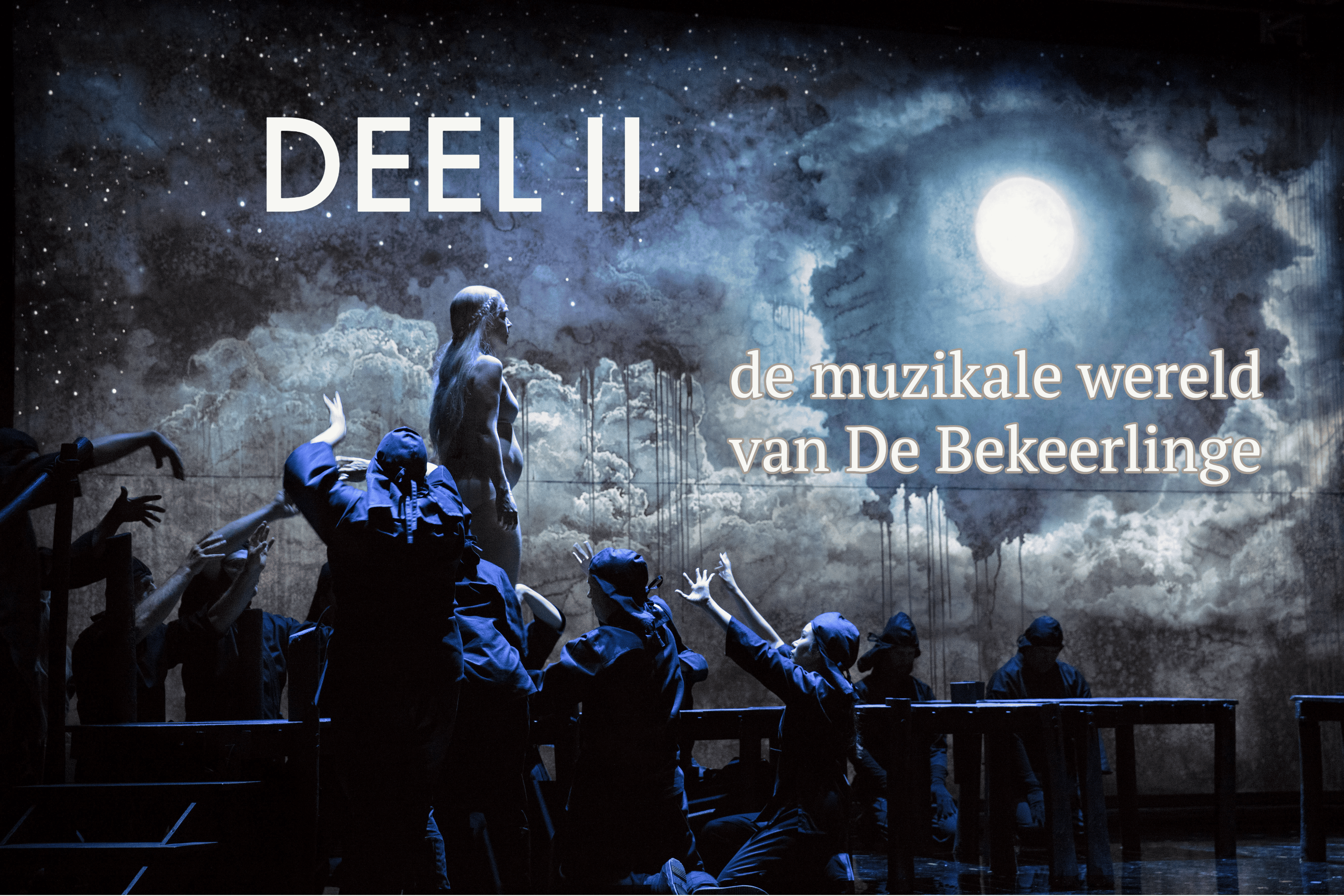
The landscape in which De Bekeerlinge takes place is a location influenced by many cultures and sounds. The cultural contrasts between the north and the far east emerge in the sound contrast between the soundscapes and the beautiful vocalizations of oriental chants. Contemporary techniques such as soundscapes and electronic music blend with the diverse sound facets of the choir, the stage, and the soloists. As a reviewer, I found myself repeatedly thinking of the word "Wagnerian". After a brief exchange with the composer, during which he also mentioned the term Grand Opéra, I came to the conclusion that the work is grand in its execution as Grand Opéra, but with the musical power of a Gesamtkunstwerk. Wim Henderickx's work inspires and masters the spectator.
Religion as a destructive force
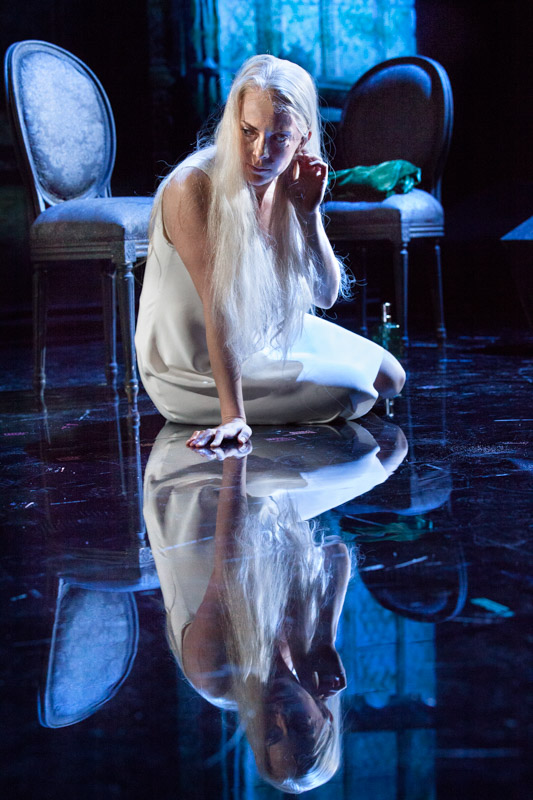
In De Bekeerlinge, religion is a red thread that continually confronts the spectator. Regardless of how the listener themselves stands on the aspect of religious confession, it cannot be denied that Vigdis is an unfortunate pawn of religion as a factor. Visible in her origin, that of her beloved David (baritone Vincenzo Neri), and her duality after her surrender. Not pausing here would simply make this account of this opera incomplete, given how powerfully and alienating Vigdis's journey becomes through the struggle of the human with religion – centrifugal forces that seem to determine a human life here.
Grand opéra and Gesamtkunstwerk
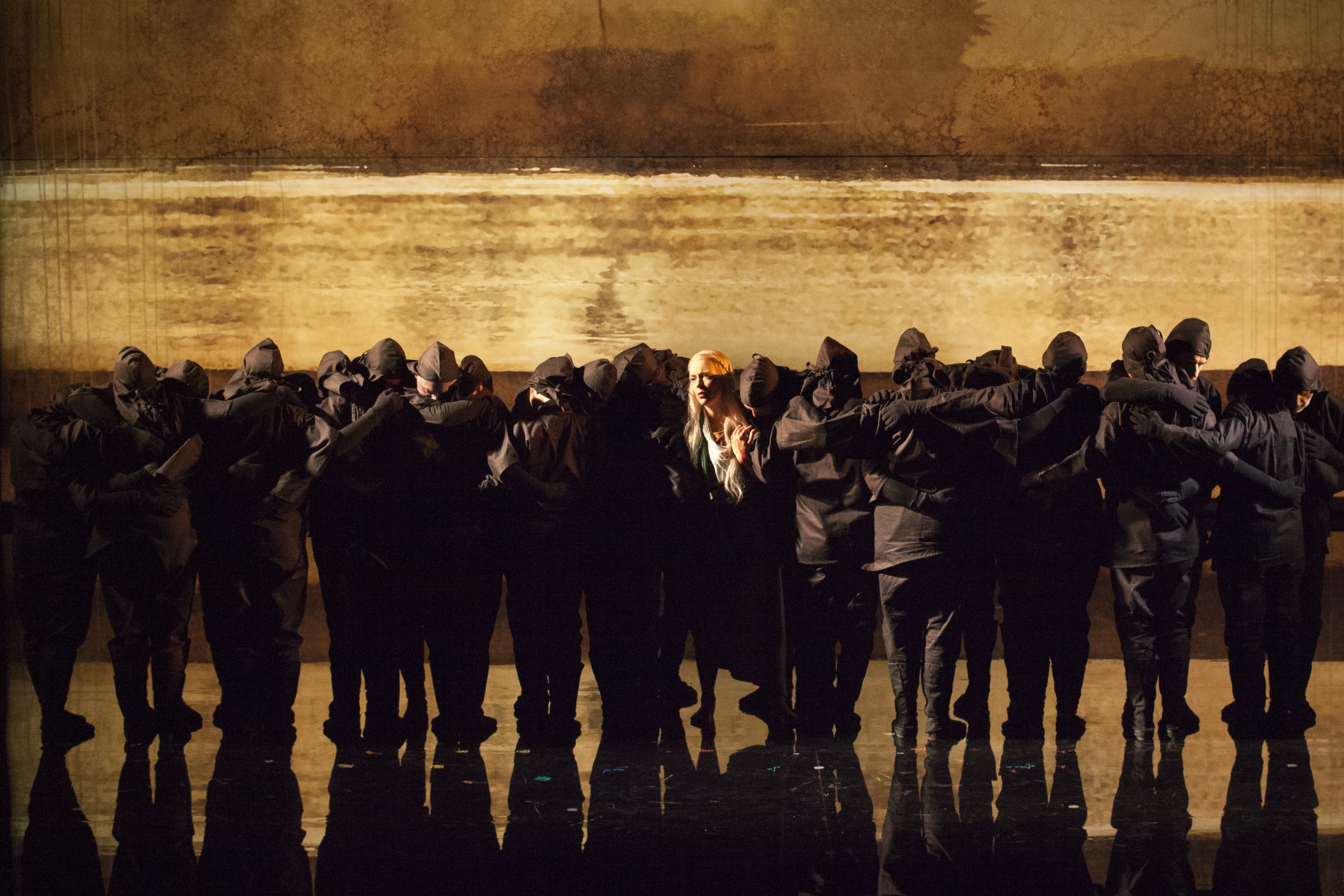
Wim Henderickx succeeds with De Bekeerlinge in uniting two musical worlds with each other. Given the tumultuous relationship between Richard Wagner (the father of the Gesamtkunstwerk in opera; 1813-1883) and Giacomo Meyerbeer (the great pioneer of French Grand Opéra; 1791-1864), I certainly see the humor, and achievement, in it as a reviewer. These are two great, separate musical languages. Which, just like Vigdis's living world, consist of different contrasting, clashing characteristics. The Gesamtkunstwerk is particularly evident in how beautifully flowing, uninterrupted the music and the story flow into each other, and then emerge in the sound expression of the orchestra and the vocalists. The scale, the tableaus, the final piece with the pyre that can almost be called a contemporary Auto-de-Fé, bring Grand opéra to the foreground again. De Bekeerlinge is grand, contrasting, sometimes tortured, and this is heard in the music. The scale on which everything is performed is overwhelming: two choirs, a recording of the Kinderkoor Opera Ballet Vlaanderen, a solo children's choir, a symphonic orchestra and nine soloists, including the powerful voice of soprano Lore Binon – an impressive cast.


The musical journey of De Bekeerlinge
During the two hours and 55 minutes that I sat in the hall as a reviewer, there was not a single moment when something new did not come to me. The opening, the language of Vigdis's northern land, was a beautiful electronic soundscape. The minimalism created a musical meditation, after which symphonic melodies gradually began to blend in.
A first powerful moment, and something that will always stay with me, is the beautiful, tragic melody "Once upon a dream, there was a princess unseen/ There was a love unspoken, but God stood inbetween [...]". This red thread, the tragic harbinger of the path of the penitent, was repeated several times during the opera. The vocal performance, partly due to her powerful and full voice (I often compare voices of this kind to liquid gold), of soprano Amel Brahim-Djelloul is a voice that will stay with me. This fragment is also the only real aria (in song form) in the entire opera, which makes it as a core piece even more powerful. The raw sounds of pieces such as "The Fool Urbanus" and "The Pyre", Oriental sounds such as the two female vocalises during "The Ritual in the desert" (sung by Brahim-Djelloul and singer Françoise Atlan) provide other threads. I compare De Bekeerlinge to an intrinsic sound tapestry that is displayed for the audience on a loom.
De Bekeerlinge is intimate in sound, raw, meditative, Eastern, Western, Contemporary, electronic, there is not a single term to describe the work of Wim Henderickx. And ultimately, this is not necessary either. This overwhelming, gripping force is what makes the work of Wim Henderickx his own. Much has been told in this exposé, and more could have been told. But ultimately, this account simply comes down to: De Bekeerlinge, flowing, Henderickxian, memorable... and unique of its kind. Bravissimo tutti!
WHAT: De Bekeerlinge (The Convert)
WHO: Wim Henderickx [music], Krystian Lada [libretto], Hans Op de Beeck [direction]
VOICES: Lore Binon, Vincenzo Neri, Amel Brahim-Djelloul, Luvuyo Mbundu
ORCHESTRA: Symfonisch Orkest Opera Ballet Vlaanderen, Choir and Children's Choir Opera Ballet Vlaanderen, Stadskoor Madam Fortuna
WHERE: Opera Ballet Vlaanderen, Antwerpen
WHEN: Tuesday 10-5-2022, premiere
INFO: De bekeerlinge can still be seen until 19 May in Antwerpen, and on 27, 29 May and on 2 and 4 June at the opera in Gent. Tickets and more information on this link.
© Annemie Augustijns
© Annemie Augustijns
© Annemie Augustijns
© Annemie Augustijns
© Annemie Augustijns
© Annemie Augustijns
© Filip Van Roe
© Annemie Augustijns
© Annemie Augustijns
© Annemie Augustijns
© Annemie Augustijns