

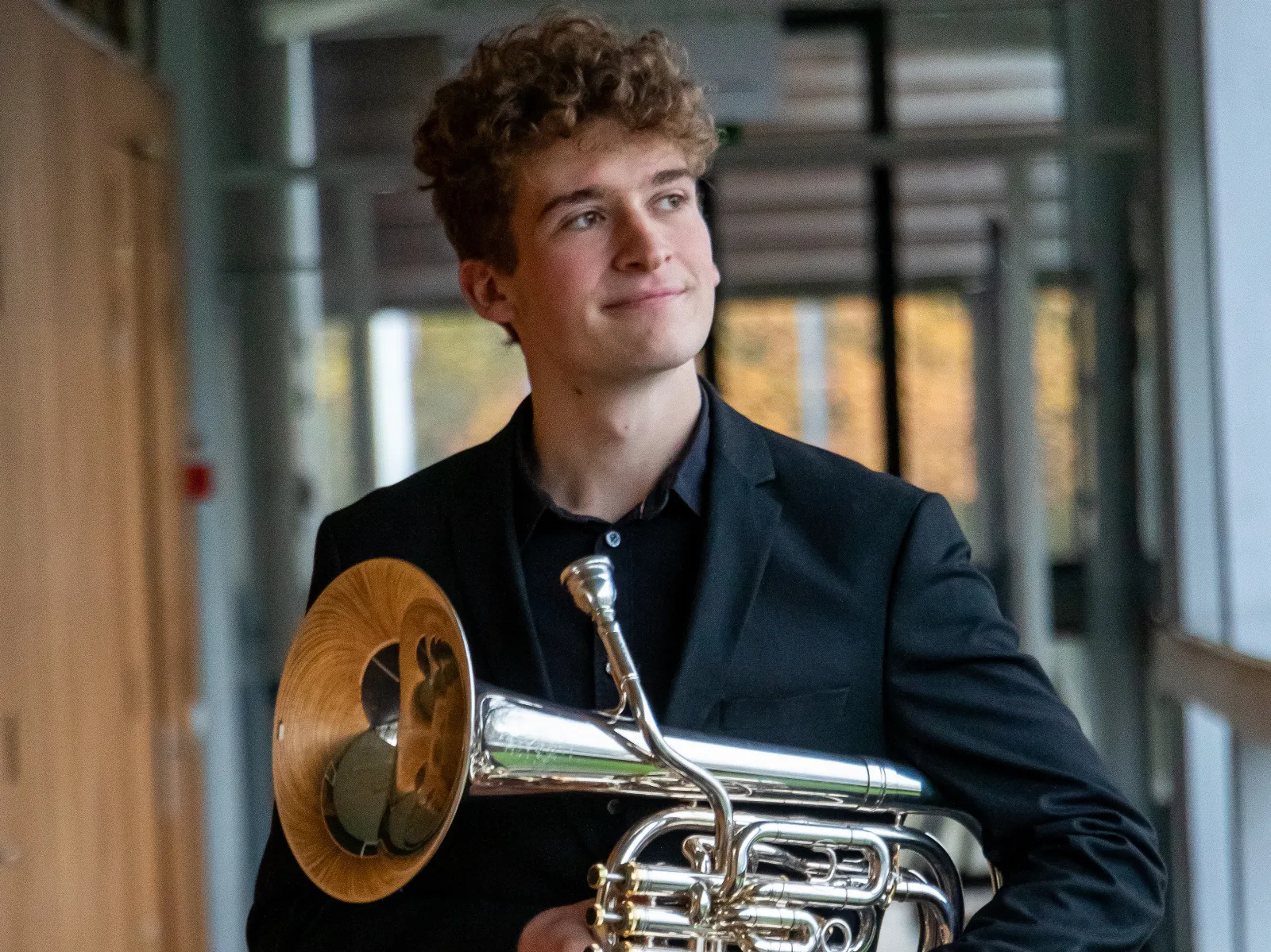
Just before the Christmas holidays of his fifth year of secondary school, sixteen-year-old Thibaut De Bondt, until then a cornettist, took home a baritone horn from the Willebroek Academy “to try something out”. It would give his musical life a different direction. With the baritone horn he discovered that he could practise much longer and enjoyed it far more.
Because the fingerings were the same as on the cornet, he needed little guidance to get started. On the cornet he could, on a good day, only practise for a quarter of an hour, because longer than that hurt too much, “which of course isn’t motivating”. With the baritone horn that changed: “I noticed that suddenly it was possible to do much longer study sessions, and I also started to enjoy myself enormously.” By the end of that Christmas holiday his practice sessions were already growing to an hour, and in the months that followed his study time only became longer: “Finally it felt possible to explore limits.”
More than a CV
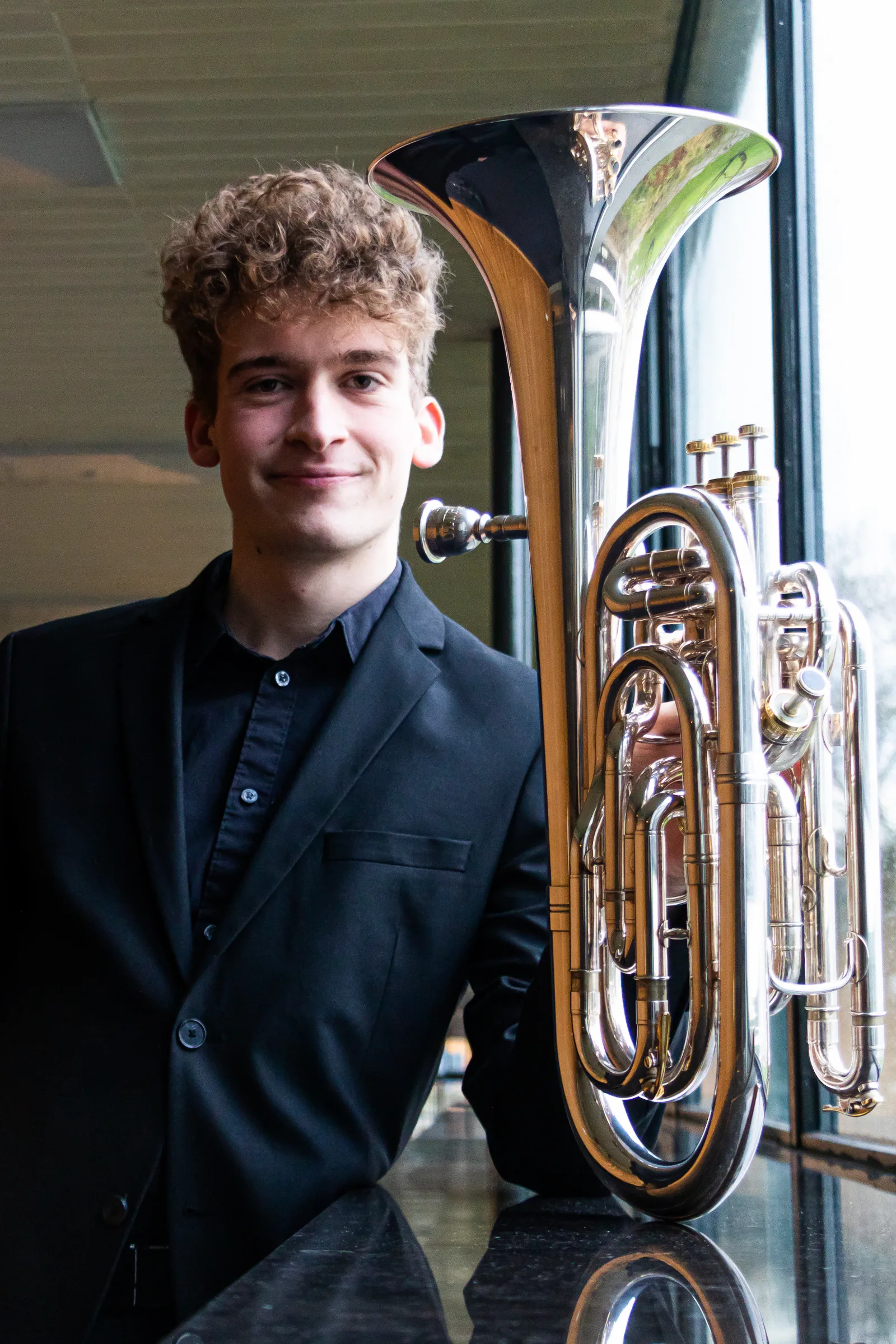 One of the qualities he is most proud of is that he always tries to help people where he can: “I am very strict with myself about not repeating private conversations. I always try to be as reliable as I can and to always have a moment to spare to help someone.” He hopes the people around him know this too.
Brassband Willebroek and conductor Frans Violet form an enormously inspiring environment for him to grow up in, although he did not play in that band his whole life. He spent his first musical years with Young Brassband Willebroek, the youth band where musicians are trained. His strongest memory is of the first concert of Brassband Willebroek that he heard, before he had chosen an instrument. The concert made such an impression that the idea of becoming a brass player never left him.
His teachers have also shaped him. Jonas Violet convinced him to give the baritone horn a chance and taught him to enjoy playing. During his bachelor's degree at the conservatory he worked with Kevin Van Giel, who according to De Bondt was exceptionally good at forming and sculpting his sound. In his master's he continued with Lode Violet. Now that he is doing a master's in composition, he takes lessons alternately from Kevin Van Giel and Lode Violet.
According to him, the greatest influence was Frans Violet, the musical mind behind Brassband Willebroek and for him the “godfather” of brass players in Belgium: “There are very few professional brass players in Belgium whom Frans cannot be placed somewhere in the history of.” He “breathes music”, says De Bondt, and everything he does feels natural: “It is a privilege to be able to make music under him.”
A warm, round sound
For those who don't know the baritone horn, De Bondt says, one can think of a warm, round brass sound, like that of the saxhorns. The baritone does lie more on the bright side of the sound spectrum. The euphonium has the same register but sounds darker. Precisely because the two instruments are so different and yet similar, they sit side by side in the brass band and each give the ensemble its own colour.
Still, the baritone horn too often remains in the shadow of its more popular “brother”. “The baritone is actually a somewhat underappreciated instrument in my view,” he says. He wants to make clear that the baritone is “truly a unique and valuable instrument” and would like to showcase its possibilities.
His favourite is the Baritone Concerto by Martin Ellerby, which he also performs often. He enjoys playing the first and third movements, but it is especially the middle movement that appeals to him: “On those lines you can really make music.” At the same time, he feels that the entire repertoire deserves more attention: “If you play an instrument that is played so little, all the repertoire actually deserves more attention.”
An encounter with the organ
For the concert on Tuesday 6 October in St. Lodewijkkerk in Mortsel with organist Luc Vanvaerenbergh, De Bondt looked for pieces that he thought would work well with the combination of baritone horn and organ, while also trying to put together an interesting programme. The programme ranges from Fauré and Hummel to Sparke, Golland and Appermont. The rehearsals went well. His mother, musician Nadia Bierinckx, also listened in to check that the balance between the two instruments was right.
Which piece would become their favourite was not clear beforehand. During the rehearsals De Bondt and Vanvaerenbergh found a musical click and discovered a new favourite several times. In the end Peace by John Golland became their shared favourite. The piece was originally written for euphonium and piano, but according to De Bondt it is “a beautiful piece of music that is actually perfect to be performed by this baritone and organ”. It is moreover not the only work that works better than they had expected beforehand.
Above all, he hopes that listeners will see the baritone horn after the concert as a unique instrument: “I want to broaden the options for baritone players and show that the instrument deserves its place in the spotlight.”
From stage to composing desk
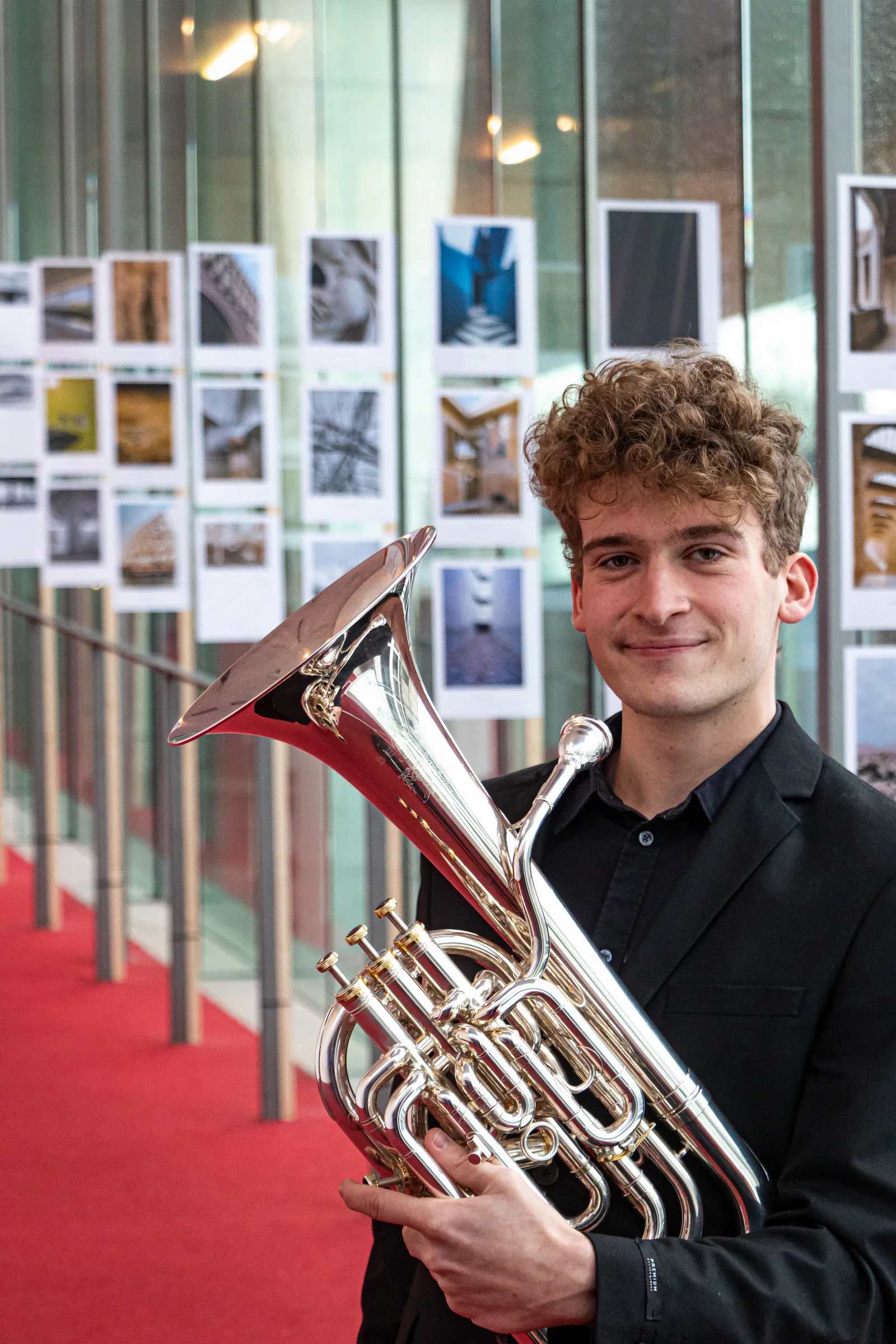 De Bondt is a soloist, brass band musician, composer and teacher. As a composer, he says he is still at the beginning: "I'm currently trying out a lot, how to start my compositions, how to keep writing, what I base my compositions on." His concerto for his master's thesis was the second time he wrote a concerto: he also played a concerto of his own for his bachelor's thesis. In that first work he made his own part far too difficult and "had to come to the conclusion that there are indeed limits". In his master's work he was able to keep those better in check.
In his view, knowledge of one discipline in music deepens insight into the others. The insight into scores that he gains as a composer helps him understand his role in the brass band and gives him an overview as a soloist. His solo practice in turn inspires him when writing horizontal lines, and his technical skills come in handy in the brass band. That is also where he keeps his passion alive: "Sharing musical experiences, highs and lows, with such a wonderful group of friends is beautiful and makes me want to keep working and keep exploring."
As a teacher, enjoyment of playing comes first. "Enjoyment of playing remains for me the most important thing to pass on to students, even above technical mastery." He tries to make his lessons as fun as possible, to pair students with classmates they get along with, and to motivate them to play in orchestras that have a pleasant atmosphere. In this way he wants to get them enthusiastic about what music has to offer "beyond standing on a stage with knocking knees".
From Klara Twintiger to his own CD
De Bondt was selected as one of the Klara Twintigers of 2026. This gave him a taste of playing for a wider audience and taught him above all that there are organisations and initiatives, such as Klara's De Twintigers, ready to help young musicians: "It gave me confidence in myself and in the future."
https://www.vrt.be/vrtmax/a-z/de-twintigers/6/de-twintigers-a5/
In 2023 he won the European Soloist Competition. In the final he performed for the first time with a brass band as accompaniment for a complete concerto, "a very different feeling" from playing with piano: "To do that, an enormous amount of self-confidence was needed." Despite the stress, it succeeded in the moment itself, and since then he tries to find that same self-confidence on every stage.
His dream of a solo CD is by now very concrete: the recordings continue in January and preparations are in full swing. All the works have been composed specially for the CD. Alongside established names such as Philip Sparke, Martin Ellerby and Roger Derongé, there are also emerging composers, such as the young Belgian composer and Brassband Willebroek percussionist Lennert Van Laenen and the young Norwegian composer Kjetil Djønne. It will be a varied programme, due out on CD by April, although De Bondt cautiously adds "hopefully". All information will be posted on his socials and his website.
Looking ahead
At present De Bondt's focus is on composition, but he continues to maintain his instrumental practice. He hopes to have made some progress there within five years. He also hopes to make the baritone "somewhat more prominently" present in his compositions within the brass band world.
Whether that will lead to a wider spread of the instrument within five years he finds ambitious to predict, but he doesn't want to rule it out either: "I'm tremendously looking forward to the future and to which projects still lie ahead on my path!"
If you'd like to see Thibault at work live, come to Mortsel on Tuesday 6 October: https://www.mortsel.be/activiteiten/detail/7511/de-baritontrompet-in-de-hoofdrol