Wim Winters, 2025
'This evil is caused by the changed times, which want to seize everything on the fly and conquer it by storm. Where that attitude is justified, it is very good and useful, such as railways on which one would like to fly if it were already possible. Nowadays one rushes ahead in many things, and music is no exception.' 1
[caption id="attachment_42513" align="alignleft" width="400"] Gottried Wilhelm Fink[/caption]
We are in Leipzig in 1839. Gottried Wilhelm Fink, in the winter of his career, desperately wields the only weapon at his disposal to oppose an evolution in musical performances that he will describe as barbaric. The old tradition, that of the Vienna of Beethoven's time, in which 'The characteristic, the expression fired by Truth and Authenticity, the Aesthetic Beauty that sweeps the listener with his whole being without any attempt to surprise him or impress him with effects, has long since vanished.' Fink cut through the new reality with surgical precision. Mozart's music was 'spoiled' by 'exaggerated tempi' and it did not stop with Mozart alone: 'Many have already sacrificed the finales in Beethoven to mad exaggerations, without anyone calling them to account for such childish behavior.' Something that Beethoven himself could not have done, his generation simply did not have the technique for it: '…they did not want to package Art exclusively in fast runs and overwhelming 'fioritures', as is now possible through improved technical skills and the ease with which one overcomes technical difficulties.'
Fink was not blind to the reason why musicians en masse gave in to this trend. The modern public wanted nothing else. But he placed many musicians in the same light: 'The vanity of virtuosity has placed itself above everything else.' Although the younger generation knew no better: 'Such things are like a plague: they spread and infect even the healthy. (…) The feeling for what is right is lost through this frequently repeated habit … There is no longer a desire to inspire, but only to blind, so that the public calls it magic.'
Fink's article breathes pent-up irritation, a string of reproaches that the author cuts without anesthesia from the musical social fabric and, still held by the surgical forceps, shamelessly shows to the world: 'It sometimes borders on pure madness, so incomprehensibly wild and barbaric is the way Mozart's works are often treated, with all pleasure spoiled while one oneself thinks one is increasing enjoyment.'
Fink was not alone. As early as 1821, the Quarterly Musical Magazine and Review in London reported that the visit of guest conductor Georg Kiesewetter, recently appointed vice-president of the Viennese Gesellschaft der Musikfreunde and regularly Schubert's piano partner, had caused a minor shock wave with the London orchestra:
'Mr. Kiesewetter urged, during the rehearsals of Beethoven's and Haydn's symphonies with the Philharmonic Concert, as we understand, strongly that they be played more slowly than this orchestra was used to doing (...).' 2
A trend that apparently became widespread in a very short time: '(...) we have heard very old, but able musicians say that the boundless drive for speed has become so great of late that even first-class violinists sometimes become confused if they are not completely familiar with the passage.' According to the author, the solution was to encourage composers to metronomize their works. That would, once and for all, put an end to all confusion. Fink had the same thought. He conceived the plan to ask old musicians to metronomize works by deceased composers. It would ultimately remain with just one contribution. But what a contribution! The Prague composer Wenzel Johann Tomaschek (1774-1850), somewhat forgotten today, but in those days a figure of the old times, came forward with a complete metronomization of Mozart's Don Giovanni. Tomaschek had, in 1791, heard Don Giovanni in Prague, performed by the same orchestra with which Mozart had premiered his opera. Whether his tempi actually reflect Mozart's or not is not relevant. What is relevant is that Fink published them as an illustration of how much slower tempi were in the past compared to 1839.
Right. How much slower…
That is particularly strange, because today we read of Tomaschek's tempi that they 'were generally poorly received by academics and conductors, because they do not take into account the character and drama of the music … and especially because they are unreasonably fast.'3
But… did Fink not publish those same figures to show how much slower Mozart originally was? Were tempi in 1839 then still much faster than what by 2025 is already considered impossible?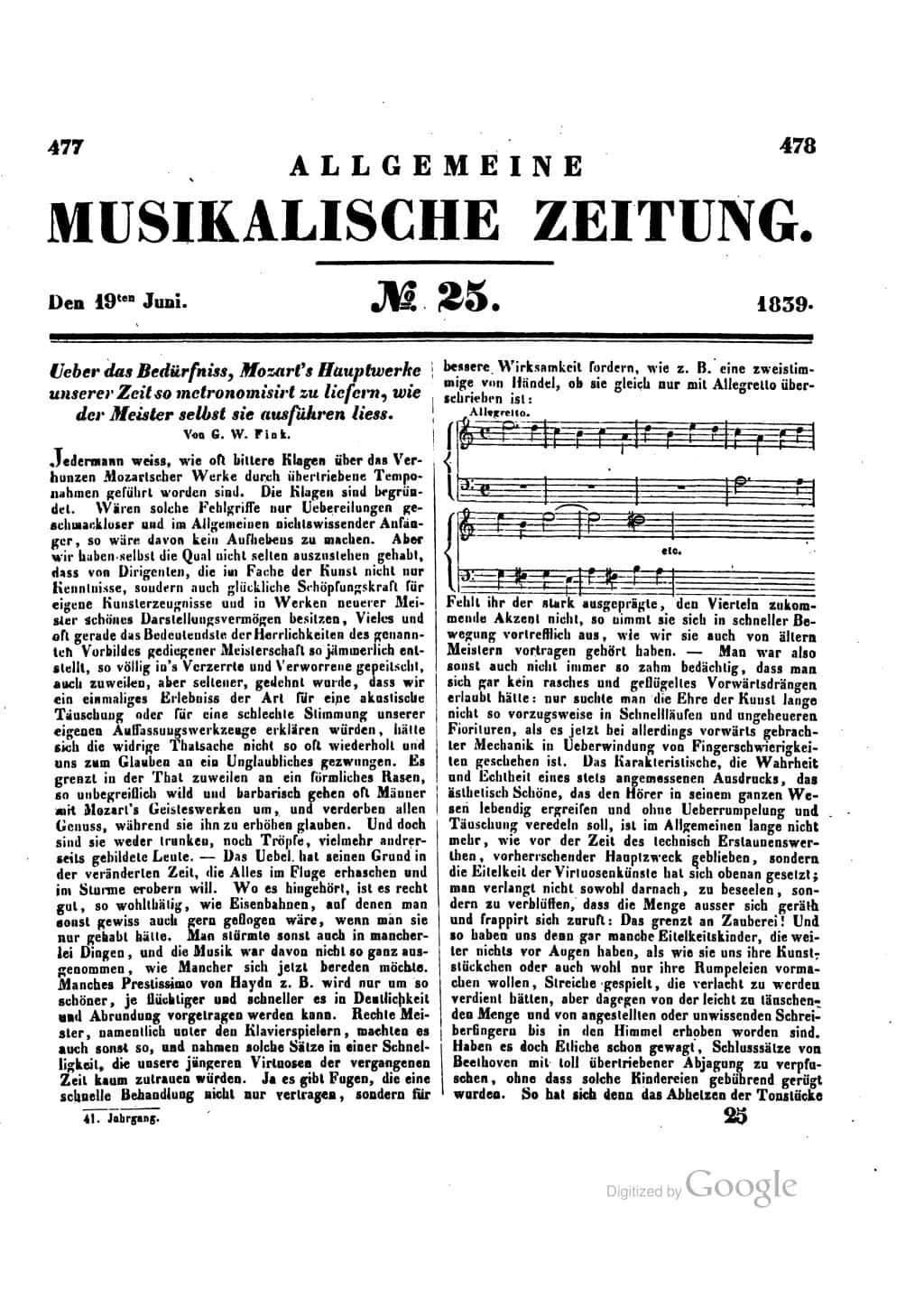
That Tomaschek's tempi are truly problematic is proven by the performance Roger Norrington gave of them. Norrington, a well-known advocate for taking tempi according to the specified metronome markings, takes a slower tempo in no fewer than 27 movements compared to Tomaschek4. J.E. Gardiner, who operates entirely on the same line as Norrington, shows the same pattern in his live performance from 1994. And, for those familiar with Gardiner's work, his Don Giovanni is still labeled as breakneck-fast today. But apparently not fast enough for Tomaschek and Fink. As an example:
-
Andante (overture): Gardiner: 80 / Tomaschek: 92.
-
The following allegro molto: Gardiner: 122 / Tomaschek: 132.
-
The famous canzonetta even nearly half: Gardiner: 50 / Tomaschek: 80
Fink's 'slow' Tomaschek tempi force singers to a constant speed of 6 to 9 syllables per second. For the aria 'Mille torbidi pensieri', we are supposed to assume that the average singer in 1839 had no problem at all with even 11 syllables per second. You can experience this stunt yourself right now: count aloud from 1 to 11. And try to do that within 1 second. And then 20 times in a row.
But we're not done yet. Those impossible 11 syllables per second form only the starting point of our problem. If we read Fink literally, we must indeed assume that musicians in 1839 played and sang much faster than this. And not a little bit given his strong wording. But how can that be? The answer of many: they played in smaller spaces, smaller orchestras, different instruments, … whereby we must simply assume that this is sufficient to have singers in 1839 comfortably sing up to 15 syllables per second? The same ingredients don't work today, because we have been playing music from that period in every conceivable historical context for decades. And we accept that our young musicians already come out of their conservatory years with chronic injuries. And still it is not enough. Still not fast enough.
[caption id="attachment_42514" align="alignleft" width="400"]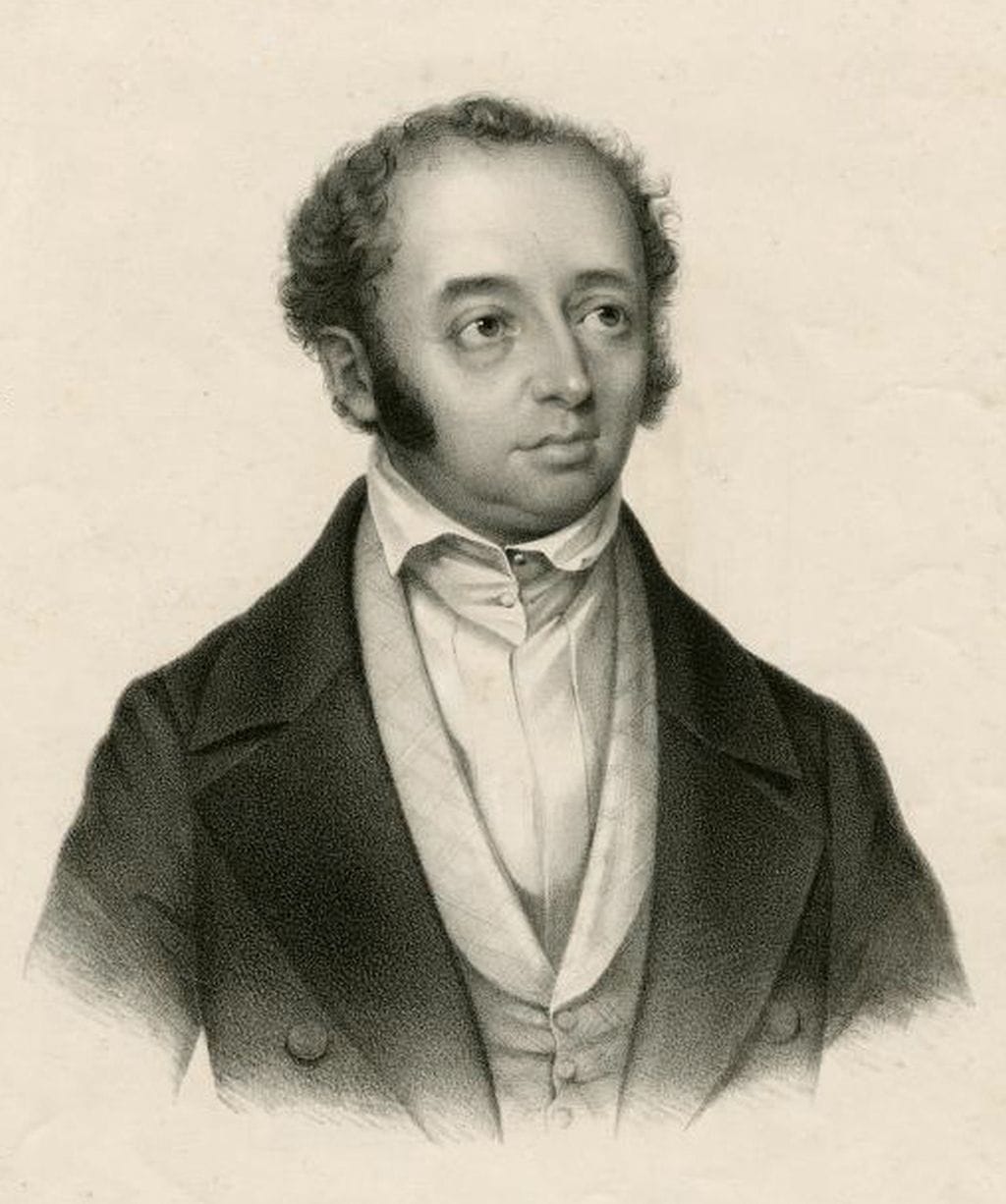 Adolf Bernard Marx[/caption]
One last handful from the virtually endless basket full of 19th-century speed warnings. Warnings, not from a feigned sense of romanticism, whereby romantic for the modern tempo researcher apparently is synonymous with slower, but from the perspective of authenticity, of how it, even for the 19th-century person, 'earlier' really was. We leave Leipzig and travel to Berlin 1863, where the still well-known Adolf Bernard Marx (1795-1866) prepares the publication of his book on Beethoven. Marx had previously written for the Berliner Allgemeine Musikalische Zeitung. His pieces were appreciated by none other than Beethoven himself. Befriended with Mendelssohn and many others, contemporary of Moscheles and Czerny, he stood at the center of music throughout his life. In 1863, he certainly knew what he was talking about when he wrote that all doubts about the correct tempo 'have been eliminated by Mälzel's metronome, with which an absolute measure for a movement can be given.'5 In 1863, the Italian tempo words 'have changed their original meaning. The tempo is now taken much faster.' When the Italian tempo words around 1863 were taken faster than, say, in 1825, that also applies to the metronome markings that are in any case related to them.
But how much is much? Marx gives us a unique answer to that, an answer that, given the pen from which it flowed and the total absurdity it sketches, could have, perhaps should have, directed musicologists away from a different metronome reading for a century. About the finale of the A major sonata Op. 101, he writes that 'for a trained player it is not impossible to play this passage twice as fast as it actually should be; but can the listeners then still perceive all the voices and feel those that form the polyphonic texture?'
Twice as fast as it should be… twice as fast then compared to the metronome markings that 'as everyone knows' eliminate all doubts once and for all? And it doesn't stop with that one sonata. The following question must be asked to players who are 'driven by pride': 'If you really,' we must ask them, 'play the Finales of the Sonatas, Op. 26, 27 no. 2, 53, 57, twice as fast as they actually should be played, do the senses then really become more brilliant?'
Now I invite the reader to search for these finales on YouTube. And to make use of the option that YouTube offers to set the speed to x2. The original tempo does not need to be checked, even though in many cases it will be slower than the figures we have for these sonatas from Czerny or Moscheles or others. What you then hear is, according to modern musicology, in that doubled speed, with absolute certainty the result of how Beethoven was played in 1863. The 15 syllables of Fink evaporate in the radiant heat of the absurdity that arises here. Where Fink still spoke of barbaric performances due to exaggerated tempi, we know from Marx that this in certain cases was even twice as fast as originally intended. Whoever hears Lisitsa play the finale of the Moonlight opus 27/2, for example, will immediately realize that in her version she is already at a limit. Let alone being able to double this tempo. But in absurdity, sometimes the solution awakens too. As here. For from the modern tempo one cannot double. In the cases Marx lists, that is only possible when one starts from… half. Let us continue with that, as a conclusion, for a moment.
In the book, Fixing the Beethoven Mistake, a Paradigm shift in Classical Music, to which we are currently putting the finishing touches, several chapters will be devoted to this irrepressible 19th-century evolution that, today actually still, is taking place. The reader will also be able to discover, by means of a hundred quotations, what the metronome really meant to the 19th-century composer. That the function of the metronome consisted mainly of establishing tempi with absolute precision is a finding that has penetrated with an almost disarming evidence. Yet we no longer see it this way today: the absurd tempi at first glance have replaced that original image of exact tempi with abstract figures whose only purpose could have been to encourage musicians to ever higher tempi. As the well-known conductor Paavo Järvi recently said in a fine documentary for the BBC: Beethoven's tempi are so abnormally high because he predicted the 'Wagner effect'.6 His metronome markings would thus have to be regarded as a visionary and brilliant act of something of which there was no indication whatsoever in his time. That statement fits perfectly with how we stand towards those enigmatic figures today, but remains strange when you plug those words back into the original context. Only with Beethoven. The only thing he was really concerned about was his tempi. Everyone who knew him intimately knew that the question would come first when visiting following attendance at a concert of his music: what were the tempi? Barely four months before his death, the composer of the 9th Symphony still wrote this to his publisher Schott:
'The metronome markings will be sent to you very soon. Please wait for them. In our age, such indications are certainly necessary. Moreover, I have received letters from Berlin in which it is mentioned that the first performance of the symphony [the 9th] was received with enthusiastic applause, which I attribute largely to the metronome markings.'7
We thus see a phenomenon in which the metronome was introduced at a time when tempi were already becoming drastically faster and composers, including some of the greatest, massively used the device to establish their ideal tempo. Moving forward in time, we read that performances of (by then already) old music – a new trend by the way – were often performed at absurd tempi. With reference to how much slower it was originally.
How can we reconcile all this? The solution is simpler than a good article deserves just before the climax at the end. So first this: personal experience. On paper, the impossibility of a tempo is difficult to demonstrate. Abstract figures say very little. But whoever can play a little piano, and wants to experience firsthand how absurd a modern reading of historical metronome markings really is, I recommend pausing the reading for a moment, taking Czerny's famous (infamous) Opus 299 out of the cupboard or downloading it – Schüle der Gelaufigkeit – and playing the first study. It consists of very simple scales in C major, playable at sight for almost anyone. And then take a metronome or download a metronome app. [half note] = 108 is the target. That is more than 14 (!) notes per second. The following etudes demand the same speed, some even more. For those approaching this experiment with some suspicion, because we so often hear that these tempi are no more than targets, I like to quote from the original foreword. We read along with Czerny:
'The following exercises are intended solely to develop, increase and maintain this aspect of virtuosity, provided they are practiced daily as first, in the very fast indicated tempo, with attention to all other rules of beautiful and correct execution, after they are thoroughly mastered.'
In tempo then. And, perhaps not unimportantly in light of this article: in repertoire lists of 19th-century piano schools this etude is prescribed for … beginners. Not a word about unattainable speeds.
Or, for the Bach enthusiasts, play the first invention in C major. Czerny, following in his own words the tempi that Beethoven used, writes [quarter note] = 138 for. For reference: Gustav Leonhardt plays half as slowly. And, another reference: this is almost the same tempo that Beethoven gave for the fugue from his Hammerklavier sonata. And which we regard as impossible today.
If Czerny is not sufficient, take a look at composers such as Kalkbrenner, Moscheles, Ries, De Méreaux, Alkan, Thalberg, Schumann, ... the list is endless. Often this metronome problem is reduced to a few Chopin etudes and Beethoven. The reality is different. And larger. Chopin's etudes today belong to the repertoire of top virtuosos for the simple reason that we attempt to perform them at double tempo. The same for Beethoven. But if this music is already problematic in light of their original ideal tempi – which they are – then the problem becomes one of even greater proportions. We may have forgotten all that crazy music that roving 19th-century virtuosos constantly spewed out and never play it again, but it exists. And in light of that, Chopin is after all no more than a brilliant update of what Cramer or Clementi already wrote. That may be a shock for many to read it this way, but do the exercise here too: compare a Chopin etude with one by Liszt.
[playlist order="DESC" ids="42516"]The point is: whoever truly wishes to go back to the composer's original intention faces an enormous problem. The metronome markings form a granite gateway that has remained closed until now. We claim that we have the key, as even Jordi Savall recently said in an interview regarding his upcoming Beethoven series in Vienna: 'Beethoven's tempi are perfect. You just have to study a bit more'8, yet the reality is that these voices, if only based on how we today view the tempi of that time, do not penetrate within the walls of old Vienna. They sound clearly on the outside, but reflect in the wrong direction. At first glance, this may sound somewhat presumptuous as a statement, but is it not the case that tempo choice is all-determining? For everyone. Andras Schiff will not play his Beethoven slower or faster in New York than in Amsterdam. And for good reason. At the basis of every interpretation lies the choice of a tempo. Whoever tampers with that changes everything: articulation, phrasing, accentuation and, most importantly: the character of the piece. That is sensitive territory, for everyone. But also therefore for the composer. Czerny described this phenomenon as follows, entirely in line with what Beethoven wrote to his publisher:
'Every musical piece produces only its correct effect when it is played in the exact tempo prescribed by the composer, and every, even the slightest deviation from it—whether faster or slower—can often completely destroy the feeling, the beauty and the intelligibility of the piece.'9
And precisely for this reason this entire 'discussion' is so sensitive. Music is emotion and that emotion is also shaped, or rather, the foundation of it is laid by… the choice of tempo. It is no other way. And if even a slight difference is capable of changing an entire composition in character and color, how much more so when what happens is that we no longer read all these old metronome markings as we do today, but regard the metronome as a mechanical pendulum? Not the single tick, but the tick-tock, the back-and-forth beats correspond to the note value of the famous MM. Not 1,2,3, but 1- and 2- and 3-and. Just as the tactus, the arsis/thesis, how we still teach music theory, the principle of time determination, the duality of so much, day and night, systole-diastole, …
This thesis is not new. Already in the 1950s it was speculated about. In 1980 Talsma's still well-known book appeared10. What we propose in our Beethoven, and later also in the 600-page book, is partly based on the same thesis. At the same time, we can now, with all respect for what someone like Talsma as a musical archaeologist personally unearthed, also better survey the pit he exposed. What Dr. Lorenz Gadient, co-author of the forthcoming book, already did in 2010 with his publication Takt und Pendelschlag, was a first attempt to straighten out a number of – for us today – evident errors, as it were. At the same time, the same thesis is described and documented from a richer context, tracing back to the 16th and 17th centuries, to Mersenne, in order to take the approach from there to what would ultimately be the introduction of the metronome. We now add our musical experiments to that as well. At the moment I am writing these words, the first collection of 9 CDs with part 1 of the complete keyboard work of Beethoven is being released. We are launching part 2 in November, part 3 in November 2026. In June this year we will still add 5 CDs with music by Chopin to that. Everything played from this whole-beat reading of metronome markings, which we call Whole Beat or: the WBMP – Whole Beat Metronome Practice.
There are still many aspects that are important to discuss, many questions undoubtedly that you as a reader have and remain unanswered in the short scope of this article. The book will answer many of them. But what you can do right now is… listen. We have been able to send the symphonies to no fewer than 31 countries. And from the reactions we learn one thing: give this new experience some time. Listen a few times, openly and without prejudice to the result. Via the CDs or via Bandcamp, where you can listen to everything three times completely free of charge. We know Ludwig's music so well, we are so steeped in modern performances that it is difficult to return to something slower. You will miss something at first. But something wonderful comes in its place. Because what this tempo does is nothing other than reconstructing a timeline. A timeline on which Beethoven scattered all the brilliant ingredients that he knew would have an overwhelming effect on his audience. On you too, then. It is that timeline that we compress so much today that many of those ingredients pass by untasted. Should you experience a quasi insurmountable shock at the first listening session, the renowned musicologist Clive Brown might perhaps help you. He wrote the following in 1999:
'Good taste is not an immutable property; it is in a state of constant change. What eighteenth- and nineteenth-century musicians considered tasteful might seem unnatural or grotesque to us on a first hearing, and they would undoubtedly have found the style of modern performances strange and probably unsatisfactory in many respects. Such considerations might prompt us to examine whether we cannot experiment with more radical and daring approaches to the performance of familiar repertoire, (…) By doing so, we might perhaps regain something of the excitement of hearing great masterworks for the first time, (…)'11
Eksel, 25 March 2025
©Wim Winters, 2025
1 All quotations G.W.Fink, Ueber das Bedürfniss, Mozart's Hauptwerke unserer Zeit so metronomisirt zu liefern, wie der Meister selbst sie ausführen liess, Allgemeine Musikalische Zeitung, 19ten Juni 1839, pp. 477 - 481 2Anonymous, Maelzel's Metronome , The Quarterly Musical Magazine and Review, Vol. III, 1821, p. 302-305 3 Magnus Tessing Schneider, The original portrayel of Mozart's Don Giovanni, Ashgate Interdisciplinary Studies in Opera, p.21 4 Stephan James Mould, Curating Opera, University of Sydney, October 2015 5 A.B.Marx, Anleitung sum Vortrag Beethovenischer Klavierwerke, Berlin 1863, Neue Auflage, Leipzig 1903 , p.70 6 Paavo Järvi, No Precise Tempo Without Beethoven? | Part 7 of the film project A World Without Beethoven? (accessed 25.03.2025) 7 Letter to Schott's Söhne, Anderson, p.1325 (letter 1545) – translation by the author 8 Jordi Savall, Jordi Savall bringt Beethoven im Originalklang nach Wien https://www.sn.at/kultur/musik/jordi-savall-beethoven-originalklang-wien-173939239 (25.03.2025) 9 Carl Czerny, Pianoforte School, Cocks & C°, London, 1839, part I, p. 157 10 Willem Retze Talsma, Wiedergeburt der Klassiker, Wort und Welt Verlag, Innsbruck, 1980 11 Clive Brown, Classical and Romantic Performing Practice 1750-1900, Oxford University Press, p.632