Four years of recording work, twenty-five cd's – too much for one ordinary review, hence this triptych. Enjoy your reading!
There are conductors who go down in history for their charisma, and there are conductors who are chiefly remembered by the stories told about them. Artur Rodziński (1892-1958) undoubtedly belongs to that second category: his name still conjures the image of an uncompromising orchestra leader, a man who could drive musicians to despair and challenged boards of directors to their limits.
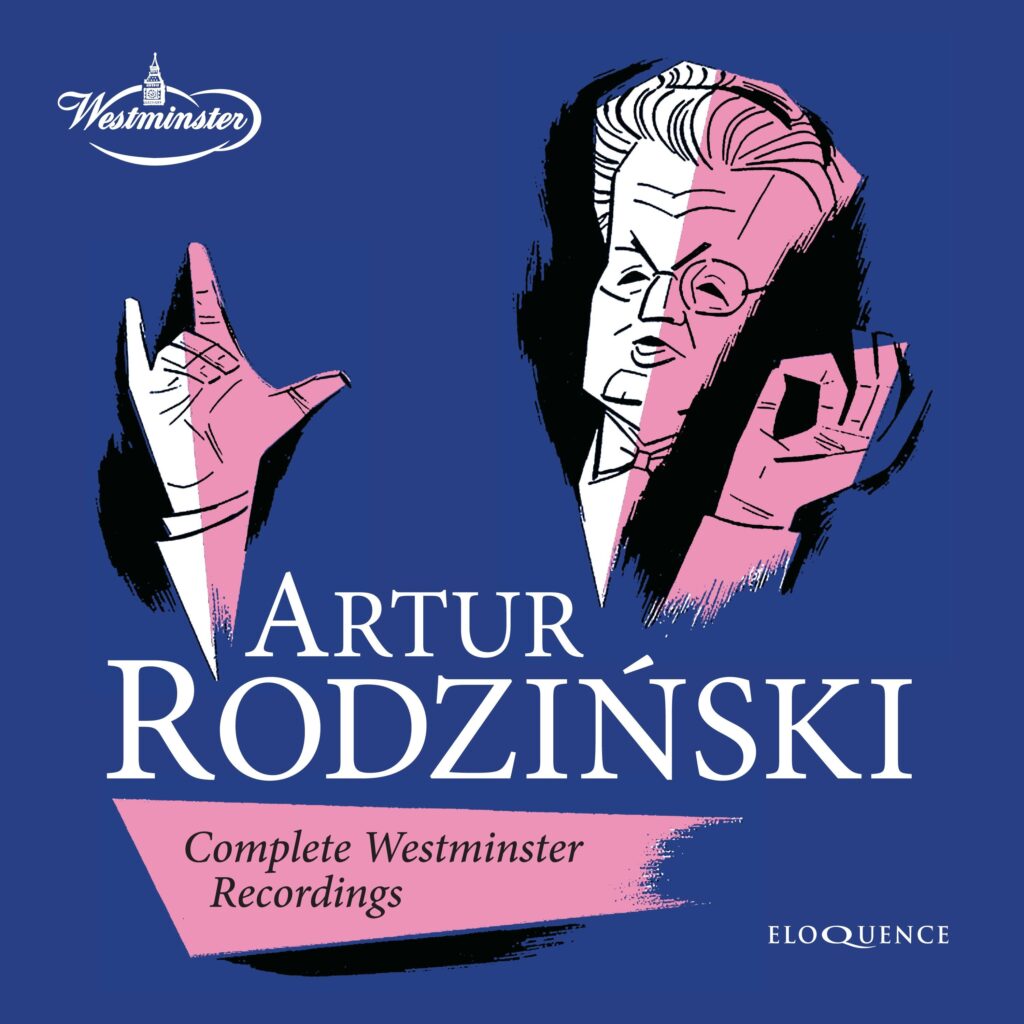
The recently released, extensive Eloquence box, containing the complete recordings Rodziński made between 1954 and his death in 1958 for the American label Westminster, offers a unique opportunity to examine that image in a different light. Whoever listens to these twenty-five cd's from the music itself hears not a conductor driven primarily by power, but a musician with an almost obsessive need to fully comprehend the score.
Born in Split, the then Austrian Dalmatia, raised in Lviv and musically trained in Vienna, after his years in Poland he became one of the most important representatives of the generation of European emigrant conductors who profoundly changed American musical life. Yet history does him a disservice when it describes him exclusively as a difficult personality: under his leadership the Cleveland Orchestra grew into an ensemble of international standing, a foundation upon which George Szell could later build, and in Chicago too he left behind an orchestra that was stronger than when he had taken it over.
What makes this box special is that it concentrates on the final chapter of that career: no more directorships, no more boards, but exclusively the recording studio, mainly with the Royal Philharmonic Orchestra in London and the orchestra of the Vienna State Opera. A musical Indian summer – Rodziński's health was deteriorating rapidly; during the recording of Tchaikovsky's Fifth Symphony there was even a nurse in the control room, but one hears hardly anything of that on the disc. Precisely in those final, free years, freed from every administrative burden, comes most clearly to the fore what had always mattered to him: not himself, but letting the score sound so clear and convincingly that the listener ultimately hears not the conductor, but the music itself.
The analyst: architecture, colour and the art of detail
One of the most striking qualities that emerges throughout this box is Rodziński's ability to analyse a score without the music losing its spontaneity in the process. His precision is never an end in itself; it serves to make the larger structure visible, to clearly delineate dramatic arcs and to let each orchestra section retain its own function within the whole. Rodziński wants not only to make us hear how music sounds, but above all why it sounds the way it does.
The opening disc of the box is immediately an interesting confrontation with that historical Rodziński. The Unfinished Symphony (cd 1) by Franz Schubert (1797-1828) begins with him in dark earnestness and a slowness that can sound unfamiliar to modern ears – the tempi are noticeably lower than what is customary today, causing the music sometimes to lose something of its natural breathing. Yet whoever gets past that slowness discovers a deeply felt, almost contemplative interpretation in which Rodziński seeks not so much melodic beauty, but the underlying tragedy hidden behind this unfinished symphony. It may not be the recording with which one best gets to know this conductor, but it is an interesting document of a musician who also wanted to expose the dramatic undercurrent in Schubert.
The Fifth Symphony by Ludwig van Beethoven (1770-1827), on that same cd, shows a completely different side of him: dramatic, contrastive and strongly focused on the rhetoric of the score, with echoes of the great pre-war Beethoven tradition without fully following in Furtwängler's footsteps. Striking are the accents with which he colours certain moments differently than we are accustomed to today: the trumpet in the second movement does not sound like an obvious triumphal affirmation, but rather like a voice slowly seeking certainty, and the beginning of the finale too thus takes on less the character of an immediate victory march and more of a breakthrough still to be fought for. The added rehearsal fragment may even be more interesting than the final recording, for here one hears the real Rodziński: not the caricature of the authoritarian chief, but an extremely critical, detailed and remarkably calm conductor who knows exactly what he is looking for and from a clear musical insight constantly returns to articulation and tonal balance. The most telling moment comes at the end, when the orchestra's response does not sound like a dutiful tribute, but like genuine appreciation – musicians who had clearly experienced that Rodziński did not challenge them out of a display of power, but because he was striving for a particular musical ideal.
We hear that same combination of precision and sensitivity to color with Antonín Dvořák (1841-1904). The Slavonic Dances (cd 6) may not be among the most revelatory recordings of the box, but they do show how Rodziński manages to combine rhythmic energy and orchestral clarity without ever reducing the music to folklore: the various orchestral groups receive their own space, so everything remains lively without becoming superficial. The Ninth Symphony "From the New World" (cd 7) reaches even deeper, where especially the Largo develops into one of the most beautiful moments of this box: the famous English horn solo convinces through its simplicity and warmth, and Rodziński lets the melody breathe without making it sentimental. The symphony is performed without repeats, which was not unusual in that period, but the overall line remains completely intact, as if he trusts that the architecture of the work itself possesses sufficient convincing power.
With the Symphony in D minor and the symphonic poem Le Chasseur maudit (cd 8) by César Franck (1822-1890), Rodziński ventures into territory where comparison with great French conductors almost naturally presents itself. Anyone expecting the refined transparency and color of, for example, Monteux or Cluytens may perhaps miss something here. Rodziński does not choose that couleur locale, but rather the symphonic power of Franck's music: from the opening measures, the drive is striking, the arcs of tension are carefully built up and the different moods flow naturally into one another, aided by the warm, rich string sound of the Vienna orchestra, which suits Franck's sometimes almost Wagnerian soundworld perfectly. In Le Chasseur maudit too, the horns make a great impression and every orchestral color contributes to the story that Franck tells.
We hear another, surprising side of this analytical conductor on cd 11 in concertos by Wolfgang Amadeus Mozart (1756-1791). After the dark seriousness of Schubert, one might not expect light Mozart, but Rodziński proves his versatility here: the Clarinet Concerto sounds with a warm Vienna orchestra sound but without heaviness, the strings possess brilliance, the woodwinds are given space and the soloist is continuously supported by transparent accompaniment. The slow movement may be taken somewhat broadly by contemporary standards, but precisely thereby a special attention to phrasing and color emerges; the Oboe Concerto also follows suit: no academic Mozart, but a performance in which every musical line is shaped with care.
And then there is Pictures at an Exhibition by Modest Mussorgsky (1839-1881), in the famous orchestration by Ravel (cd 12), a work that seems almost tailor-made for Rodziński: a composition in which color, rhythm and character continually change, and in which the performance possesses enormous drive while every detail remains audible. Particularly striking is the way he builds The Great Gate of Kiev – not by starting with maximum monumental grandeur from the beginning, but by letting the climax grow gradually, which makes the result less massive but perhaps precisely more convincing. Night on Bald Mountain too demonstrates his dramatic instinct, with an almost chilling intensity that never dissolves into chaotic orchestral tumult. And even the less well-known Caucasian Sketches by Mikhail Ippolitov-Ivanov (1859-1935) receive the same seriousness as the major repertoire.
To be continued in part 2, in which Rodziński's experience as an opera conductor takes center stage: how he turned orchestral works into musical drama time and again.