

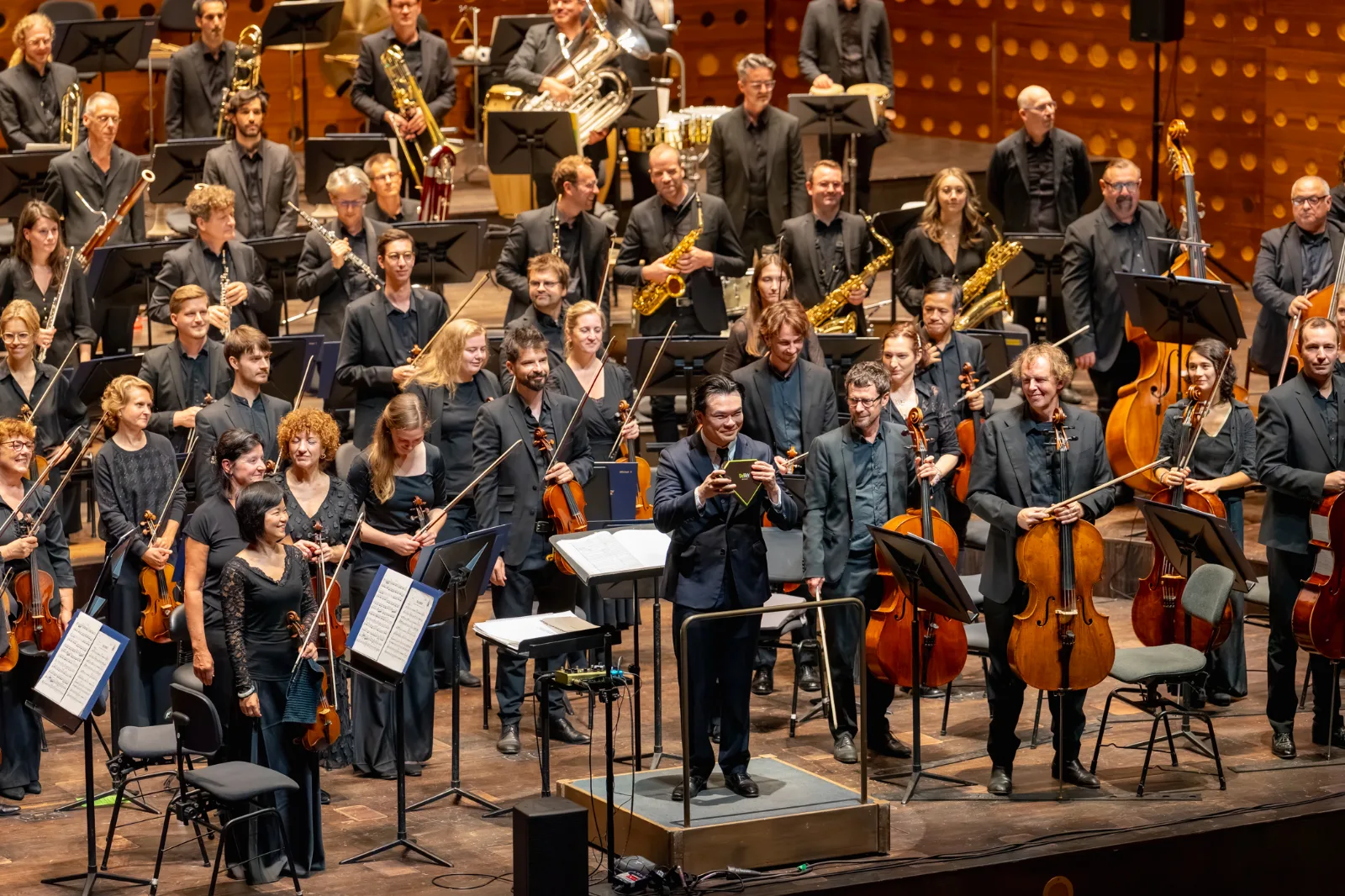
After the Choir of the Vlaamse Opera had given a sample of its abilities in the hall of the Koningin Elisabethzaal and introduced the upcoming season, the large audience moved into the concert hall for the closing of Open Houses. The Antwerp Symphony Orchestra (ASO) had put together a program for this occasion in which George Gershwin (1898-1937), Toots Thielemans (1922-2016), Samuel Coleridge-Taylor (1875-1912) and Abdullah Ibrahim (1934-2026) alternated with each other. A program with considerable contrasts, but with color and rhythm as connecting elements.
For me, conductor Wilson Ng was also an important reason to attend this concert. During the corona period I got to know him through several recordings. What struck me then was the way he relates to the music as a conductor. There is little distance between him and what is on the lectern: his whole body seems to be involved in the music-making. Tonight I saw him work live for the first time and that impression only grew stronger.
His gestures are accurate, but at the same time strikingly lively. Ng constantly responds to what is happening in the orchestra and at the same time looks ahead to what must come. A movement can be an invitation, a phrase an answer. He does not conduct from a distance, but seems to continually be part of the music-making itself. It was precisely this interaction that made it interesting to watch not only the orchestra, but also the conductor.
Clara De Decker provided the connection between the different parts of the program with some fine anecdotes. Her interventions kept the atmosphere relaxed and gave the audience a brief insight into the music that followed each time.
Gershwin's Girl Crazy formed the ideal opener. The music immediately set a light-footed, energetic atmosphere and gave the orchestra ample opportunity to move through different styles and moods. The alternation between rhythmic fluidity, lyrical moments and pronounced orchestral colors came into its own nicely. The ASO played with great mobility and especially with a great sense of timing.
After Gershwin came the tribute to Toots Thielemans, with Bluesette and Midnight Cowboy. Steven De bruyn was given all the space to show how many possibilities lie in the harmonica. His instrument sounded now clear and transparent, then warmer and more muffled. It was especially the variety of timbres that made an impression.
Moreover, placing a harmonica in a symphonic setting is not self-evident. The instrument has a very different physical presence than an orchestra group and can easily be overshadowed by the larger ensemble. That did not happen here. Ng held sufficient space around De bruyn, while his sound simultaneously became a full part of the orchestra. De bruyn especially did his own thing. Thielemans remained of course the source of inspiration, but there was no attempt to reconstruct his style. Both Bluesette and Midnight Cowboy received a personal accent and thus became more than a mere nostalgic tribute.
A real discovery for me was Coleridge-Taylor's Ballade in A. I had never heard a work by this composer live before and was therefore pleased to finally be able to discover him in the concert hall. Moreover, the choice proved to fit particularly well within this program. Where Gershwin starts strongly from rhythm and direct sound effect, Coleridge-Taylor asks for more attention to the development of the musical material and the relationships within the orchestra.
The ASO showed a different side of itself here. The Ballade is clearly structured and offers plenty of opportunities for orchestral color, without that color displacing the musical flow. The musicians handled it carefully and Ng kept the whole thing moving nicely. For me it was a pleasant discovery, both of the work and of the way the orchestra dealt with it.
Then it became quiet.
The hall darkened and Steven De bruyn brought solo his own arrangement of De lichtjes van de Schelde. With a melody so strongly connected to Antwerp, a recognizable and nostalgic performance is obvious. De bruyn fortunately chose a different approach. He treated the familiar material not as a given, but almost took it apart to rebuild it afterwards. This made the melody sound both familiar and strange and you started listening to it again.
It was at the same time the only moment of the evening when the orchestra fell completely silent. After the richness of the preceding pieces, this return to one instrument worked as a natural pause for breath.
After this intimate passage, African Marketplace followed with a sharp transition to a completely different musical world. The music of Abdullah Ibrahim was unknown to me until tonight, but appealed to me immediately. The percussionists especially made an impression with their rhythmic precision and infectious musicality. It was difficult not to move along. The many rhythmic patterns never became an incomprehensible mass, but remained clearly distinguishable from each other. Here too, Ng gave the different groups sufficient space and held the multitude of rhythms together.
With Gershwin's An American in Paris followed a logical conclusion. The score brings together an enormous wealth of orchestral colors once again, from refined passages to moments where the full ensemble can display its power. The orchestra visibly enjoyed those successive mood changes.
That pleasure was indeed palpable throughout the evening, but became perhaps most visible here. Several musicians played with a smile on their faces and the interplay with Ng seemed particularly natural. The conductor did not need to constantly keep the orchestra in check; he provided direction, space, and impulses, to which the musicians responded.
The acoustics of the Elisabethzaal also proved excellently suited to such a program. Even when the full orchestra played with considerable dynamic force, the sound remained clear and transparent. The combination of different orchestra groups came across particularly clearly: even in the most exuberant passages, there remained space between the individual voices.
As an encore, a touch of Bernstein followed, after which the audience went wild.
What made this conclusion to Open Huizen particularly strong was the variety. Gershwin, Thielemans, Coleridge-Taylor, and Ibrahim each received their own place and were not artificially merged into one whole. It was precisely the differences that worked: at one moment rhythm was central, then again orchestral color or the intimacy of a single instrument. Wilson Ng moved effortlessly between those different worlds. He gave Gershwin the necessary fluidity, allowed Coleridge-Taylor space for his orchestral development, ensured that De bruyn's harmonica could breathe within the larger whole, and kept Ibrahim's complex rhythm clear and manageable.
With such an evening, Antwerp could not have wished for a better start to the new concert season…
More information:
https://www.antwerpsymphonyorchestra.be/nl/programma/open-huizen-afsluitconcert-ode-aan-toots-sywc