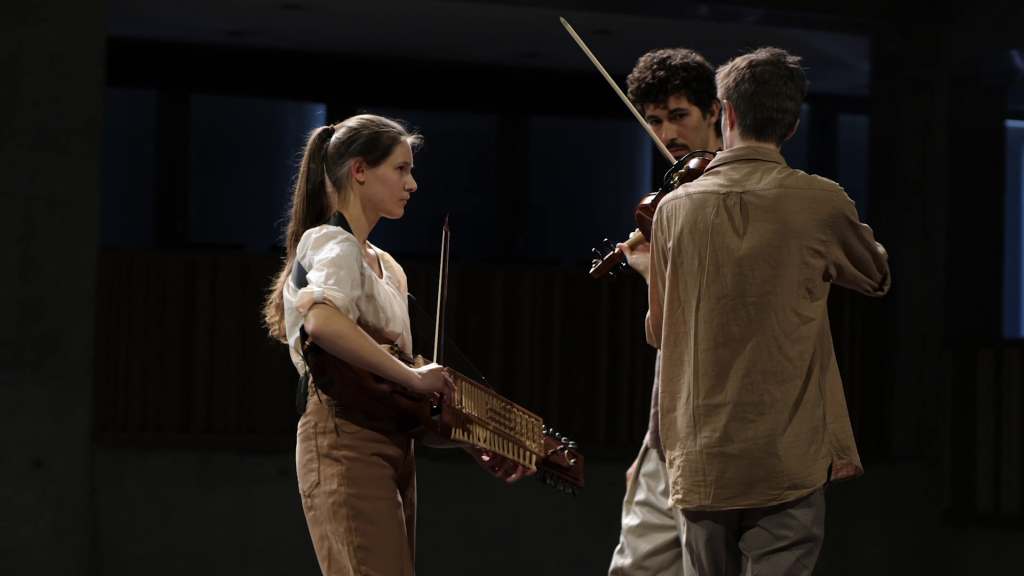
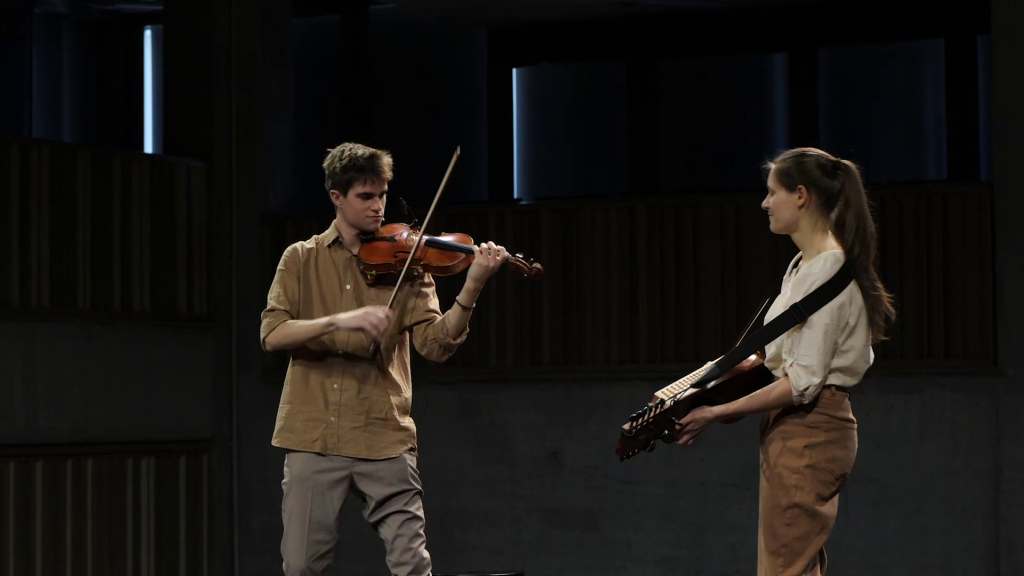
For those who don't know them yet, Antanjula – which means 'Bridge to the other country' – is a young and driven musical duo of early twenty-somethings, consisting of the Belgian Theo Carpentier and the German Angela Ambrosini. They bring intimate music of their own making to the fore, with influences from various stylistic idioms.
With violin and nyckelharpa, they explore a combination that is not often seen. They met during an internship at Burg Fürsteneck in Germany and have not stopped playing together since.
Nyckelharpa
Today the nyckelharpa is a fairly rare instrument. Until well into the 15th century, however, this special instrument was widely distributed across Western and Southern Europe, after which it fell into disuse. Only in Sweden has the instrument managed to survive. Angela Ambrosini has dedicated her heart to it. At the age of 13, she took part as a musician and composer in the project ENCORE (European Nyckelharpa Cooperation Orchestral Experience). In that same year she went on her first concert tour in France with the ensemble of Lucilla Galeazzi. She has since performed on stages in Germany, Italy and Estonia.
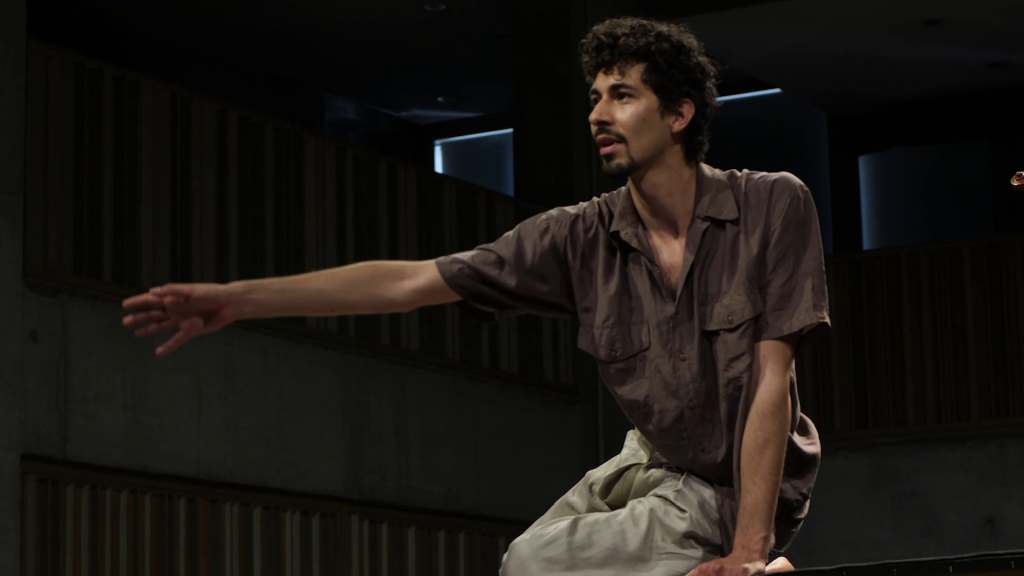
Theo Carpentier studied violin at the Lemmens Institute. His love for this string instrument is so great that he also devotes himself to baroque violin and folk music. For Bending Bridges, their first production, the ranks were strengthened with dancer/choreographer Robson Ledesma, who is also active at P.A.R.T.S.
Out of the darkness...
... sounds the distinctive timbre of the nyckelharpa. After a few chords, the violin joins the rather shrill soundboard. On a dark stage, a crescent moon takes shape, formed by the shadow of a round platform with a white stripe in the middle. As the light intensity increases, the three protagonists move onto the small, round playing surface. The dancer lies down. The musicians play.
The three protagonists are on a slowly rotating platform and position themselves opposite each other. Although the playing surface is small, there is no connection. Three individuals standing on their own, lonely souls. In the arena of life – which can be both battleground and stage – two images meet. How you see yourself (identity) and how others see you (image). The difference between identity and image often leads to tension and conflict, but it can also be the exciting beginning of a dialogue.
That ping-pong happens almost every day. Sometimes you lose your identity to what you think you are through the eyes of others. You can also lose yourself in your image. No longer knowing what comes from within, because so many impulses from outside act upon you. It is a bit like tightrope walking. You are constantly trying to find your balance between the inner and the outer. In the first instance, this is a dialogue with yourself and also with all the others. A kind of mental treasure chest. Leaving the safe and familiar for the unknown, discovering the other and the world.
Dancing towards the unknown
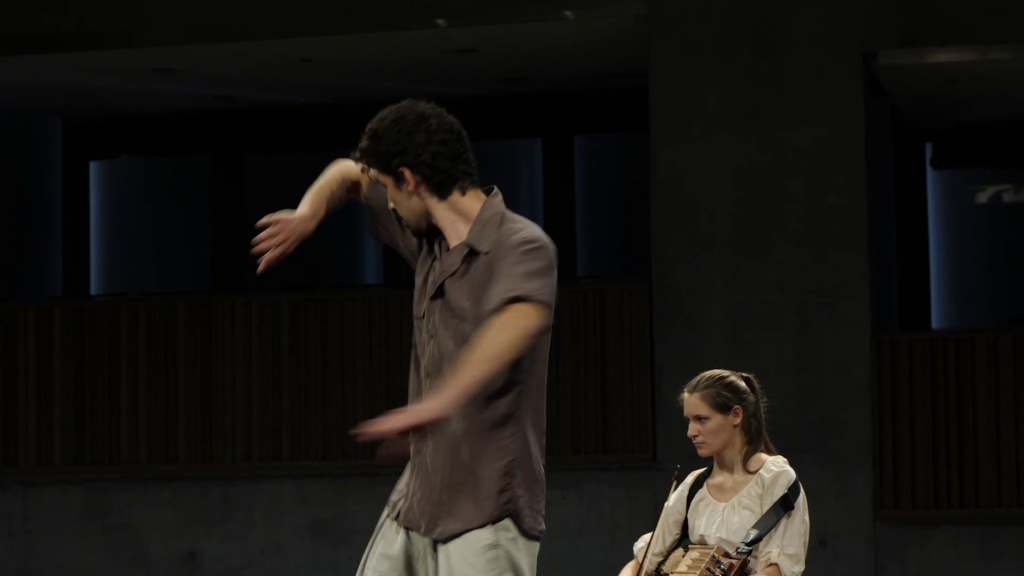
The stage is and remains an inexhaustible reservoir of inspiration and magnetism. Art born from practice or pure improvisation. Where the dancer is at first content with his spot on the small intimate island, he soon becomes curious about the space around it. He reaches for the unknown. He feels out the space. Gradually, interest in one another grows, and the dancer also ventures beyond the round playing surface, encouraged by the playful sounds of the string duo.
Robson Ledesma is a dancer with a strong and flexible body. Musical too, so that he interprets the notes almost instinctively. The simple beauty of his flowing gestures is appealing. Gradually the light dims. The players are enveloped in the soft darkness of safety.
The premiere of the interdisciplinary performance Bending Bridges took place on 1 May at the Concertgebouw in Bruges and could be watched via streaming. In the last weekend of June the production toured, stopping in Antwerp, Ghent and Turnhout. As a first work, it is a commendable attempt, but the whole turns out somewhat meagre, lacking depth and sparkle.