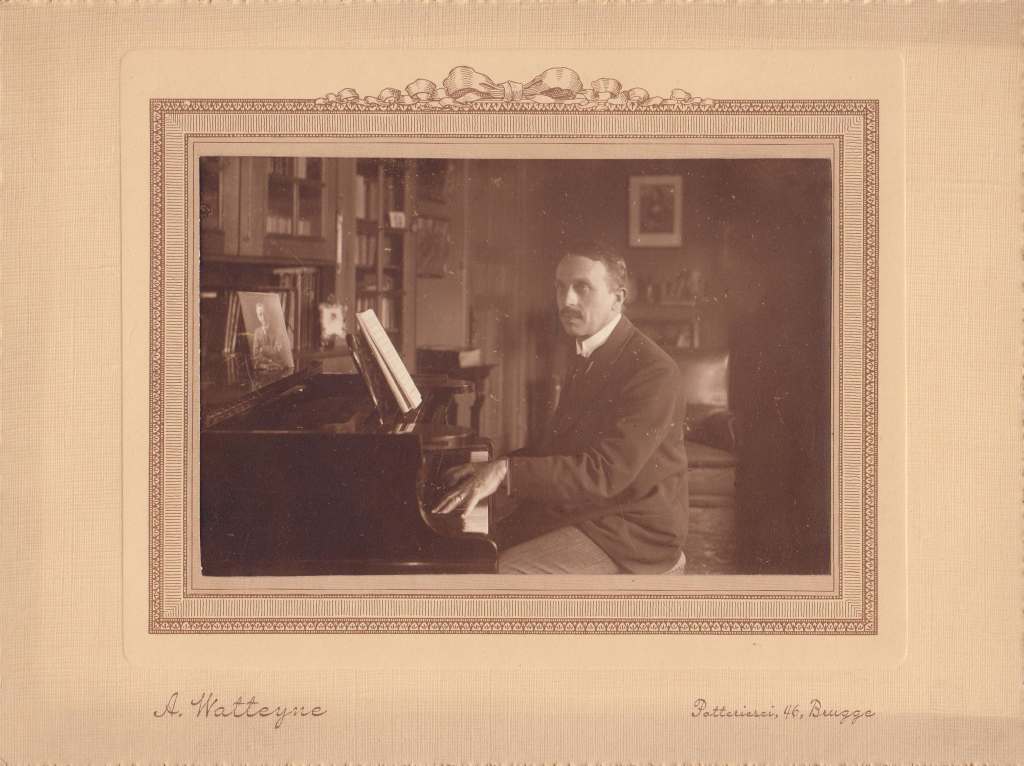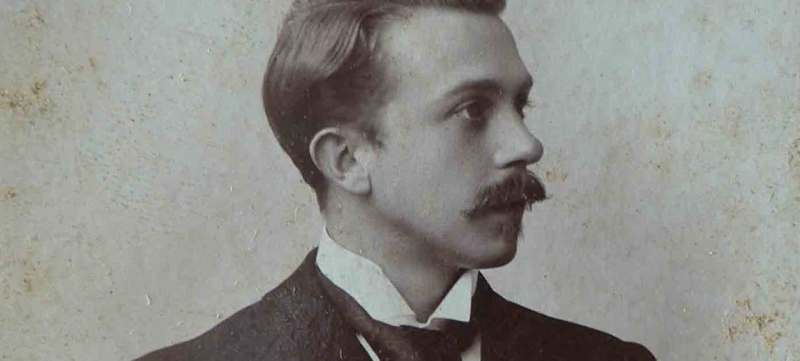
Bruges residents who no longer live in their birthplace and have moved elsewhere gather every year in the summer in their Bruges on a meeting day. They are members of the association 'Bruges residents outside Bruges', in short BBB. I too am such a Bruges resident and was there on that last warm Saturday of the summer holidays. The festive speech, after the welcome by the mayor, was naturally about a Bruges resident, born 150 years ago next year: fin-de-siècle composer Joseph Ryelandt (1870-1965). Who still knows him?
With a bit of exaggeration you could say that he wrote a soundtrack for 'Bruges la morte'. It was the speaker and art historian David Vergauwen himself who made this allusion. Ryelandt lived to be 95 and died in his Bruges in 1965. He was born into a wealthy, devout and French-speaking family and was also married to a woman from a wealthy and devout noble family, Marguerite Carton de Wiart. "When I was working on my book about Ryelandt," David Vergauwen told us, "I asked a descendant if he had ever heard his grandfather speak Dutch. After some hesitation the answer came: 'yes, to the maid.' But he knew it, spoke it and wrote it too. He wrote, of course, primarily in the language of music. From an early age, and he wanted to study music. Against his mother's wishes: it had to be law studies, like his father who died young. But when Edgard Tinel said about him that he was greatly impressed by a sonata of his, that he had never seen anything like it from such a young man, the parental resistance was broken and he became an apprentice to Tinel, head of the Lemmens Institute, which was then still in Mechelen.
He wrote mainly vocal religious music. This is evident already from the titles of his works: oratorios with names such as Christus Rex, Agnus Dei, Maria, Purgatorium and several masses, a musical drama Sainte Cécile… He never went out of his way to promote his oeuvre. He didn't have to do it for a living, he was wealthy enough. Yet he published with the well-known German publisher Breitkopf. David Vergauwen also played a few fragments from his work. It sounds romantic, you can hear the spirit of the times in it: Fauré, Franck, Wagner too and certainly Brahms. And you have to place him, said Vergauwen, in the 'Generation 1870' of Belgian composers such as August De Boeck, Paul Gilson, Guillaume Lekeu, Lodewijk Mortelmans, Joseph Jongen….
134 opus numbers are known, he began composing in 1892, his most productive period was during the interwar years. He then wrote his religious choral music and more intimate spiritual compositions. But he also composed chamber music, five symphonies and songs. In 1924 the city appointed him director of the Conservatory. After the Second World War his output slowed and he devoted himself mainly to writing poems and reading world literature. Almost Ryelandt's entire oeuvre is now in the possession of the city. That city and the Concertgebouw commemorate '150 Years Ryelandt' next year for a month – from 7 March to 7 April – with performances of his liturgical music, his Gezelle songs, with music by other fin-de-siècle composers, an exhibition, guided tours and lectures. David Vergauwen's book about Ryelandt will also be presented there.
- WHAT : Meeting day of the "Bruges residents outside Bruges" on 31/8/2019, with a lecture by David Vergauwen.
- WHO : "Joseph Ryelandt 1870-1965. A romantic fin-de-siècle composer"
- WHEN : "Festival 150 Years Joseph Ryelandt", 7 March to 7 April 2020
- WHERE : Concertgebouw Brugge, Arentshuis Brugge, Ryelandtzaal, Sint-Salvator kathedraal, Stadsschouwburg
- WEBSITE: www.bruggelingenbuitenbrugge.com
[embed]https://www.youtube.com/watch?v=Tni51qQBwEo[/embed]