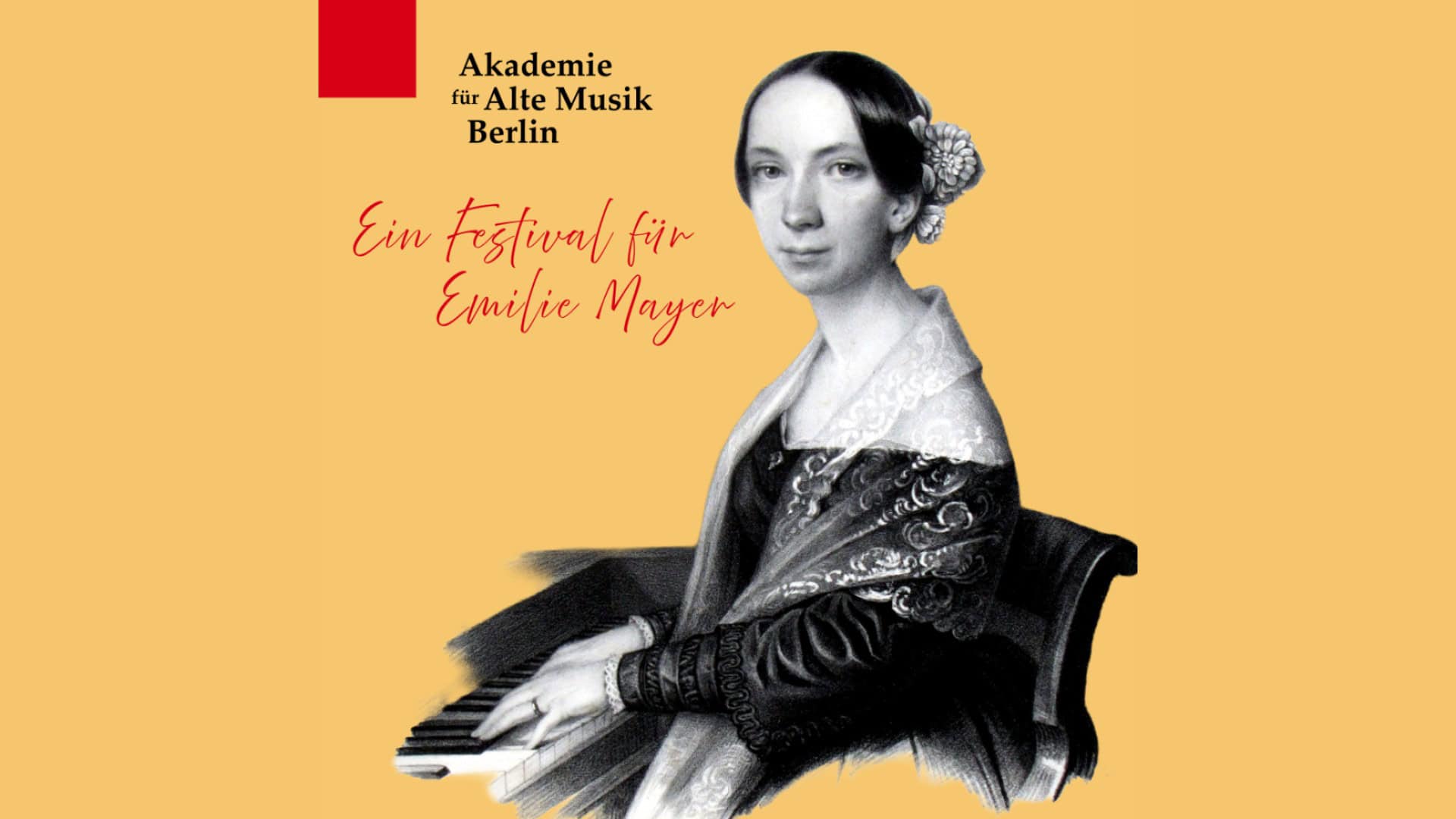
Clara Schumann and Fanny Mendelssohn are gaining more and more recognition these days, and rightfully so. But in Germany, it is their contemporary Emilie Mayer who is now considered the most important German female composer of the 19th century. This is due to her extensive body of work, which consists primarily of orchestral pieces. Her life path as a deliberately unmarried woman also plays a role. Emilie Mayer was so aware of her capabilities that she dared to be the first woman to establish herself as a 'professional composer'. The Akademie für Alte Musik Berlin will definitively bring her out of the shadows at the end of October with a series of three concerts in Berlin. A city trip well worth taking.
Emilie Mayer (1812-1883) held an exceptional position in the 19th-century musical landscape. As a woman among her male colleagues, but also in relation to her female contemporaries. She deliberately remained unmarried to avoid the risk of having to accept a subordinate role as a wife and mother. This allowed her to fully concentrate on her musical career. And remarkably for a woman: her extensive body of work consisted mainly of orchestral compositions.
Unlike, for example, Clara Schumann and Fanny Mendelssohn, Emilie—pronounced eh-MEE-lee-uh—Mayer did not grow up in an artistic environment. Her father was a pharmacist, as was one of her brothers. Another brother and her brother-in-law were doctors. Nevertheless, she received full support to develop her musical talent, which emerged from an early age. However, her career got off to a late start. In 1840, exactly 26 years to the day after Emilie's mother's death, her father took his own life. That was the moment when the then 28-year-old Emilie decided to make a dramatic turn in her life.
Independent life
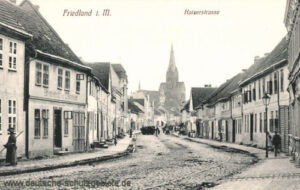
She realized that in Friedland, her small hometown in what is now the northeastern German state of Mecklenburg-Western Pomerania, she had little future. Her inheritance allowed her to establish an independent life. She moved to Stettin, the present-day Polish city of Szczecin. There she took lessons with Carl Loewe, a renowned composer, organist, pianist, and singer. Although he had his doubts about composing women, he was immediately willing to accept Emilie Mayer as his student. Under his tutelage, she immersed herself in the works of Mozart, Beethoven, and Haydn. Her first two symphonies received performances in Stettin right away.
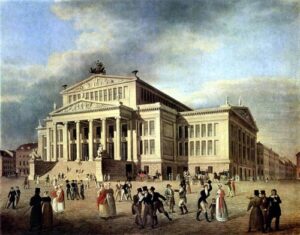
She then went to Berlin to study fugue and counterpoint with Adolphe Marx, a revolutionary who openly advocated for girls' access to music education. He was also the publisher of the Berliner General Musical Newspaper and music director at the university. Emilie Mayer finally learned orchestration and instrumentation in Berlin from Wilhelm Wieprecht, director of the Prussian military music band. He would conduct the premieres of several of her works.
Her work was also performed in Munich, Leipzig, Vienna, and even Brussels. Usually she had to organize those concerts herself and bear all the costs, such as having her unpublished scores manually copied. In Berlin, however, she had the Königliche Schauspielhaus at her disposal free of charge.
Breadcrumbs
She owed this favor to her good connections with the court of Friedrich Wilhelm IV. This friendly bond was the result of a peculiar hobby: she sculpted with {{NOTRANSLATE_1}} Breadcrumbs – breadcrumbs or panko – and with the help of scissors and needles she created artworks. She gifted such a bowl, for example, to Queen Elisabeth of Prussia, who later gave her a gold medal in return. A similar bread artwork by the composer is said to still be housed in the Grüne Gewölbe collection in Dresden.
Unique
Her concerts were consistently enthusiastically announced by Ludwig Rellstab, the renowned critic of the Vossische Zeitung, a newspaper widely read by the political and cultural elite. In 1850, Rellstab wrote, for example, the following glowing words: 'This coming Sunday morning, the musical world will have something special to offer. A lady, Miss Emilie Mayer, will perform a number of her compositions in the concert hall of the royal theater (…) Such a concert program, brought entirely to life by a woman, is, at least to our knowledge and experience, unique in the history of world music.'The program was certainly impressive: an overture for orchestra, a string quartet, a song for tenor and one for alto, four-part choral pieces, work for choir, an aria and her third symphony, nicknamed Military Symphony
, performed by the leading orchestra Euterpe under the direction of Wieprecht. The reviews were also praiseworthy. TheNeue Berliner Musikzeitung
was impressed: 'Until now, a woman's hand has barely mastered the art of the song (…), but a quartet, let alone a symphony with all the required artistry of voice-leading and instrumentation – that is quite extraordinary. What feminine talents, talents of the second order, are capable of – that is what Emilie Mayer has achieved and demonstrated.' Professional Composer She was also very aware of her own abilities. This is evident from the fact that she presented herself, perhaps as the first woman in history, as a 'professional composer'. In dealing with her publisher Bote & Bock Verlag, she dared to negotiate politely but firmly over the printing costs she had to pay.
Moreover, she did not shy away from approaching the greatest composers of her time. She asked Franz Liszt to make a piano arrangement of her string quartet in D minor, which she had dedicated to him. Liszt refused, however, because he found it 'impossible' to 'reproduce her indispensable sound and color on the bare keyboard'. He praised her enviable musical talent.
So many performances, so much praise, but when she was not properly appreciated, she experienced it as particularly painful. We learn this from a letter to composer and musicologist Wilhelm Tappert. Her teacher Carl Loewe had asked her for details about her background when he was working on his autobiography. When Loewe died, however, and another author completed the work, she had to discover that she was not included in it at all. She complained about this to Tappert: 'As you may know, his biography was recently published. At his request, I had to send some notes about myself while he was still alive, how long I studied with him, how many works I published and actually wrote. Incomprehensibly, Privy Councillor Bitter in Posen, who took over the editing, did not include the passage about me, for reasons I don't know – it has deeply wounded me.'
Or how women were even excluded from history books during their lifetimes and consequently were very quickly forgotten.
140 years
It took about 140 years before Emilie Mayer received any attention again. Interest began cautiously in 2012, on the occasion of her 200th birthday. The Neubrandenburg Philharmonie under Stefan Malzew performed her fourth symphony then. In 2019, that orchestra, based in the city of Neubrandenburg, 30 km from Friedland, released that symphony on a double CD, together with other fine works such as her lovely piano concerto and a string quartet (
{{NOTRANSLATE_1}}
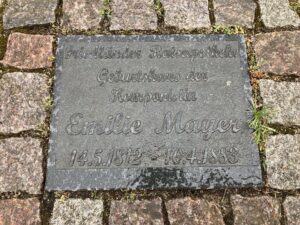
In Friedland, at the instigation of a local women's choir, a street was named Emilie-Mayer-Weg and a commemorative plaque was installed in the middle of what is now a large, paved Marktplatz, but where her father's pharmacy once stood. To promote her legacy, an Emilie Mayer Gesellschaft was also established.German pianist Kyra Steckeweh meanwhile became the first to record Mayer's piano sonata in D minor (CD).
Vita brevis ars longa
"). Together with filmmaker Tim van Beveren, she delved into the archives, which resulted in an award-winning documentary Life is short, art is long). Together with filmmaker Tim van Beveren, she delved into the archives, which resulted in the award-winning documentary Female Composers (2018, which also featured portraits of Fanny Mendelssohn, Mel Bonis, and Lili Boulanger). Through the continued efforts of Tim van Beveren, Emilie Mayer was further honored in 2021 with a commemorative stone at the Dreifaltigkeitsfriedhof cemetery in Berlin, at the location where she may be buried according to city archives – notably not far from the graves of Fanny and Felix Mendelssohn.
Secret Diary
At last there is something to read about Emilie Mayer – albeit currently only in German. Based on an out-of-print academic study (Almut Runge-Woll, 2003), German journalist Barbara Beuys wrote the worthwhile biography Emilie Mayer: Europe's Greatest Composer (2021). However, source material is scarce. It consists mainly of a long series of announcements and reviews in newspapers and magazines, but little can be found about Mayer's personal life. First-hand information is provided only by 21 original letters preserved in the Berlin State Library. After her death, two portraits were published, possibly based more on family anecdotes than on scientifically founded facts.
Yet recently the 'secret diary' of Emilie Mayer appeared. A fictional one, of course, written by Gitta Martens, co-founder of the Emilie Mayer Gesellschaft. She deliberately calls the result of all her research a novel, not a biography or non-fiction. After all, it cannot be determined how Emilie Mayer truly managed to hold her own in a man's world that was not waiting for a composing woman, and certainly not for an unmarried woman who made composing her profession. At the same time, that lack of preserved personal documents gave Gitta Martens as ghostwriter plenty of room to fill the gaps. Cleverly, she manages Emilie Mayer, Composer – Symphony of a Life to make vivid how it might have been. Through Emilie's eyes, you gain a comprehensive view of the living conditions of her time, the social and technological developments, the difficulties and prejudices women faced, how she as a self-confident woman dealt with them, and so on. In short, a novel that will captivate a broad readership and thus deserves a Dutch translation. (Read a review on the blog notities.vrouwaandepiano.be.)
Baroque Orchestra
It is clear that with this book and the increasing number of CD recordings, often with first recordings, of her chamber music and orchestral works, attention in her native country is on the rise. On the occasion of the 140th anniversary of Emilie Mayer's death, the Brandenburger Symphoniker already staged an Emilie Mayer Retrospektive in 2023. And at the end of this month there is the Emilie Mayer Festival by the venerable Akademie für Alte Musik Berlin under the direction of Bernard Forck. A unique opportunity to get acquainted with all her orchestral works – at least what has been recovered, as she composed much more. The three concerts of the festival include five symphonies, four overtures, and the piano concerto with Alexander Melnikov as soloist on the pianoforte.
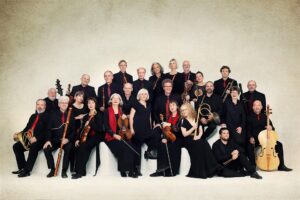
That it is precisely an orchestra with a focus on Baroque and Viennese Classicism that delves into a 19th-century female composer may be surprising, but the Akademie has good reasons for it, as dramaturg and assistant director Linus Bickmann explained to me.
'Emilie Mayer's earliest work is deeply rooted in Viennese Classicism. Furthermore, in recent years we have repeatedly ventured into the 19th century, because we also like to look ahead. We apply our experience to do justice to Emilie Mayer's sound and style. Finally, as a Berlin orchestra, we enjoy engaging with composers who were active here. Emilie Mayer lived in Berlin for a long time, precisely in the period when many of her symphonies and overtures were created.'
Historical Performance Practice
Characteristic of the Akademie für Alte Musik Berlin is historical performance practice: they want to approach the composer's original intentions as much as possible, including by playing on historical instruments or copies thereof. They also go back to source material. That is why they bring only works to the festival of which Emilie Mayer's own orchestral score has been preserved. That is the reason why, of all things, the fourth symphony is not on the program. 'Of that, a version for piano four-hands was printed in Mayer's time, but the preserved orchestrated version is a reconstruction not by her.'
The piano concerto is on the program, although it presumably did not have a public performance in her time. 'After all, no reviews of it have been found. Moreover, the orchestral score contains no signs of use, while the piano part contains many annotations. In any case, we are preparing a new edition of her posthumous orchestral works.'
Bickmann suspects that this may be the first time the Akademie für Alte Musik Berlin performs work by a woman, but the orchestra is determined to include Emilie Mayer more frequently on its program. CD recordings are also being made of the upcoming concerts. Something to look forward to for those who won't be in Berlin during the fall break.
Faust Overture: The World Turned Upside Down
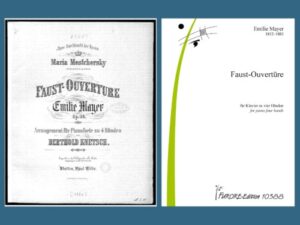
From Mayer's orchestral works, I would like to highlight one composition: Faust Overture for Large Orchestra op. 46 (1879), composed when she was already 67. Two years earlier, Emilie Mayer had performed at a concert in Stettin, alongside the Adagio from her seventh symphony, also Wagner's Faust Overture programmed. The Faust theme was hugely popular at the time; Schumann, Berlioz, and Liszt also tackled it. The fact that Emilie Mayer, as a woman, did the same seemed almost provocative. In none of her five previous overtures had she chosen a subject, yet now she went straight for an unmistakably 'masculine' theme. After all, the superhuman that Goethe created through this character, with all his creative drive and titanic passions, is naturally a man. Yet the composer received plenty of praise. The Musical Weekly wrote: 'The world turned upside down! Our young composers indulge in lyrical outpourings, singing of spring and love, while the women (…) write their musical reflections on powerful and sublime subjects on sixteen-line manuscript paper.' Quite the reversal.
The work quickly conquered concert halls as far as Prague and Vienna. At the publisher Bote & Bock, a version for piano four-hands appeared, allowing the work to penetrate drawing rooms and salons. A clever move. Furore Verlag, the German publisher that publishes exclusively works by women, brought out the score again. A tip for pianists out there!
________________
• Emilie Mayer Festival by Akademie für Alte Musik Berlin on October 24, October 28, and November 1 at the Pierre Boulez Saal in Berlin. Info and tickets: https://akamus.de/de/emilie.
• Gitta Martens: Emilie Mayer, Composer – Symphony of a Life, Barton Verlag, 2025, 203 pp.
• Barbara Beuys: Emilie Mayer: Europe's Greatest Composer, Dittrich Verlag, 2021, 220 pp.
• This article also appeared on the Woman at the Piano blog.