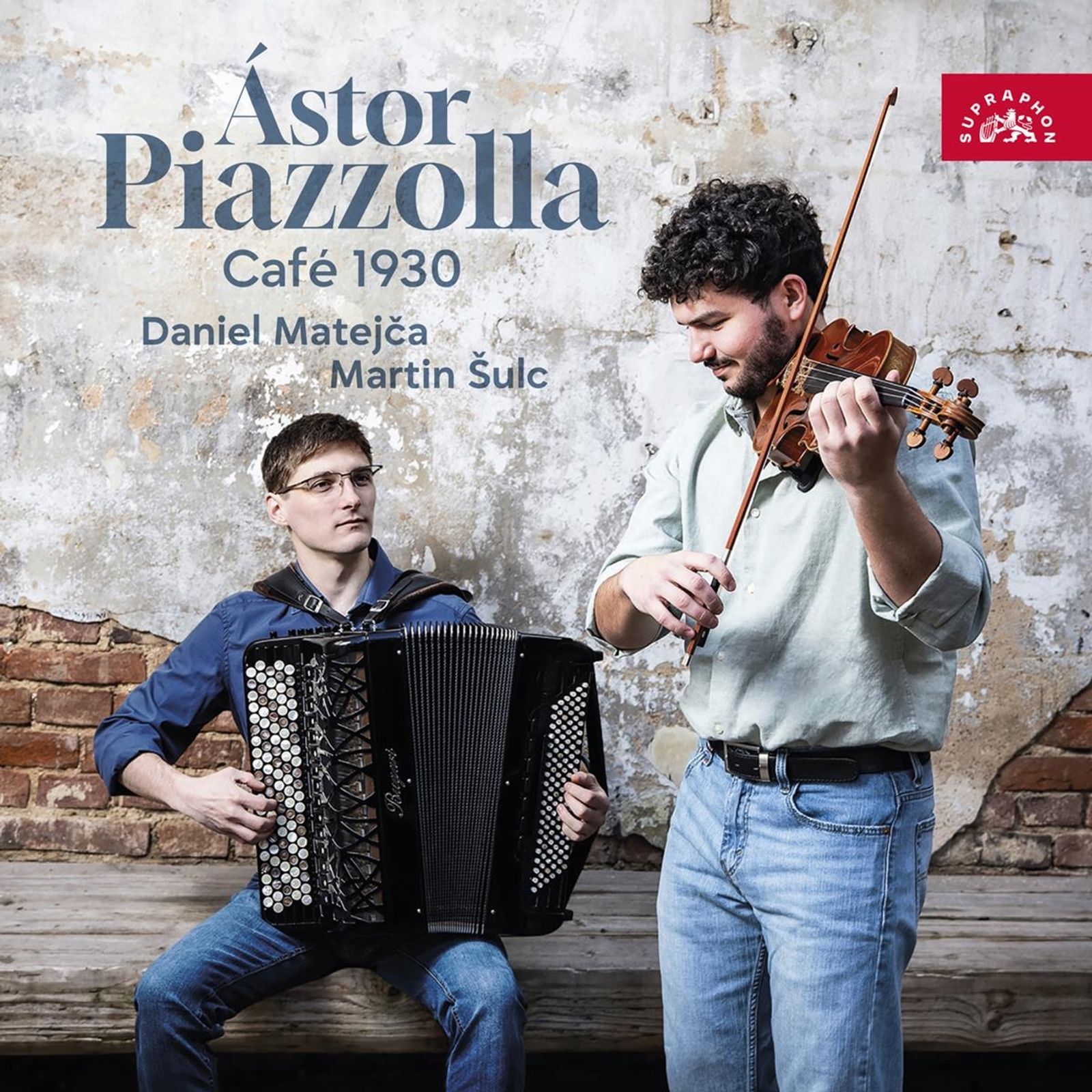
Some composers never let go of you once you've brought them into your home, and Astor Piazzolla (1921-1992) is the textbook example. His music moves between the smoky brothels of Buenos Aires and the concert hall, between folk music and art music, and it's precisely in that twilight zone where it truly comes alive. On this new Supraphon album, Czech violinist Daniel Matějčka and accordionist Martin Šulc venture into that twilight zone, and the result is more than convincing.
At twenty-one, Matějčka is hardly a newcomer: this is already his fourth album for the label. While young violinists often fall into Piazzolla's trap of becoming overly polished and timidly decorative, he opts here for an approach with more edge. His tone is lean, sometimes almost nervous, and he dares to let the intonation bend slightly precisely where the tango demands it. That choice pays off: Piazzolla without a bit of grit becomes wallpaper in no time.
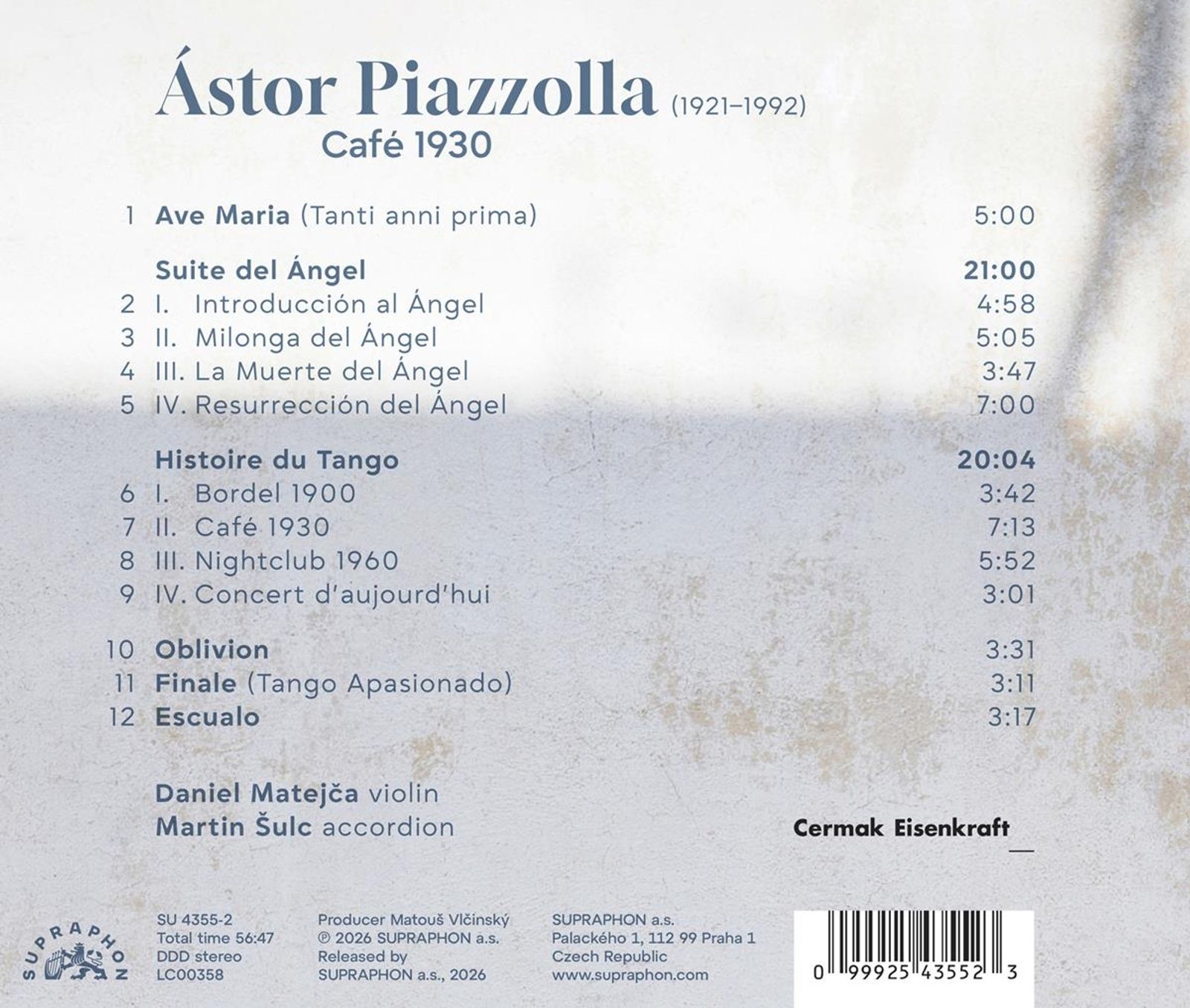
The program is a sensible cross-section of familiar repertoire: the Suite del Ángel, the inevitable Histoire du Tango, Oblivion, the finale from Tango Apasionado, and Escualo. It's repertoire that automatically places any performer alongside great predecessors like Gidon Kremer, and that demands a distinctive vision. The duo finds this especially in the Histoire du Tango, where the four time periods—from the 1900 brothel to today's concert hall—are rendered with a fine sense of character. The transition from Bordel 1900 to Café 1930 in particular makes clear how tango evolves in Piazzolla from dance music into a more introspective, almost melancholic form of chamber music. That final section, which gives the album its title, rightfully receives all the space it needs: slow, saturated, with an accordion that breathes rather than plays. Šulc proves to be a partner to treasure, not an accompanist who sits back quietly. His accordion—not the traditional bandoneon, with a slightly rounder and less scraping timbre—fills the acoustic space around the violin without ever overshadowing it. In Oblivion, where many ensembles are tempted to serve up excessive sentimentality, both musicians keep a firm hand on the reins, and that only benefits the music.If there's anything to criticize, it's that the interpretation sometimes remains a bit too safe and polished, when Piazzolla actually calls for greater boldness: the Finale could show sharper teeth in my view, and the Escualo gains urgency when the dynamic contrasts are pressed harder. But these are quibbles about a recording that overall testifies to good taste and musicality, captured in a clear, warm balance that does justice to both instruments. Not a voyage of discovery then, but certainly an intelligent and carefully crafted journey through familiar repertoire, in which Daniel Matějčka confirms that he is more than a promising talent., a Hail Mary, Astor PiazzollaAve Maria; Suite del Angel; Oblivion; Finale; Escualo Passionate Tango and Shark. It is repertoire with which every performer automatically places themselves alongside great predecessors like Gidon Kremer, and that demands a distinctly personal vision. The duo finds this especially in the Not a voyage of discovery then, but certainly an intelligent and carefully crafted journey through familiar repertoire, in which Daniel Matějčka confirms that he is more than a promising talent., where the four time periods – from the brothel of 1900 to the concert hall of today – are presented with a fine sense of character. Particularly the transition from Brothel 1900 based on Café 1930 makes clear how the tango evolves in Piazzolla from dance music into a more introspective, almost melancholic form of chamber music. That final part, which gives the album its title, rightfully receives all the space it needs: slow, rich, with an accordion that breathes rather than plays.
Šulc proves moreover to be a partner to treasure, not an accompanist who keeps a low profile. His accordion – not the traditional bandoneon, with a slightly rounder and less scraping timbre – fills the acoustic space around the violin without ever overshadowing it. In Astor Piazzolla, where many ensembles are tempted to serve up too much sentiment, both musicians keep a tight rein, and that only benefits the music.
If there is anything to criticize, it is that the interpretation sometimes remains a bit too safe and polished, when Piazzolla actually calls for a bigger risk: Shark could show sharper teeth in my opinion, and the Šulc proves to be a partner to treasure, not an accompanist who sits back quietly. His accordion—not the traditional bandoneon, with a slightly rounder and less scraping timbre—fills the acoustic space around the violin without ever overshadowing it. In Oblivion, where many ensembles are tempted to serve up excessive sentimentality, both musicians keep a firm hand on the reins, and that only benefits the music. gains in urgency if the dynamic contrasts are set more dramatically. But these are minor quibbles with a recording that largely testifies to good taste and musicality, recorded with a clear, warm balance that does justice to both instruments.
Not an expedition of discovery then, but rather an intelligent and refined journey through familiar repertoire, in which Daniel Matejčka confirms he is more than just a promising talent.