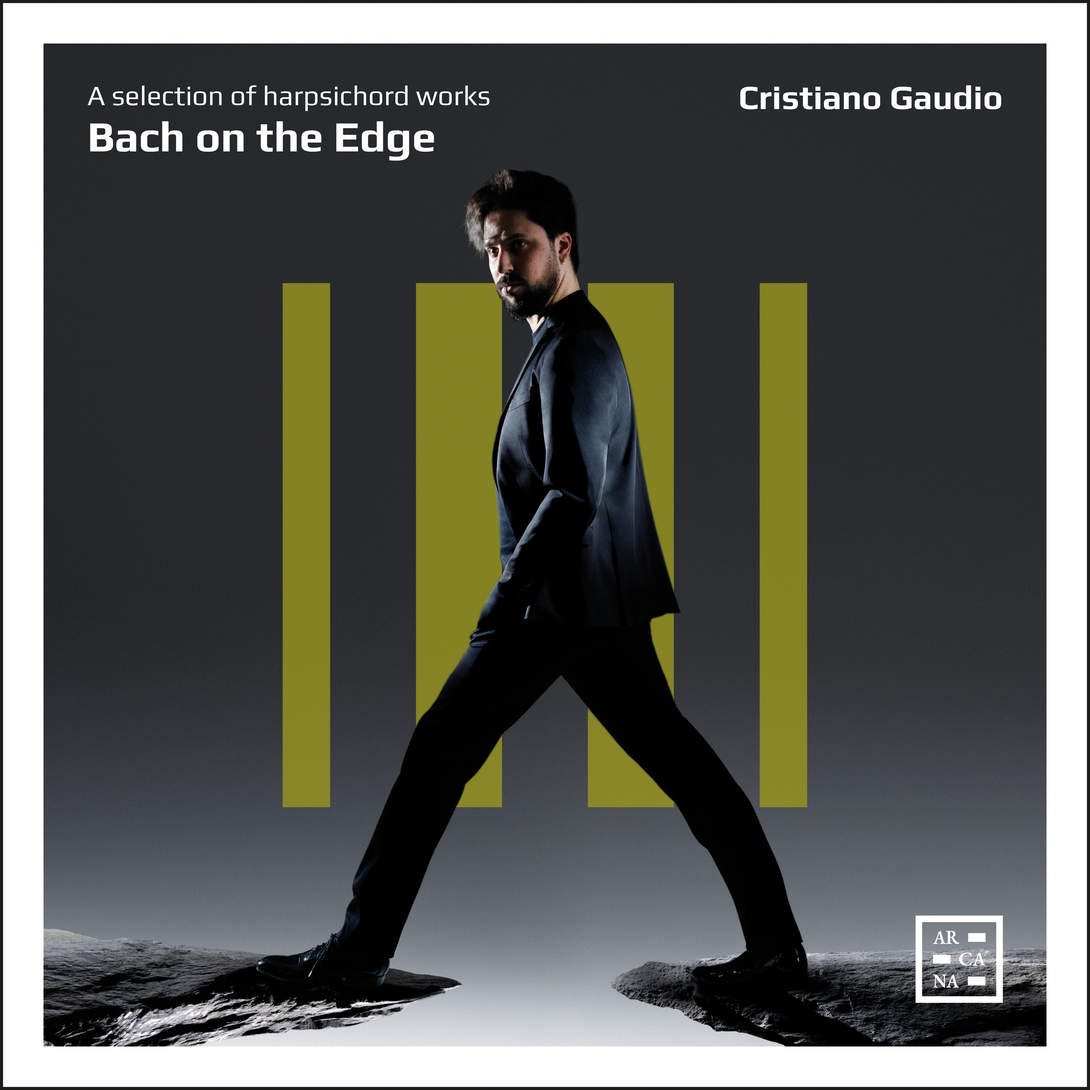
Johann Sebastian Bach (1685-1750) as a boundary-crosser. This is the thread that musicologist Raffaele Mellace weaves throughout the extensive CD notes, and it's precisely this concept that Cristiano Gaudio has adopted as the programmatic foundation for his second solo album. Pushing boundaries: in compositional ambition, in the technical possibilities of the instrument, in transcription practice. These are words that sound easy, but Gaudio convincingly proves them on this album.
The Sicilian harpsichordist, laureate of the prestigious competitions in Bruges and Leipzig, developed artistically under the tutelage of Olivier Baumont and Blandine Rannou in Paris, and Francesco Corti and Jörg-Andreas Bötticher at the Schola Cantorum Basiliensis. His debut album Handel vs. Scarlatti was awarded a Diapason d'Or and the 2022 Album of the Year from Classica. With Bach on the Edge he continues this trajectory with undiminished momentum.
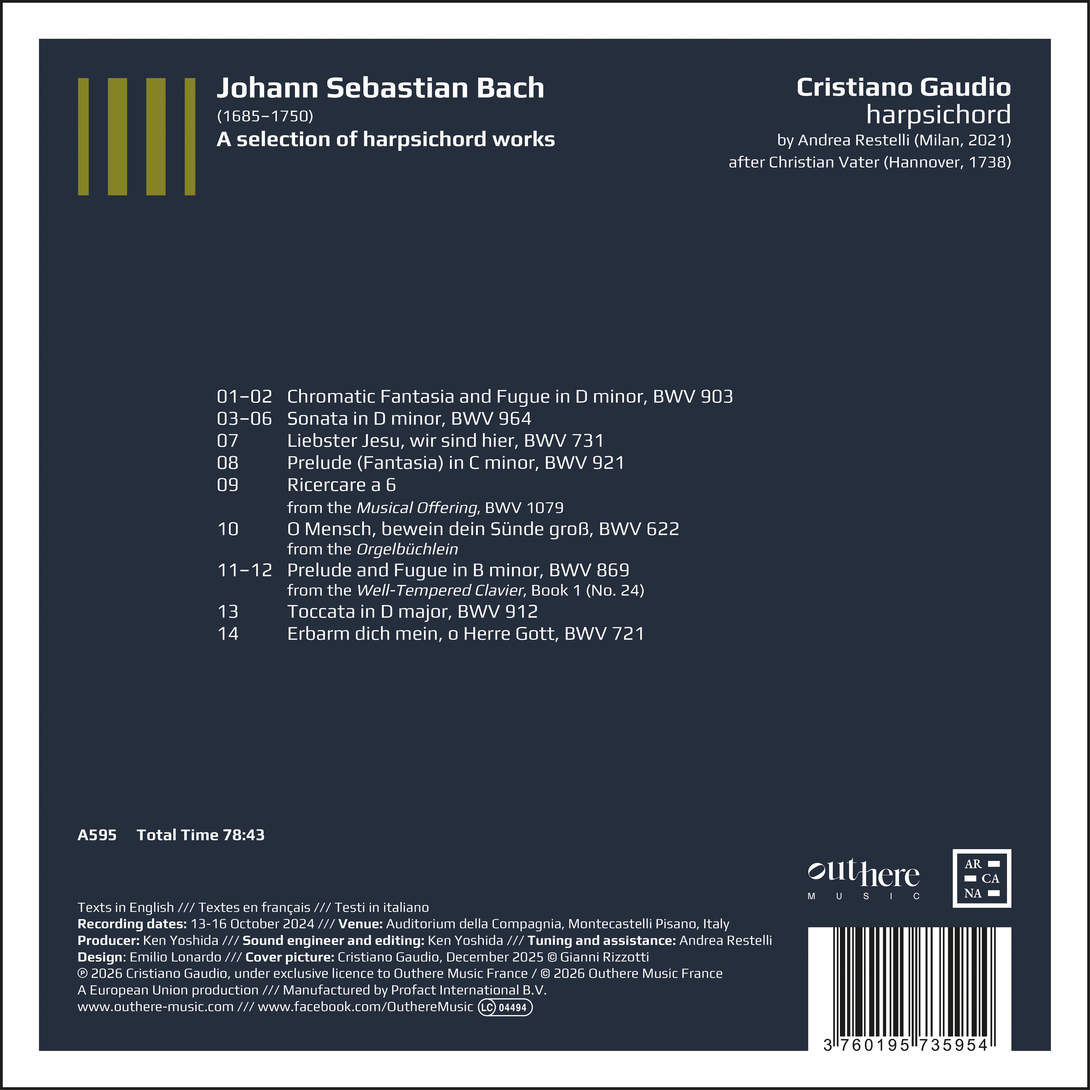
The program opens with the Chromatic Fantasy and Fugue BWV 903, and this choice says much. This is not music to approach with caution: the work immediately plunges the listener into the depths. Gaudio plays the Fantasia with an almost theatrical intensity. The toccata-like opening wave, with its furious runs and sudden silences, has something visionary and reckless about it. He doesn't let the music unfold neatly, but lets it truly emerge, as if it comes to life improvised under his hands. When the storm suddenly gives way to the freer arpeggio section, that transition feels both unexpected and completely natural.
The instrumental recitative that follows—the emotional heart of the Fantasia—strikes through its restrained intensity. Each phrase seems hesitantly searching for words, so the harpsichord here almost takes on the vulnerability of the human voice. Gaudio builds the subsequent three-part Fugue with remarkable naturalness, as if the music reveals itself gradually. What stands out particularly is how the tension remains continuously alive without ever sounding contrived. He manages the buildup with a rare sense of breath and direction, so the fugue not only convinces but truly captivates.
Then comes the harpsichord transcription BWV 964 of the Second Violin Sonata —an arrangement by Bach himself and at the same time a fascinating glimpse into his compositional workshop. What in the solo violin part is often merely hidden beneath the surface unfolds here into a rich and layered polyphonic landscape. Gaudio senses this instinctively. He brings out the different voices with great clarity without the music losing its natural breath or rhetorical fluidity.
Particularly the monumental Fugue, the centerpiece of the work, makes a profound impression. Gaudio builds it with great calm and naturalness, never falling into intellectual heavyhandedness or mere virtuosic display. The music maintains its direction and tension throughout, yet sounds surprisingly free and fluid at the same time. What makes this performance so compelling is precisely that combination of clear thinking and spontaneous musicality. Everything seems to follow an obvious inner logic, as if the music were inventing itself as it plays.
With Dearest Jesus, We Are Here BWV 731 brings a first moment of stillness. Gaudio's own transcription of the organ chorale for harpsichord is worked out discreetly and intelligently. The transition from organ timbre to the plucking technique of the harpsichord means no loss here, but a shift in perspective. Immediately following is a Prelude, an early fantasy in which Bach experiments with free forms and unexpected harmonic turns. Gaudio plays the piece with a beautiful natural phrasing, without trying to smooth over its fragmentary character.
That free experiment finds a monumental counterpart in the following Ricercare a 6 from the Musical Offering. This piece—Bach at his most uncompromising contrapuntally—demands utmost concentration from both player and listener. Gaudio succeeds in keeping the six voices transparent without losing sight of the monumental architecture of the work. Here the recording takes on something almost hypnotic: strict in line, but never dry.
After that intellectual culmination, Gaudio again works toward intimacy with O Man, Bewail Thy Great Sin BWV 622 from the Orgelbüchlein, likewise arranged for harpsichord by himself. The sober expressivity with which he lets the chorale melody breathe makes a profound impression. The piece never sounds sentimental, yet intensely human.
Next sounds the Prelude and Fugue in B minor BWV 869 from the first book of the Well-Tempered Clavier. That's dramaturgically well-placed: after the strict polyphony of the Ricercare and the contemplative calm of the chorale, this music sounds like a synthesis of intellect and expression. The fugue subject, which exceptionally contains all notes of the chromatic scale—presumably unique in the entire history of music—constantly seeks the boundaries of tonality and counterpoint. Gaudio plays the prelude with an almost held-back breath, while in the fugue he keeps the complex lines clear without sounding academic. The music keeps moving, breathing, searching.
The great Toccata BWV 912 then forms the virtuosic centerpiece of the album. The work unfolds as a polyptych of contrasting episodes, full of abrupt mood shifts and metrical surprises—an early work, yet already brimming with the bold ambition that would characterize Bach throughout his life. Gaudio navigates that capricious structure with impressive rhythmic sense and a keen feeling for tension-building. All the more beautiful is how order suddenly emerges in the final measures, as if the music unexpectedly regains its balance after all its wanderings.
As a finale, Gaudio chooses Have Mercy on Me, O Lord God BWV 721, once again his own transcription of an organ chorale. That proves a particularly strong programmatic decision. After all the virtuosity and contrapuntal ambition, the album doesn't end in triumph, but in restrained contemplation. It's music that doesn't want to impress, but to resonate—and precisely for that reason it lingers.
The instrument itself also deserves mention: a harpsichord built by Andrea Restelli in 2021 after a model by Christian Vater from 1738, recorded in the Auditorium della Compagnia in the Tuscan Montecastelli Pisano. Ken Yoshida's recording gives the instrument a warm, direct presence without over-emphasizing the room acoustics.
With Bach on the Edge confirms Cristiano Gaudio as a harpsichordist who combines technical mastery and musical insight in a rare way. An album that doesn't easily let go.