To truly get to know the work of Leoš Janáček (1854–1928), you must visit Brno. In this Moravian city, where the composer lived for most of his life, worked, and premiered his most important operas, Cimarosa Cultural Travels is organizing a seven-day music tour from November 12 to 18, 2026, around the biennial Festival Janáček Brno. Under the musical guidance of Pieter Bergé and the overall leadership of Hilde Bergé, a program awaits that combines three operas, a concert, and a rich cultural framework.
A city with a rich past
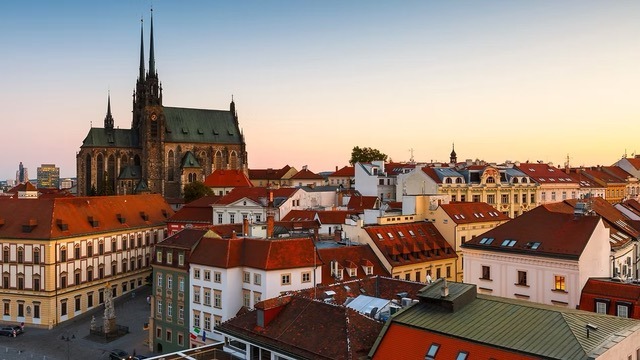
After Prague, Brno is the largest city in the Czech Republic and has been the capital of Moravia since 1641. It is not only the city of Janáček, but also of writer Milan Kundera, architect Adolf Loos, and Johann Gregor Mendel, the founder of genetics. Perched on two hills stand the medieval Spilberk Castle and the Gothic Petrov Cathedral, while art nouveau facades enrich the city center. In one of the suburbs stands the Villa Tugendhat, a masterpiece of modernist architecture that was inscribed on UNESCO's World Heritage List in 2010.
The journey departs on Thursday, November 12, from Zaventem with a direct flight to Prague, followed by a coach journey to Brno. Along the way, there is a stop in Kutná Hora, the former silver city that has been a UNESCO World Heritage Site since 1995 due to its historical significance and the late Gothic St. Barbara Cathedral. In the evening, guests check in at the Grandhotel Brno, which serves as the base for the entire week.
Music at the heart
The beating heart of this journey is the music program of the Festival Janáček Brno 2026. Each morning, Pieter Bergé provides an expert introduction in which he prepares the audience for that day's performance or concert—a formula that deepens listening and places the works in their biographical and historical context.
The first musical highlight is Friday, November 13, devoted entirely to the festival composer. In the evening, the opera Katja Kabanova (1921) is performed at the Janáček Theater, a work that was originally premiered in Brno. Janáček based this opera on Aleksandr Ostrovsky's play "The Storm" and composed one of his most poignant female portraits: the story of a sensitive woman who is destroyed by the suffocating morality of her environment. The characteristic melody, rooted in Czech speech patterns, which makes Janáček so recognizable, fully comes into its own here.
On Saturday, November 14, the music program briefly leaves the opera house for sacred music. In the Basilica of the Assumption of Mary in Old Brno—the place where Janáček himself sang as a choirboy and later conducted the choir—the renowned Czech ensemble Collegium 1704 presents a varied program of religious music. On the program are Giovanni Pierluigi da Palestrina's Missa brevis (1525–1594), the Graduale in Dominica Resurrectionis by Pavel Křížkovský (1820–1885)—Janáček's own teacher, no coincidence—Janáček's Exaudi Deus (JW II/4), and Johann Sebastian Bach's Magnificat (BWV 243) (1685–1750). A program that reveals the roots of Janáček's sacred music training, performed in the place where that training began.
Sunday, November 15, brings another opera performance at the Janáček Theater: The Makropulos Case (1926), Janáček's penultimate opera, conducted by Robert Kružík and directed by David Radok. This late masterpiece, based on Karel Čapek's play, revolves around the three-hundred-year-old Emilia Marty and poses profound questions about mortality, love, and the meaning of an endless life. The mature, concentrated style of the aging Janáček makes it one of his most fascinating scores.
The musical climax follows on Tuesday, November 17, with the closing ceremony of this festival edition. In it, Janáček's two final major works—the opera From the House of the Dead (1928), based on Dostoevsky's novel about life in a Siberian prison camp, and the Glagolitic Mass (1926), his monumental setting of an Old Church Slavonic liturgical text—are brought together in a single theatrical creation. The fact that these two late masterpieces are united in one performance makes the festival's conclusion an exceptional event: Janáček at his most existential and visionary.
In the footsteps of the composer
Between performances, the journey takes participants literally to the places that shaped Janáček's life. On Friday, a city guide leads the group "in the footsteps of Janáček" through Brno. The walk passes, among other places, the Augustinian monastery, the organ school that Janáček founded and which later developed into the municipal conservatory, and the garden house where the composer lived between 1910 and 1928. His original study with the grand piano at which he composed is still there.
On Sunday, the St. Thomas Augustinian monastery is visited, where the young Janáček sang as a choirboy and received music lessons; participants gain insight into the basilica and the impressive monastery library. In this way, the music that sounds in the evening is made tangible during the day in the buildings and streets where it was born.
Culture and architecture as a common thread
Besides Janáček, the journey offers a broad cultural program. On Saturday, a visit to Lednice Castle is on the agenda, the neo-Gothic pleasure palace of the Liechtenstein family that, together with Valtice, forms a UNESCO-protected park domain. On Monday, November 16, there is a day trip to Olomouc, the historic Moravian city with its stately squares, baroque fountains, and St. Wenceslaus Cathedral. The central Horní náměstí is home to the monumental Holy Trinity Column—also a World Heritage site—and a striking astronomical clock. This is followed by an exclusive visit to the Villa Primavesi, a refined town villa from the early twentieth century.
Brno itself is extensively featured during the city walk on Sunday, passing the Cathedral of St. Peter and Paul, the lively Zelný trh with the Parnassus Fountain, and the Reduta Theater—the oldest theater in Central Europe, where the young Mozart performed in 1767 together with his sister Nannerl. Participants also learn why the cathedral bells consistently ring an hour early in the afternoon.
On Tuesday, the modernist Villa Tugendhat by Ludwig Mies van der Rohe is on the program (subject to availability), and on the final day, Wednesday, November 18, a visit to the impressive underground water reservoirs at Žlutý kopec. These cathedral-like brick halls, constructed between 1874 and 1917, testify to the technical ambition of late-nineteenth-century Brno and today serve as a special cultural venue. In the afternoon, the coach takes the group to Vienna for the return flight to Brussels.
Practical Information
This seven-day journey thus combines an intensive immersion in Janáček's oeuvre with a rich historical and architectural program. Anyone who wishes to experience the work of this unique twentieth-century voice in the place where it was created will find in this journey an excellent opportunity. Don't wait to register!