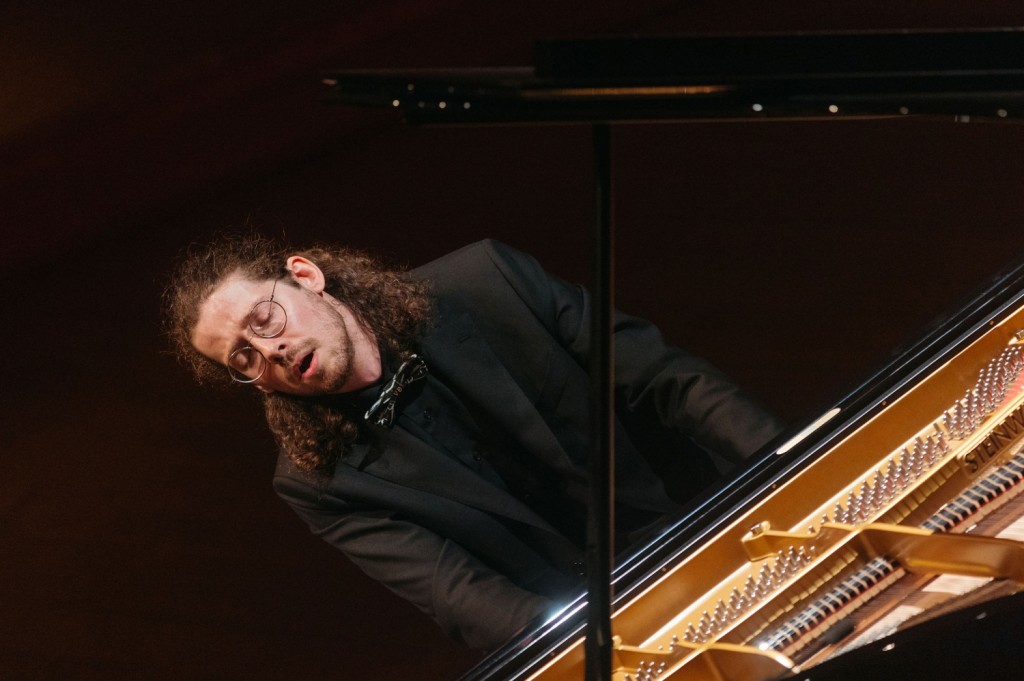
Saturday May 31, 2025, Bozar… I can still hear Gilles Ledure saying it: "Third Prize, Prix du comte de Launoit, Count de Launoit Prize, Valère Burnon". And there he walked, neatly dressed in blue, hair loose, past the jury table. An extra hug from Anna Vinnitskaja and a warm embrace with Jean-Claude Vanden Eynden were no accident or mere formality.
When the 8-year-old boy from Marche-en-Famenne saw Vinnitskaja win First Prize, he knew it: "One day I will compete in this Competition". And when he became Artist in Residence in 2022 at the prestigious Music Chapel in Waterloo, he ended up in the class of Frank Braley, Avedis Kouyoumdjan and, indeed, Vanden Eynden. He came third in 1964. Burnon also came third, with thunderous applause, a standing ovation, royal greetings plus the Public Prizes from Klara and Musiq3.
For me, that first Friday of June 2026 was the third time I saw him, after a concert at Bozar with the Grand Concert Band of the Royal Music Chapel of the Guides conducted by Yves Segers and after a pleasant piano recital at the home of Mia Vleminckx (+) – Bogaert in Schiplaken. For the Festival der Voorkempen at De Werf 44 in Schilde, he performed Fauré, Nocturne 6, opus 63, as he did during his first round at Flagey, Liszt, Rachmaninov but also Szymanowski.
Fresh Perspective
That's also typical of Burnon: his drive for innovation. Although both are Polish and only separated by a generation in age, the musical language of Karol Szymanowski (1882-1937) is quite different from that of Chopin. Szymanowski doesn't shy away from dissonant harmonies and thus approaches Scriabin. Lyrical passages and recognizable motifs and rhythms alternate with robust sounds, typical of the folk music of the Tatra Mountains. From the 'Twenty Mazurkas opus 59' Valère Burnon chose four and thus conveyed the somewhat mysterious atmosphere of the region around Zakopane, where Szymanowski lived in a wooden house that is now a museum.
The choice of 'Thirteen Preludes opus 32' by Sergei Rachmaninov (1873-1943) is a step in his continuous quest for lyricism and expression. While 'Rach 3' may have earned Burnon a fine place in the rankings, the overwhelming charm of this Concerto is worlds away from the unpredictable melody of the Preludes. And yes, there are 'déjà vu, déjà entendu' numbers, such as the dreamy Moderato in G, no. 5 or the Vivo, 8, which Valère presented as an encore. His second CD testifies to the same youthful drive for innovation, leading from Debussy and Prokofiev 8 to the avant-garde of Sergei Protopopov, whom he encountered during a Masterclass in Russia.
Were there no 'wow' moments then? Certainly, there was the second Ballade by Franz Liszt (1811-1886) and the most beautiful Nocturne by Frédéric Chopin (1810-1849) one can imagine. Under Burnon's supple fingers, opus 27,2 became an expansive tale of tenderness, surrender, ecstasy and pianistic freedom. For some perhaps a bit much, for me a revelation. No, we haven't heard the last from Valère Burnon!