Second Semi-final Day – Afternoon
We listened to the same Concert in C Major Op. 4 by Anton Kraft that the Orchestre Royal de Chambre de Wallonie performs each time with the same enthusiasm and professionalism under the baton of conductor Vahan Mardirossian, who enthusiastically supports all candidates. After the intermission, two recitals followed.
program
Anton Kraft (1749-1820) – Concerto in C Op. 4
Royal Chamber Orchestra of Wallonia, dir.Vahan Mardirossian
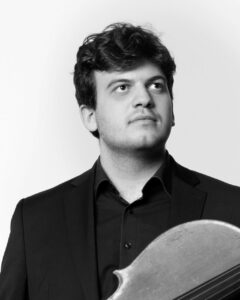
He demonstrates considerable stage presence and performs with passion in the Anton Kraft Concerto, with an opening movement – I Allegro aperto – executed in classical form of the highest order, interwoven with virtuosic passages that are brilliantly approached and executed. In the II. Romance-Andante, the lyrical voice of the cello is further explored and his skill in handling technical difficulties is particularly evident in the III. Rondo (Alla Cosacca), with more dynamic movement, varied textures, frequent double stops, glissandi and all cello bowing techniques.
program
Anton Kraft (1749-1820) – Concerto in C Op. 4
Royal Chamber Orchestra of Wallonia, dir.Vahan Mardirossian
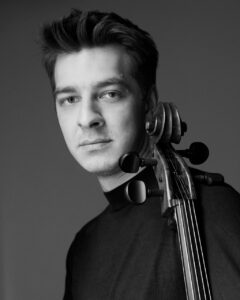
He displays considerable determination in his performance of the Anton Kraft Concerto. With his impressive stage presence, calm and composed, he appears to overcome all the challenges of the competition program with ease. His musical style clearly shows that from an early age he grew up in a rich musical environment that provided him with every opportunity. The quality of the instrument made an important contribution to the overall performance.
We learned that he began music lessons at age three, that he previously played on a Vuillaume cello, and that he now owns an instrument built by the Cremonese master Nicola Bergonzi.
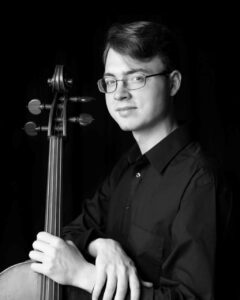
Henri Dutilleux – Trois Strophes sur le nom de Sacher
Harold Noben – Caffeine
Francis Poulenc – Sonata for Cello and Piano FP 143
Thomas Hoppe, piano accompanist
His interpretation bears witness to a subtlety born from experience in diverse cultural contexts, filtered through reflection on the musical repertoire. The depth and character of the instrument shine through in the chromatic passages. Excellent balance and control in the bowing, masterful sense of timing and technique, impeccable intonation, fluidity and versatility.
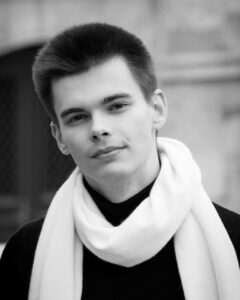
Frédéric Chopin – Introduction et Polonaise brillante in C op. 3
Robert Schumann – 5 Pieces in Folk Style op. 102
Harold Noben – Caffeine
Sarah Zajtmann, piano accompanist
Tuesday, May 12, 2026 – Studio 4 (Flagey) – 20:00
Although he meets the competition requirements, he transcends all established boundaries. He possesses an extraordinary wealth of inner talent and strength, giving the impression that he and his cello know no limits. As a born musician, he seems to come directly from the world of brilliant tonal colors, to which he gives voice. Is he a phenomenon? We must refrain from passing judgment, but it is sometimes difficult to wait for the jury's decision.