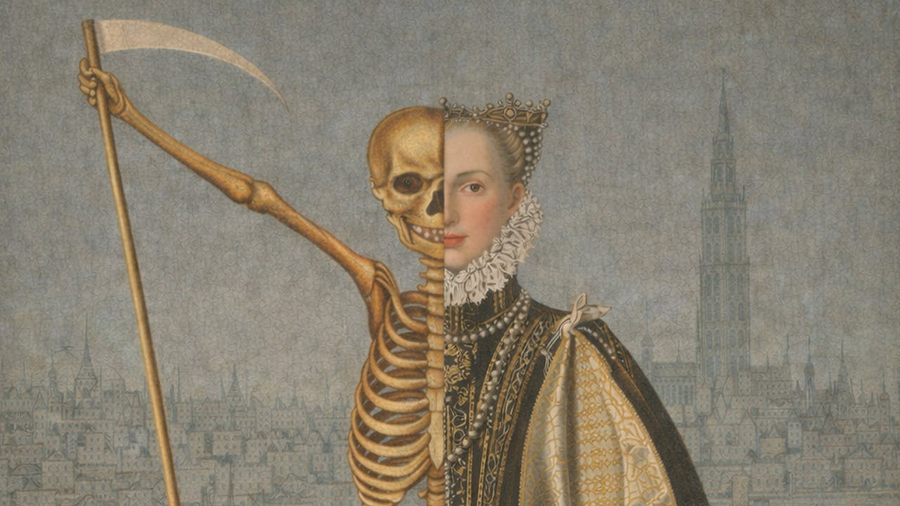
It's rare to find a concert program that is both musicologically sophisticated and seamlessly integrated with the acoustic space in which it resonates. With Mors et Vita the choir Melpomene, conducted by Jan Melaerts, delivered a poignant homage to sixteenth-century polyphony in the Sint-Bartholomeuskerk in Merksem. On Saturday, May 9th, the boundaries between Iberian expression and Flemish contrapuntal refinement dissolved organically. At the center stood Pedro Rimonte (1565-1627), the Spanish chapel master whose masses were published in Antwerp by Phalesius – a fine example of how music traveled freely across Europe in that era and how styles blended effortlessly.
Anyone who attends a Melpomene concert knows that there is always more on the program than a mere performance. Melaerts searches with audible passion for forgotten repertoire and hidden gems that are rarely heard live anymore. His ensemble – a tight-knit group of singers, many of whom have performed together for years – throws itself with great dedication at this music each time, and precisely that combination of musicological insight and visible engagement gave this evening its special intensity.
The opening with Parce mihi, Domine by Pedro de Cristo (ca. 1540-1618) immediately set the right atmosphere. The restrained eight-voice work was rendered with serenity and transparency, and it worked almost as a musical transition from the day's bustle to a state of stillness. The modest supplication from the Book of Job took on a distinctly human quality: no grand drama, but a restrained, almost fragile form of sorrow. The voices entered with precision, with an almost ascetic purity of intonation, while the long phrases maintained their tension effortlessly.
This was followed by the complete performance of the Missa pro defunctis by Pedro Rimonte. On paper, a requiem in May might seem like an odd choice, but this music breathes anything but sorrow. Rimonte composed no requiem full of threat and darkness, but a mass for the dead in which warmth and consolation prevail. The performance emphasized that remarkable vitality, with a choral sound that constantly breathed and moved. The fact that the concert was bathed in the last evening light further strengthened the sense that this music radiates comfort and brilliance rather than heaviness.
The choral sound remained homogeneous across all voice groups. Melaerts opted for dynamic arcs rather than pronounced contrasts, which served the liturgical gravity of the work well. Noteworthy again was the role of the Melisma Gamba-Consort, which supported the vocal lines with a warm, almost organ-like sonority. The instruments breathed in sync with the choir and functioned not merely as accompaniment, but as an extension of the polyphonic texture.
After the requiem, a drum suddenly struck, after which an instrumental intermezzo with the gambas subtly shifted the atmosphere. It formed an ideal preparation for the following In Paradisum from the Missa pro defunctis by Juan Esquivel de Barahona (ca. 1560-1626), which was performed with particular poignancy by choir and instrumentalists. Where Rimonte's mass was still marked by farewell, here a musical gateway to paradise seemed to truly open. Particularly striking was the transparency of the upper voices: gently sustained and almost floating above the harmonic foundation. Hopefully Melpomene will bring this mass for the dead in its entirety another time, because this left us wanting more.
After the intermission, the perspective shifted from death to resurrection and light, with a series of Marian antiphons and motets – a logical choice for the month of May, though the combination with the funeral liturgy from the first part initially presented a surprising programmatic leap. Yet the transition proved thematically coherent: Mary as "advocata nostra," as mediator between earth and heaven.
The motet O quam fulges in aetheris by Jean Mouton (ca. 1459-1522) sounded polished and clearly structured, though it remained compositionally rather academic and emotionally somewhat distant. After the Gregorian chant sung by the male voices Queen of Heaven followed by a polyphonic setting by Diego Ortiz (ca. 1500-ca. 1570), performed by seven soloists and accompanied by the viol consort. Here a compelling arc of tension unfolded: from the austere Gregorian contours, the music grew toward a more rhythmic and almost dance-like vitality, as if the restraint of the concert's opening gave way to light and movement. The charming delicacy of the work moreover sparked curiosity for more of this composer's repertoire. In the performance, the solo ensemble did feel somewhat more vulnerable here; a doubled voice part might have lent even more resonance and stability.
The absolute highlight of the evening came with the monumental twelve-voice Queen of Heaven by Nicolaas Gombert (ca. 1500-1556). By then the sunlight had vanished, but the music itself began to shine. Gombert's polyphony unfolds like a richly woven tapestry without clear beginning or endpoints, in which voices continually flow into one another. Here Melpomene proved its maturity: despite the complex weave, everything remained remarkably transparent. The careful placement of the singers in the space allowed the antiphonal effects to shine beautifully without voices ever overwhelming each other.
Melaerts led his ensemble, as always, with a restrained, refined direction. His gestures are economical yet highly functional: entries remain clear, breathing moments natural, and the text treatment reveals a deep understanding of Latin prosody. His years of experience translate into an ensemble that not only sings with technical reliability but also responds flexibly to space and acoustics.
But Melaerts wouldn't be Melaerts without one more unexpected turn at the finale. With The Green Valley Lass by Juan Vásquez (ca. 1500-ca. 1560), the evening received a playful, almost theatrical closer. Trombone, recorder, four soloists and a visibly delighted choir suddenly brought color and movement after all the contemplation. Life, as it were, stepped back in. The choir showed a completely different sound here: lighter, more rhythmic and almost dance-like.
With Mors et Vita confirmed once again that Melpomene Renaissance music need not be museum repertoire, but remains living heritage when performed with knowledge, imagination, and audible devotion. Thanks to Melaerts and his engaged singers, the audience discovered once more works that are rarely heard, but which undoubtedly deserve to be heard on an ongoing basis.