You need guts to program such major repertoire as enthusiasts, albeit with the support of a few professionals. Beethoven's 5th Symphony is a demanding heavyweight, and the rarely performed Stabat Mater by Francis Poulenc is so grand yet simultaneously fragile and intimate that it might demand even more than the Fifth.
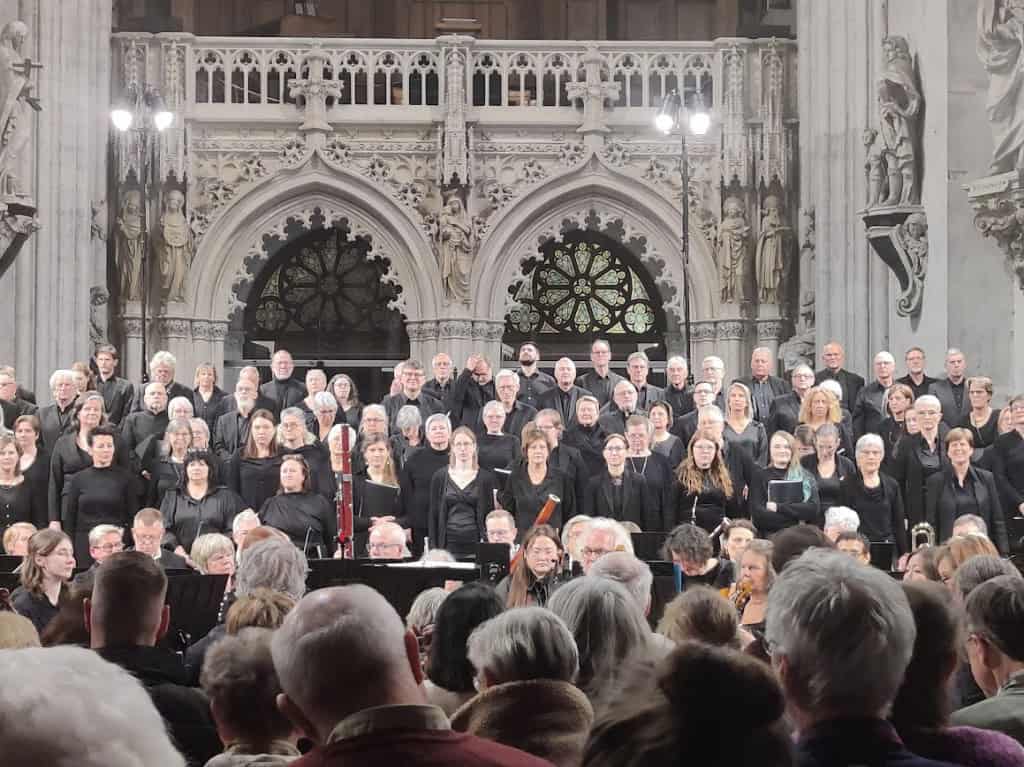
All that hay of these genuine masterworks was pitched by the Flemish-Brabant Symphony Orchestra, the mixed choir Omnia Cantica and the choir Salvocalee, soprano Noa Vanden Broucke, under the baton of conductors Rik Ghesquière and Wouter Versavel. Personally, I find it rather difficult that enthusiasts, however dedicated they may be, take on such demanding pieces. The risks are extremely high, even for seasoned professionals, so it's more than bold to perform not just one, but two works of and for the ages. And yet...
The concert opened rather cautiously with a broadly spun 'Introduzione' from Beethoven's 'Christus am Ölberge'. Don't rush the pianist, but do give him a tip: with two heavyweights on the program, a shorter introduction really isn't necessary. But still, the work sounded reasonably well in that large, high cathedral, though somewhat woolly. What would that be like with the Fifth of the five symphonies? Mechelen Cathedral isn't really suited for this repertoire. Any orchestra bringing symphonic work there plays with great difficulty, hoping to achieve enough articulation. Conductors and soloists sometimes really go the distance, but the result remains, especially from the middle toward the back of the church, too much of a turbulent play of sounds not fully coming into their own, everything blending into an unclear mush. Mechelen lacks a proper concert hall.
It proved once again, as it has done for 250 and more years, that the cathedral is indeed very suitable for choral music and smaller musical ensembles, but not for a large Romantic orchestra. Too bad for a city that is one of Flanders' five cultural cities but has no proper hall. Judging a performance on its quality is and remains difficult, and this time was no different with Beethoven V. This was possible with Poulenc's fragile Stabat Mater. A very beautiful, intimate, tear-inducing work about the Suffering Mother—whether it's the mother of Jesus watching her son die on the cross, or any mother anywhere in the world who must let go of a child, small or even grown. The pain is always there, and it's always different for a mother who gave that child life. Poulenc knows how to capture it, profoundly even. The orchestra, now in a smaller instrumentation, came into its own better, and the choirs performed at a sound middling level, which for amateurs is almost a maximum. A regrettable disappointment was soprano Noa Vanden Broucke, whose voice is truly inadequate for this demanding work, which requires a full, experienced operatic voice. Know your place in the musical world and bring what suits your instrument—in this case, the voice. There is so much possibility...
A mixed feeling was the result: great respect for the performance of the enthusiasts who pulled it off anyway, but unfortunate about the concert venue where too many details were lost in the high vaults. Mechelen, you know what to do: get that proper concert hall...