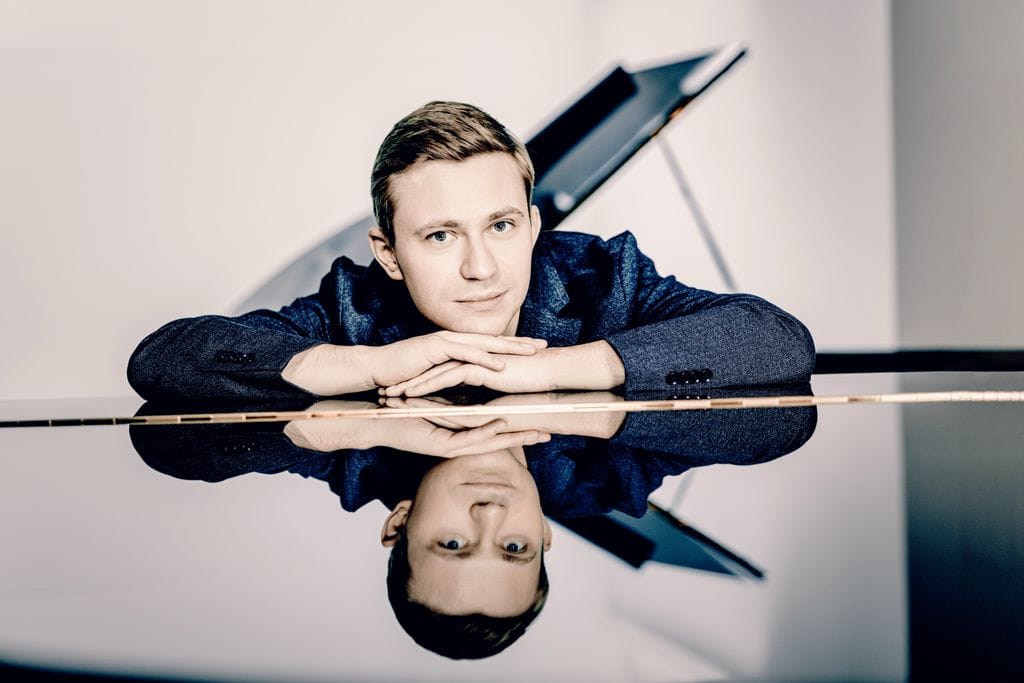
Ahead of his recital on Saturday, February 14th during the "Flagey Piano Days 2026" festival (,), in which he will present a program of miniatures by Debussy, Mendelssohn, Brahms and Lysenko, we speak with Dmytro Choni about his piano playing. About the technique he masters in order to let go again, about the tone color he seeks, and about the way he strings miniatures together into personal cycles. A conversation about presence, risk, and the freedom that emerges when music is allowed to unfold itself.https://www.flagey.be/en/activity/12726-dmytro-choniTechnique, Sound and Playing Style
When you hear Dmytro Choni play, you don't hear a pianist showing off his technique. For him, technique is never an end in itself, but a means: it opens the door to freedom, to the speaking of music, and only leads to meaning when it is completely in service of the music. He seeks a subtle balance, in which no single element of his playing dominates, but everything comes together into an organic whole. Piano playing is for Choni a complex interplay of concentration, physical coordination and mental presence. On stage, that mastery should not be rigid; the music must be able to breathe, to unfold in the moment itself.
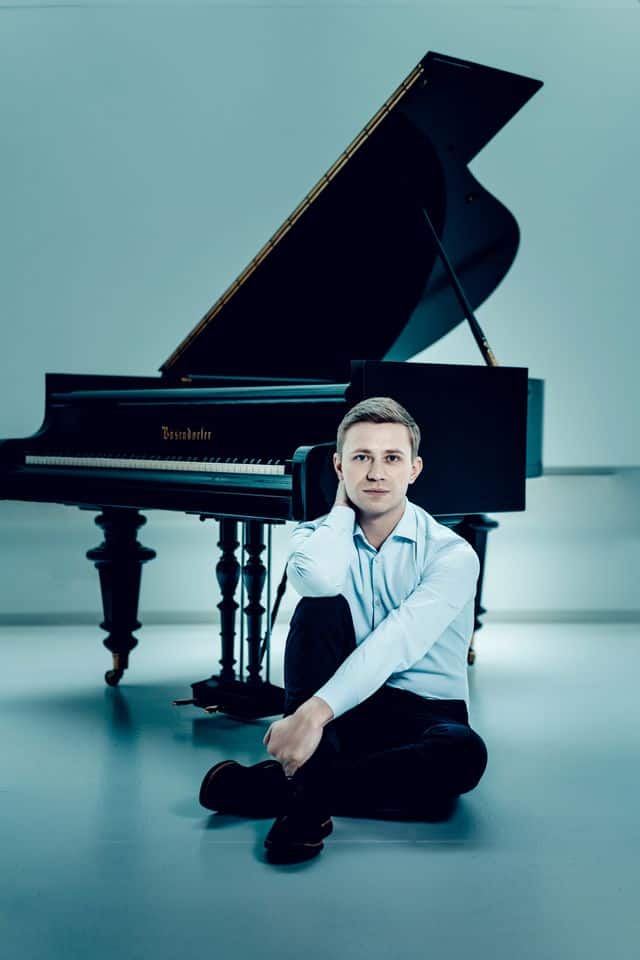 He compares this process to painting: studies and sketches lead to the canvas, in his case the live performance, a unique moment that can never be repeated. Color plays a central role in this. His sound emerges from the interplay between consciousness and intuition, between space, instrument and inner state of mind. Before he strikes a note, he attunes himself to the hall, himself and the audience, so that tone color emerges as a direct interaction of environment and inner emotion.
For Choni, music speaks where words fall short; some thoughts and feelings exist only in sound. In this way, a playing style emerges that is both controlled and spontaneous, in which the moment itself determines the decisive direction.
Miniatures, Cycles and Ukrainian Music
Choni continues the principle of balance and freedom in his choice of miniatures. For his recital, he deliberately chose short forms:
by Claude Debussy (1862-1918), Preludes by Felix Mendelssohn (1809-1847), late piano pieces by Johannes Brahms (1833-1897). Miniatures concentrate musical ideas; everything must be expressed in a short time. Small, concentrated, but no less powerful than large-scale works. Songs Without Words Choni often assembles personal mini-cycles. Pieces are placed in dialogue – through keys, character contrasts, or continuous sounds that flow from one piece to the next. He sees these miniatures as complete worlds unto themselves, and the order of pieces is flexible, allowing him to continuously experiment with structure and narrative. This creates cycles that can be rearranged again and again, depending on what moves him most at any given moment. Debussy, Brahms, Mendelssohn and Lysenko: at first glance disparate composers, but Choni seeks connection. Contrast is not the goal; inner continuity is.
The recital ends with
The recital concludes with Dumka–Shumka by Mykola Lysenko (1842-1912), in which introspection gives way to energetic, folkloric character. The first part, Dumka, is meditative and evokes the world of Ukrainian kobzars (wandering troubadours); the second part, Shumka, bursts forth with lively dance energy. Lysenko imitates folk music instruments and connects his compositions with the European Romantic tradition, making the work both authentic and internationally significant.
Born in Kyiv, Choni carries his Ukrainian heritage with him naturally. For him, Ukrainian music is no mere curiosity, but a fully-fledged voice deserving greater international recognition. The repertoire is simultaneously personal memory and cultural responsibility: he brings it to life in his own voice. Lysenko's music holds special meaning for him; he played his miniatures as a teenager and returns to them now with renewed insight and appreciation.
Risk, freedom, and audience
 On stage, Choni seeks not perfect reproduction, but open space. Every performance carries risk. Sometimes things unfold differently than planned—and it is precisely then that something can emerge that didn't exist in rehearsal. Unforeseen moments often offer new interpretations and spontaneous expressions that keep the performance alive. Virtuosity must never take center stage; ideally, the listener forgets that technique exists at all. For Choni, the essence of artistic freedom lies in vulnerability and the unexpected.
In a recital of short pieces, tension is fragile. Choni builds it not through grand narratives, but through attention: to transitions, to silences, to the delicate moments between two sounds. These silences are not practical interruptions, but an essential dramaturgical element that connects music and strengthens the concentration of both audience and performer.
For Choni, the audience is no passive receiver, but a partner. He feels differences between halls, countries, and listening cultures. Yet his goal remains the same everywhere: an active, empathetic dialogue, a shared journey in which interpretation becomes a living exchange. After such concerts, the space seems changed, and when the final note has faded, what lingers is not only the music, but also a subtle shift in the way of listening—a silence that resonates in both the performer and the audience.
The afterglow of music
And yet it doesn't end on the stage. For Choni, the freedom of music extends beyond the final note. It continues to resonate, in himself and in the audience, as a quiet shift in the way one listens. It is the echo of risky moments, of spontaneous interpretation, and of the mutual presence of the audience, that transforms the experience into something that reaches beyond technique and form. In this way, music opens, again and again, a space where listener and performer meet, and where the freedom that Choni seeks finally becomes tangible.