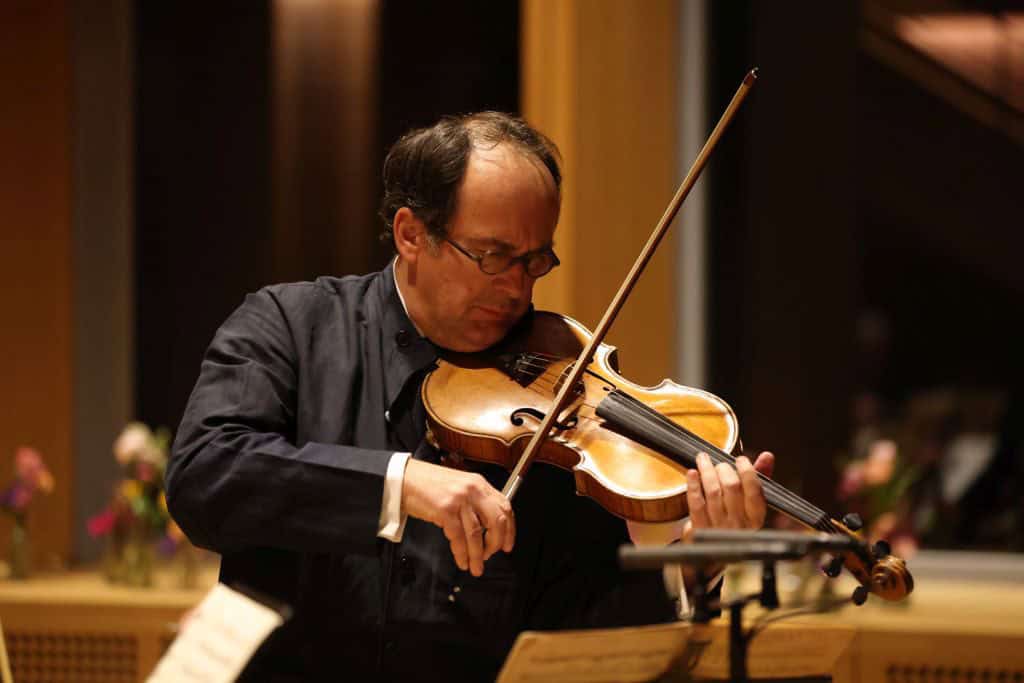
Miguel da Silva lives in music the way a bird finds its element, the way water finds its path through the landscape. He breathes it in, lets it flow through his fingers, and sees it reflected in every silence, in every breath of the moment.
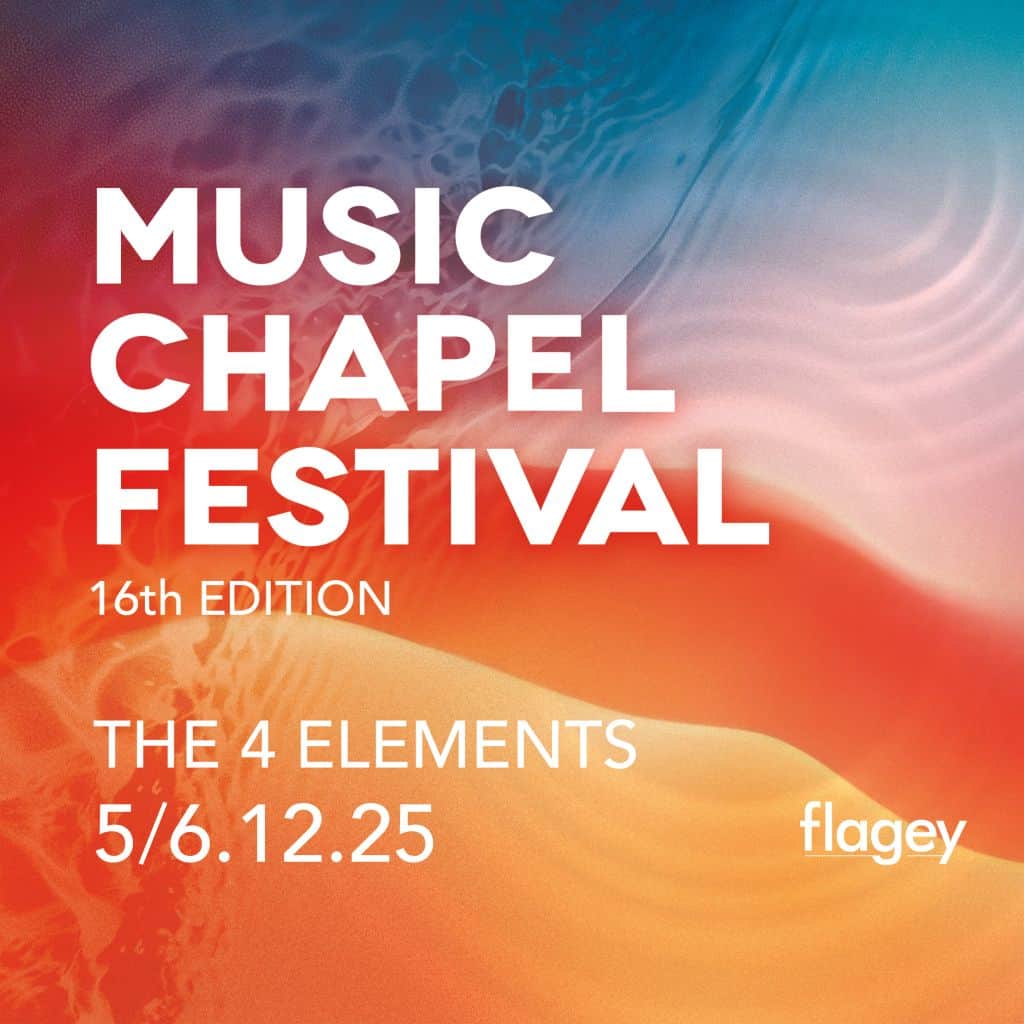
Every performance is a conversation: a whisper between him, the notes, and the listener; a journey that unfolds in tones, in breath, in the unspeakable that only music can capture. His approach combines technical virtuosity, intellectual sharpness, and emotional depth, transforming every performance into a dialogue between musician, music, and audience. His playing is a tapestry of technique, intellect, and passion. He lets the viola speak as if it were an extension of the soul, a voice that sounds both ancient and new. And alongside this virtuosity stands the pedagogue, the mentor who passes on the spark of experience, who invites young generations to discover their own universe. This pedagogical dimension runs through his career as a constant thread, wherein he shares his experience and artistic vision with younger generations. He spoke with Klassiek Centraal about these themes in connection with his performance on Saturday, December 6th as part of the Music Chapel Festival at Flagey.
The Quiet Awakening
An artist's formation is often a silent revolution. For da Silva, it began after his adolescence, when he noticed that many of his friends lived "with a rather limited imagination." For him, music offered an escape, a world of his own, a refuge. He speaks with quiet certainty: "It was a world of mine. I was a fairly introverted and shy boy, and music threw me a lifeline." Today, that core of his identity remains unchanged: music as a personal world, and at the same time a bridge to others. That world endures, a space where sound and emotion merge, where every note opens a window to the other. Music was there, inevitable and faithful, in loss and sorrow, in moments of doubt: "Music was always there to offer a horizon of hope." In the loss of his parents or loved ones, in emotional turmoil, music consistently offered him solace and support.
Values and Interpretation
Da Silva's interpretations echo loyalty and freedom. He believes that a successful performance can change a listener's life, that a note can be more than a sound, that a silence can say more than words ever could. "As for my interpretation, my values have always remained the same: to stay as close as possible to the composer's intention," he says, as if it were a mantra, a guide for the heart of every sound. His youth, family, and cultural environment shaped his musical identity, but he also acknowledges that personal freedom often emerges "in contrast to one's surroundings" and in the space that cultural possibilities offer.
Freedom and tradition meet in a delicate dance within him. As a "class defector"—someone who outgrew his social background—he stepped beyond the boundaries of the familiar world to find his own voice in the space of cultural renewal of the 1970s, a voice that carries tradition while reaching beyond the horizon. He finds personal freedom in "the space between the notes and in the power of evocative sound." There, in the emptiness, meaning arises; there music breathes. He sees tradition as a foundation, but freedom and expression emerge in the space between the notes and in evocative sound.
Comfort and Horizon
Music is a lifeline, a horizon stretching across sorrow and doubt. Every melody carries comfort, every cadence a promise of light. In those moments, the viola becomes more than an instrument for him: it becomes a companion, a guide, a silent witness to human existence. Yet that lyricism remains forever rooted in a concrete human story: music as a trustworthy companion, not as an abstract ideal.
Challenges and Repertoire
His experience with the Ysaÿe Quartet brought him face to face with Beethoven, a "musical Everest" that must be climbed anew each time, with every performance opening new paths and revealing new heights. For the upcoming festival, he performs Mozart and Schoenberg with his students—two worlds meeting in sound and emotion. He explains: "In Mozart's K. 516, a quintet with two violas, you hear the full drama of his operas. Schoenberg's Verklärte Nacht, on the other hand, offers a sublime conclusion to the German Romantic repertoire, a perfect endpoint before his leap toward the serial system. The viola stands at the intersection of theme, harmony, and dialogue in this work, suggesting all possible musical situations."
Music as breath, as truth
For Miguel da Silva, music is more than virtuosity; it is breath, humanity, the invisible made audible. His approach unites thinking, feeling, and concentration in a single breath, a single sound. As a performer and pedagogue, he embodies a rare attention: for the human behind the note, for the silence in which meaning emerges. He shows that music encompasses listening, reflection, and humanity, and that a successful performance can transform the lives of its listeners.
In his playing and teaching, he seeks the essence of communication: where sound is not merely form, but truth. This quest runs through the thread of his artistry. And in that truth, in that breath of music, both he and his listeners find a world that belongs to them and yet to everyone, a world that breathes, resonates, and never ceases to exist.
Saturday, December 6, 6:30 p.m. in Wolfgang Amadeus Mozart's (1756-1791) "String Quintet K. 516" with the Quatuor Goldberg and in Arnold Schoenberg's (1874-1951) "Verklärte Nacht".
See also https://klassiek-centraal.be/music-chapel-festival-2025-de-vier-elementen-in-klank-en-geest/