


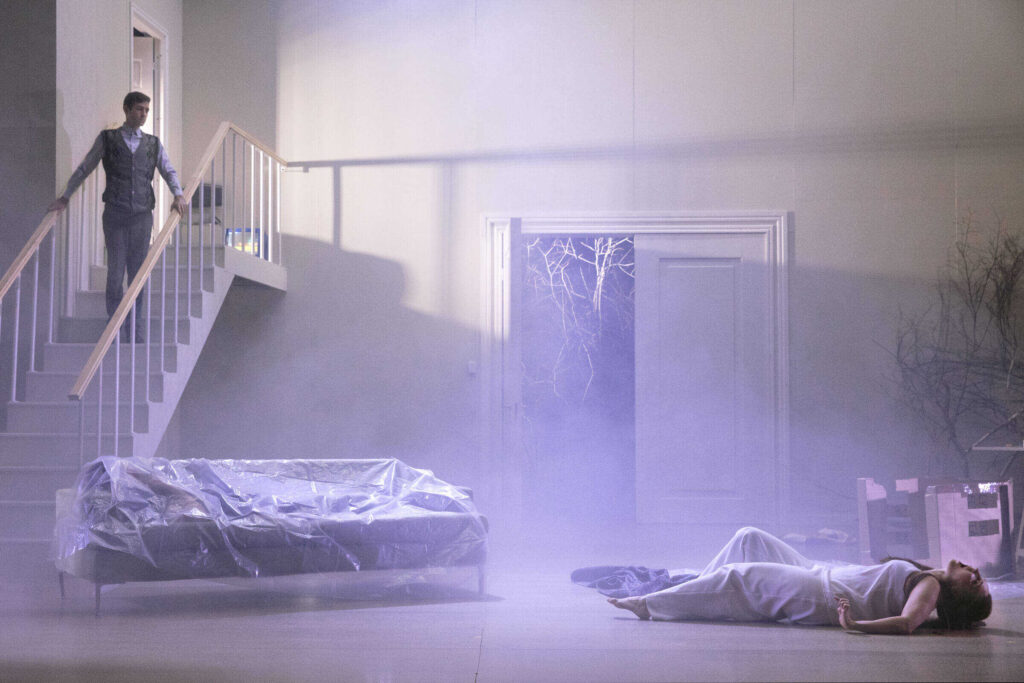
Annelies Van Parys' chamber opera Usher (2018) is a psychological thriller that lingers in the mind. Based on Claude Debussy's unfinished operatic vision, this production was created in collaboration with screenwriter Gaea Schoeters and director Philippe Quesne, focusing on a psychological power game with social dimensions.
The production received its first performance on a Belgian stage. It is a joint project by Opera Ballet Vlaanderen, Staatsoper Unter den Linden in Berlin, and Folkoperan in Stockholm, in collaboration with Muziektheater Transparant and Nanterre-Amandiers centre dramatique national. Under the direction of conductor Marit Strindlund, the performance builds from unease into a scenario of madness. The audience is thus directly drawn into the downfall of the House of Usher.
The Red Thread of Timbral Colors
Usher has a rich history. It is based on the work The Fall of the House of Usher by Edgar Allan Poe. French composer Claude Debussy (1862-1918) drew inspiration from it for his unfinished opera The Fall of the House of Usher (1908-1917).
Debussy's impressionism and the spectralism of Annelies Van Parys (b.1975) are each the unique result of the composer's search for their own color language in music. Van Parys is known for her treatment of sound "in itself." Through this, she creates a sonic world based on timbre and tonal color. Debussy sought his own poetic language through harmony and orchestration.
Both composers have developed a sound expression that searches for color and emotional resonance. It is therefore hardly surprising that Van Parys would complete Debussy's Usher vision with her own musical language. The result is a fusion of tones where it sometimes becomes difficult to discern where Debussy begins and Van Parys ends.
Power Play Between Madness and Reality
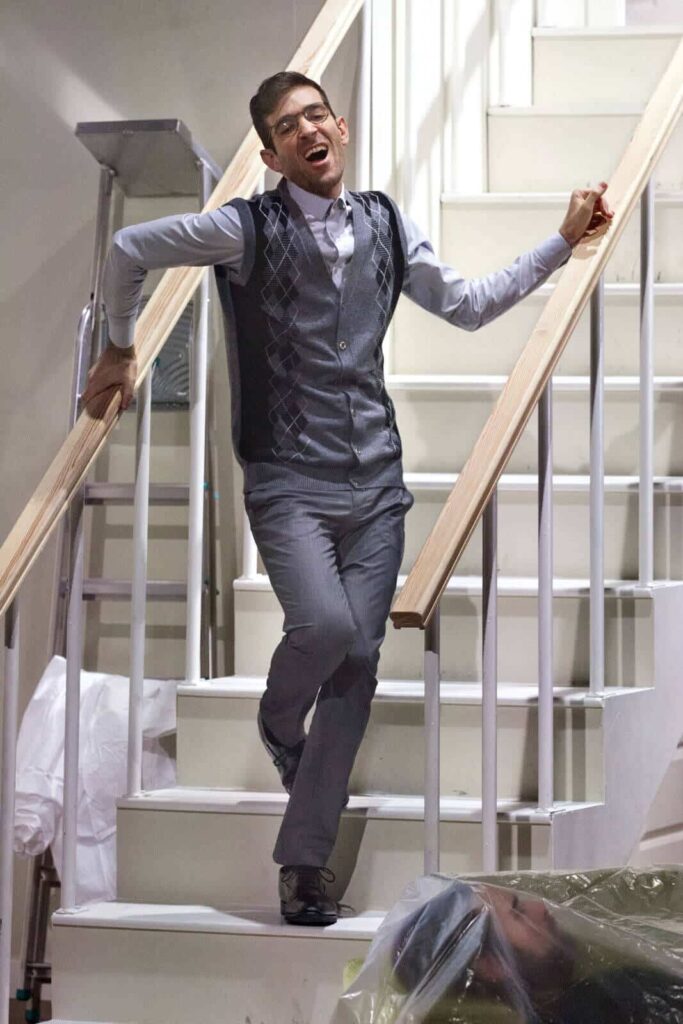
In {{NOTRANSLATE_1}}, there is always a mix of reality and illusion that are intertwined. Hoffmann the poet (tenor Arturo Chacón-Cruz) is the central player. His object of affection? The soprano Stella (soprano Jessica Pratt) in all her forms: Olympia, Antonia and Giulietta. Her opponent? Art in living form: La Muse (mezzo-soprano Julie Bulianne), disguised as Nicklausse. The antagonist is Lindorf (bass-baritone Erwin Schrott), translated into various figures (Spalanzani/Miracle/Dapertutto), but always in the same role. These four form the core that sets the game in motion and ultimately concludes it. Usher reality and the absurd merge into one another. The staging is surrealist cinema reminiscent of filmmaker David Lynch's style (Twin Peaks"). A space filled with television screens showing the crumbling reality of the house. Brilliant white walls on which Lady Madeline (soprano Alexandra Büchel) – the twin sister of Roderick Usher (baritone Ivan Thirion) – serenely paints over with blood-red hands. From the beginning, it's clear that something is amiss. Everything is chaos in the House of Usher.
A rare voice of reason is L'ami (baritone Martin Gerke). He stands in stark contrast to the manipulative doctor (Le Médecin, played by tenor Daniel Arnaldos). The doctor uses the mental state of Roderick and his sister as a perverse socio-political experiment. What unfolds during the opera is a descent into madness, which is heralded as an omen by both Ushers.
Timbral colors and musical resurrections
Musically, the line between Van Parys and Debussy is razor-thin. As the story unravels, Debussy's ethereal impressionism seems to drift further away. In its place emerge floating, spectralist sound segments. These are most audible in Roderick's rising madness, triggered by the sudden death of his sister – according to the doctor, the result of the weak-willed House of Usher. The result is a sonic palette where Debussy and Van Parys sometimes alternate, and then flow into each other.
Beyond that, there are some striking tableaux: the lilies – the symbol of innocence – in the hands of the deceased Lady Madeline, the invisible spirit chorus, the Gregorian motifs as Roderick speaks of the underground crypt, and the perversely sounding patter song as the doctor reveals his political power play to the audience. Van Parys plays with various motifs. The most striking tableau is Lady Madeline rising from the dead like a deranged Dido. Here she quotes almost verbatim the closing words from Henry Purcell's Dido's Lament.
"Remember me, but ah! forget my fate" sums up beautifully what ultimately remains of the doomed House of Usher: a surreal, painful memory. With this opera, Annelie Van Parys creates a psychological snapshot in which both Debussy and her own musical world come into their own.
- WHAT: Annelies Van Parys: Usher (2018)
- WHO: Opera Ballet Flanders
- WHEN: from February 27, livestream available for two weeks after the premiere
- PRODUCTION: Opera Ballet Vlaanderen (co-production with Staatsoper Unter den Linden, Berlin and Folkoperan, Stockholm) in collaboration with Muziektheater Transparant and Nanterre-Amandiers centre dramatique national, seen February 27, 2021
- PHOTOS: © Annemie Augustijns / Opera Ballet Vlaanderen, © De Tijd