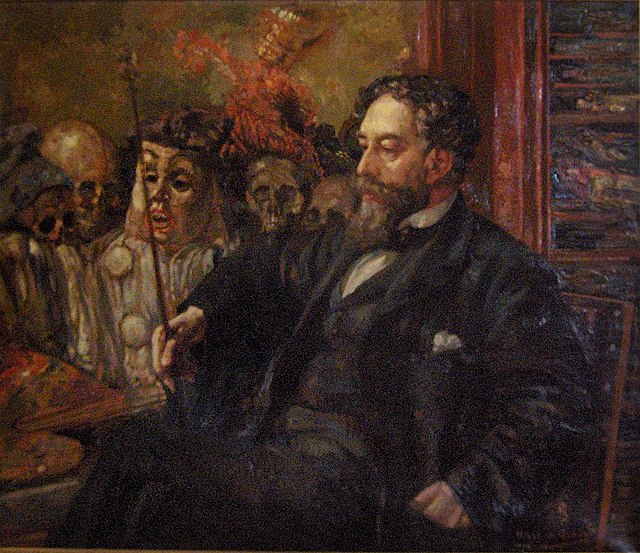
James Ensor, the renowned Belgian artist, is primarily known for his paintings and drawings that explore the boundaries of Surrealism and Expressionism. Yet beyond his groundbreaking work in the visual arts, Ensor was also a gifted composer, albeit a lesser-known one.
Born in 1860 in Ostend, Belgium, James Ensor developed an interest in music from a young age. He received piano lessons and quickly demonstrated remarkable talent for composing his own musical pieces. Although he never received formal training as a composer, Ensor created countless works throughout his lifetime. He improvised at the piano while other musicians, such as Michel Brusselmans and Georges Vriamont, transcribed the notes for him and arranged them for other instruments and/or ensembles.
Ensor's music often displays the same experimental and avant-garde characteristics as his visual art. His compositions explore a range of styles and emotions, ranging from romantic lyricism to dark dissonance. His music frequently reflects his fascination with the grotesque and absurdism, the same themes so prominently featured in his paintings. Ensor's ability to weave emotion and imagination into both visual art and music illustrates the depth of his artistic vision and his ongoing pursuit of innovation across different artistic disciplines.
His six-part pantomime ballet La Gamme d'Amour is perhaps his best-known work. Ensor completed the work in 1911. In addition to the music, he also created the stage designs and costume designs as colored lithographs. In 1917, the work was performed by the Ostend Music Academy. Despite initial failed attempts to stage the ballet in Paris, the premiere of the complete performance finally took place in 1924 at the Royal Flemish Opera in Antwerp, thanks to the efforts of François Franck. This remarkable work was also performed during a retrospective exhibition of Ensor in Brussels in 1920 and at the Royal Theater of Ostend in 1932.
In addition to this pantomime, Ensor also composed several piano works, versions for brass band or harp, and even symphonic works. However, not much of his music has been preserved. This is partly because Ensor himself could not write down his music, but also because he composed much in the moment. His improvisations were part of the entertainment to amuse his guests. Only descriptions from those in his circle remain of his "impressive, hilarious, and terrifying improvisations" preserved.
Although his music is not as widely known as his paintings, it remains an important part of his artistic legacy. Ensor the composer/musician represents one facet of his artistic personality. His compositions offer a fascinating glimpse into the creative mind of one of the most influential artists of the late 19th and early 20th centuries. As a composer, James Ensor remains an intriguing and enigmatic figure whose music invites us to further explore his artistic universe.