

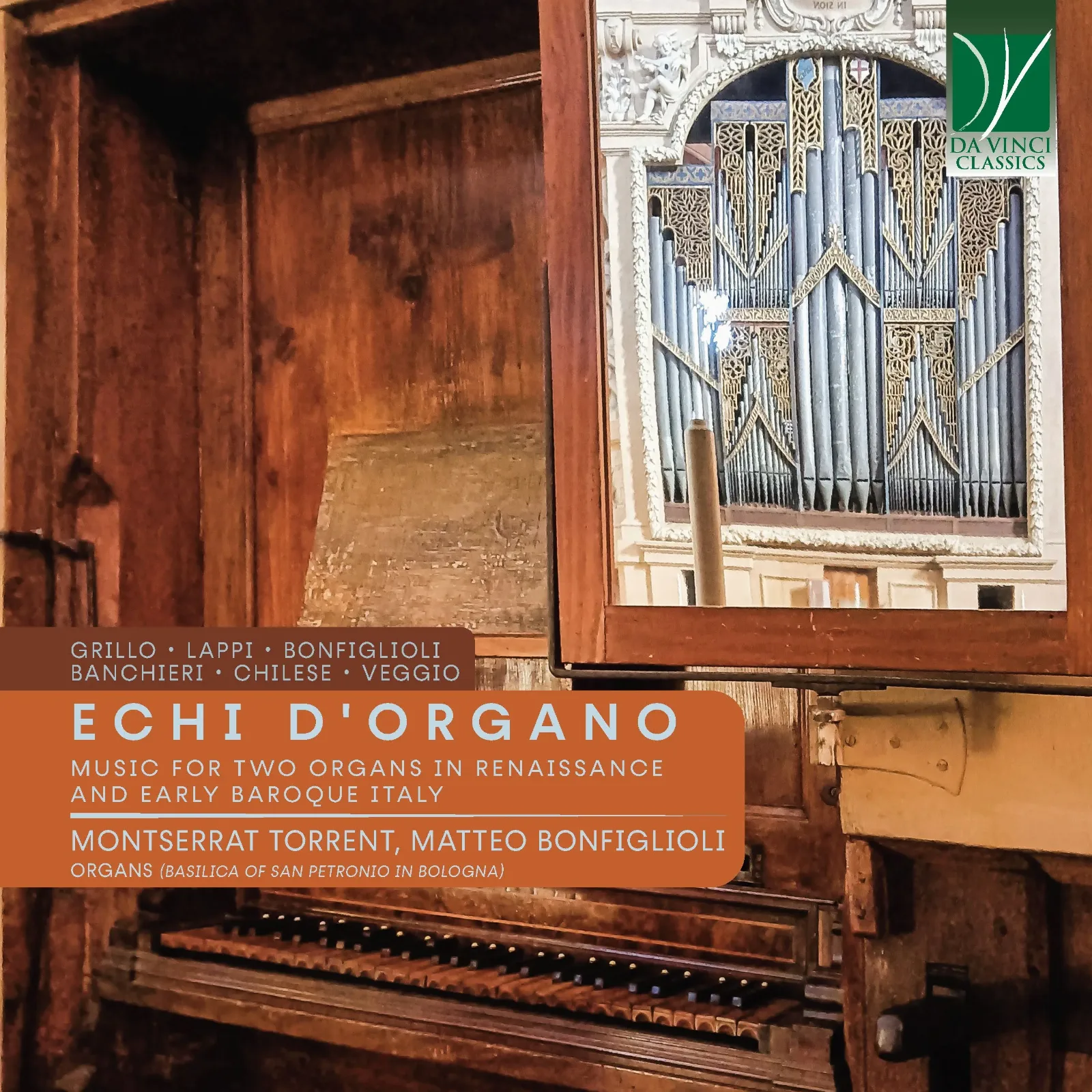
Some CDs start from a repertoire, others from a composer or performer. Echi d'Organo starts from a space. And more precisely still: from two instruments that were placed side by side centuries ago so that they could speak to each other. In the Basilica di San Petronio in Bologna stand the organ of Lorenzo da Prato from 1475 and that of Baldassarre Malamini from 1596. On this CD they are not used merely as historical witnesses, but are once again brought together in music that calls above all for dialogue, answer and echo.
Music that travels through the space
Montserrat Torrent and Matteo Bonfiglioli take us to the sixteenth and early seventeenth century, when two organs increasingly stood side by side in the great Italian churches. The organs could make music together with the various choirs, alternate with them and sometimes also answer from a distance. A specific repertoire for two organs would only emerge later, but this music already reveals the possibilities such an arrangement offered. For a number of pieces the original eight voices were divided between the two organs, so that the music here can literally sound from one side to the other.
The lovely thing is that you almost hear the space making music too. A motif sounds on one organ and receives an answer from the other, sometimes close by, sometimes from a greater distance. The music therefore moves not only in sound, but also through the space.
A lovely appetizer is the Canzon pian e forte a 8 by Giovanni Battista Grillo (?-1622), with which the CD opens. The title refers to the well-known pian e forte principle that Giovanni Gabrieli had already explicitly notated in his Sonata pian e forte some ten years earlier. With Grillo it becomes above all a lively conversation between the two organs. The difference between the two instruments is a real asset here: the fifteenth-century Da Prato organ and the Malamini organ, more than a century younger, remain clearly recognisable and immediately set the tone for the rest of the CD.
The Toccata in Ecco per l'Elevatione, from the archives of the cathedral of Como, has a completely different atmosphere. The piece was originally written for a single organ, but through its division between two instruments it gains an additional dimension. It is a restrained, almost meditative work in which the organs seem to answer each other gently. A pleasant resting point.
Then things turn playful with the anonymous Pavana, Saltarello de la pavana, La Coda, from the manuscripts of Castell'Arquato. The different sections flow together very naturally and are played here as if they were one piece. The transition to the dance-like saltarello is particularly infectious. The light, graceful sound even has something Christmassy about it, which makes this short piece one of the most charming moments of the CD for me.
Canzon XVII 'L'Allé' in Ecco by Pietro Lappi (1575-1630) brings us back to the echo effect. Here too it is not a matter of loud versus soft, but of two organs seeking and answering each other. One instrument introduces a musical idea, the other takes it up and gives it its own colour. You constantly have the impression that both organists listen closely to each other and know exactly when to add something or step back. In this way this atmospheric music is given every opportunity to speak.
From old sources to a new Ave Maria
In the middle of the programme stands a work that does not come from the old sources: Tiento sopra Ave Maria by Matteo Bonfiglioli (b. 1977). It is an interesting addition, because Bonfiglioli does not try to imitate the sixteenth or seventeenth century. He does choose the Iberian tiento form, but works out the Gregorian Ave Maria in his own searching way. The well-known prayer sounds here as if reborn, in an almost timeless atmosphere. The birdsong – provided during the recording by Benedetta Bonfiglioli – is a small but surprising detail and gives the piece something unexpected.
With Dialogo Acuto & Sopra'Acuto by Adriano Banchieri (1568-1634) we return to the early seventeenth-century repertoire. The short piece gains its character through the exchange between the two instruments: a musical idea is introduced, answered and finally brought together in a shared conclusion. Precisely because of this compact form it works as a small dialogue within the larger whole.
With Canzon XXXI 'Risposta dell'Eco' by Bastiano Chilese, included in Raveri's collection of 1608, the echo idea is literally in the title. Here it is not a simple contrast between loud and soft. The answer lies mainly in the space. The two organs react to each other and in doing so come ever closer together. The piece also ends unusually abruptly, so that the music is not neatly rounded off but is, as it were, broken off in the middle of its movement.
That the CD then switches back to a single instrument provides a pleasant change. O gloriosa Domina by Adriaan Willaert, in a keyboard arrangement from the manuscripts of Castell'Arquato, shows how much richness there is to discover in a polyphonic composition when it is transferred to a single organ. The original six voices are of course simplified, but the music loses none of its character. On the contrary: on this organ it acquires a clarity that makes you hear some lines and details differently. I suspect that next time I will listen to Willaert with different ears.
Le morceau techniquement le plus exigeant est la Recercada per B quadro del primo tono de Claudio Veggio (1504/1505-1553/1557). Les gammes rapides et les passages virtuoses se succèdent à vive allure et sont rendus de façon impressionnante par Bonfiglioli. Après les pièces plus retenues précédemment sur le disque, cela apporte une belle dose de vitesse et d'énergie. Le fait que ce passage virtuose soit joué sur le plus ancien des deux orgues le rend d'autant plus remarquable : l'instrument sonne ici étonnamment puissant et vivant.
Le disque se conclut à nouveau par une œuvre de Giovanni Battista Grillo, la Canzon in Ecco a 8. Le programme revient ainsi au principe avec lequel il a commencé : deux instruments, deux positions, une seule idée musicale.
La force de l'interprétation
Montserrat Torrent, qui a fêté son centième anniversaire le 17 avril 2026, apporte à cet enregistrement sa vaste expérience. Elle participe aux six pièces pour deux orgues ; les pièces en solo sont confiées à Bonfiglioli, qui, en tant qu'organiste de San Petronio, connaît bien les instruments et le lieu dans lequel ils résonnent. Je ne pouvais pas toujours distinguer qui jouait sur quel orgue, et c'est peut-être le plus beau compliment pour leur jeu d'ensemble : les instruments restent reconnaissables, mais les deux organistes forment une unité convaincante.
La prise de son elle-même contribue à cette expérience. L'acoustique de l'église est clairement présente, sans que le son ne se noie dans une réverbération excessive. On perçoit les différences entre les instruments ainsi que la distance qui les sépare, tandis que la musique dispose de suffisamment d'espace pour respirer.
Echi d'Organo est un disque auquel je reviens volontiers. À chaque nouvelle écoute, de nouveaux détails se font remarquer : une réponse qui m'avait échappé, une autre couleur sonore ou une légère différence dans la manière dont les deux orgues se répondent.
