

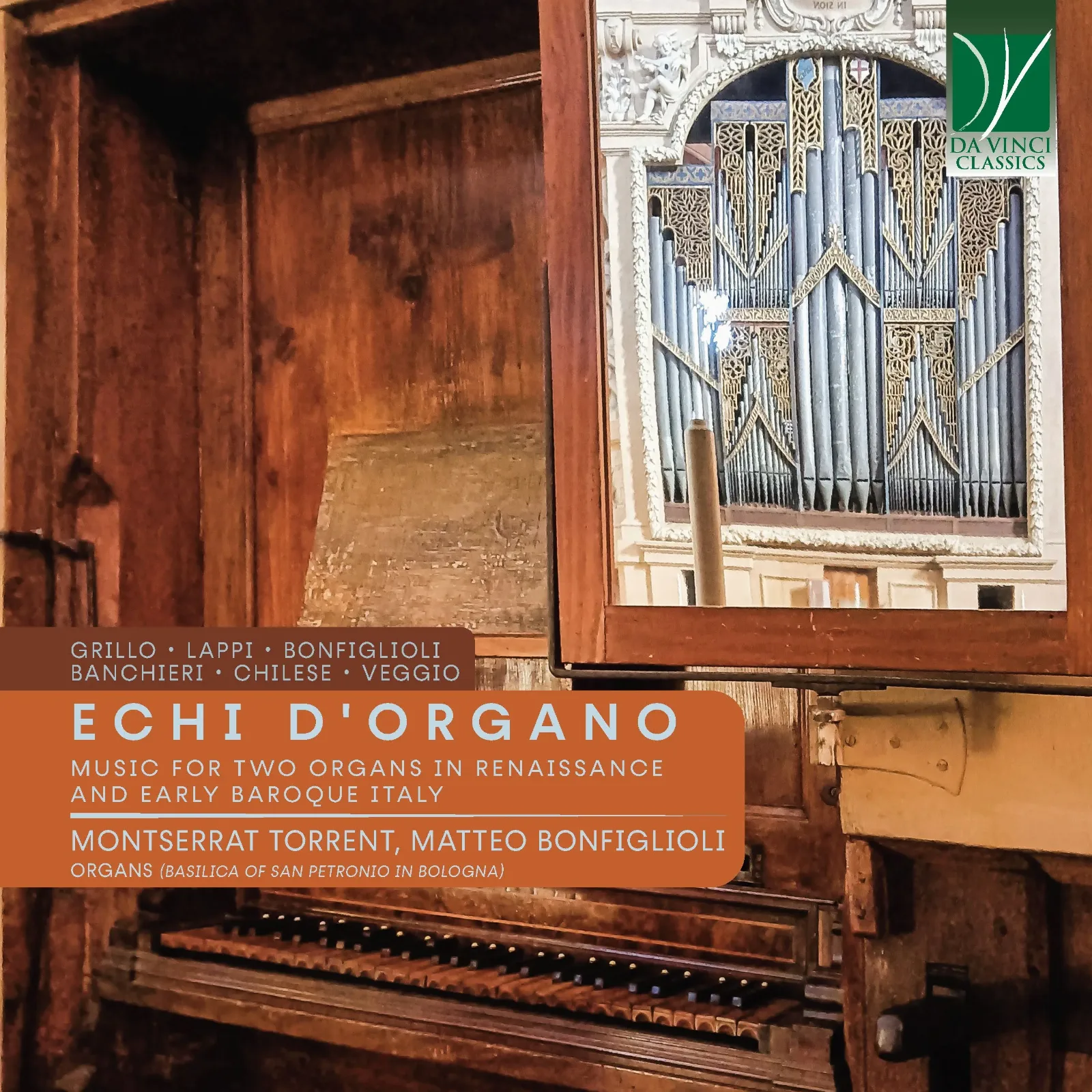
Some CDs start from a repertoire, others from a composer or performer. Echi d'Organo starts from a space. And more precisely still: from two instruments placed next to each other centuries ago so that they could speak to one another. In the Basilica di San Petronio in Bologna stand the organ of Lorenzo da Prato from 1475 and that of Baldassarre Malamini from 1596. On this CD they are not used merely as historical witnesses, but are once again brought together in music that calls above all for dialogue, answer and echo.
Music that travels through the space
Montserrat Torrent and Matteo Bonfiglioli take us to the sixteenth and early seventeenth century, when two organs increasingly stood side by side in the great Italian churches. The organs could play together with the various choirs, alternate with them and sometimes also answer from a distance. A specific repertoire for two organs would only emerge later, but this music already reveals the possibilities such an arrangement offered. For a number of pieces the original eight voices were divided between the two organs, so that the music here can literally sound from one side to the other.
The beauty is that you almost hear the space making music too. A motif sounds on one organ and receives an answer from the other, sometimes close by, sometimes from a greater distance. The music therefore moves not only in sound, but also through the space.
A fine appetiser is the Canzon pian e forte a 8 by Giovanni Battista Grillo (?-1622), with which the CD opens. The title refers to the well-known pian e forte principle that Giovanni Gabrieli had already explicitly notated in his Sonata pian e forte some ten years earlier. With Grillo it becomes above all a lively conversation between the two organs. The difference between the two instruments is a particular asset here: the fifteenth-century Da Prato organ and the Malamini organ, more than a century younger, remain clearly recognisable and immediately set the tone for the rest of the CD.
The Toccata in Ecco per l'Elevatione, from the archives of the cathedral of Como, has a very different mood. The piece was originally written for a single organ, but here the division across two instruments gives it an additional dimension. It is a restrained, almost meditative work, in which the organs seem to answer each other gently. A pleasant resting point.
Then it becomes playful with the anonymous Pavana, Saltarello de la pavana, La Coda, from the manuscripts of Castell'Arquato. The various sections flow very naturally into one another and are played here, as it were, as one piece. Especially the transition to the dance-like saltarello is infectious. The light, graceful sound even has something Christmas-like about it, making this short piece one of the most charming moments of the CD for me.
Canzon XVII 'L'Allé' in Ecco by Pietro Lappi (1575-1630) brings us back to the echo effect. Here too it is not a matter of loud against soft, but of two organs seeking and answering each other. One instrument introduces a musical idea, the other takes it over and gives it its own colour. You constantly have the impression that both organists listen closely to each other and know exactly when to add or step back. In this way this atmospheric music is given every opportunity to speak.
From old sources to a new Ave Maria
At the heart of the programme stands a work that does not come from the old sources: Tiento sopra Ave Maria by Matteo Bonfiglioli (b. 1977). It is an interesting addition, because Bonfiglioli does not try to imitate the sixteenth or seventeenth century. He does choose the Iberian tiento form, but he develops the Gregorian Ave Maria in his own searching way. The familiar prayer sounds here, as it were, reborn, in an almost timeless atmosphere. The birdsong – provided during the recording by Benedetta Bonfiglioli – is a small but surprising detail and gives the piece something unexpected.
With Dialogo Acuto & Sopra'Acuto by Adriano Banchieri (1568-1634) we return to early seventeenth-century repertoire. The short piece gets its character from the exchange between the two instruments: a musical idea is introduced, answered and finally brought together in a shared conclusion. Precisely because of this compact form it works as a small dialogue within the larger whole.
In Canzon XXXI 'Risposta dell'Eco' by Bastiano Chilese, included in Raveri's collection of 1608, the echo idea is literally in the title. Here it is not a simple contrast between loud and soft. The answer lies mainly in the space. The two organs react to each other and in doing so come ever closer together. The piece moreover ends unusually abruptly, so that the music is not neatly rounded off but is, as it were, broken off in the middle of its movement.
That the CD then switches back to a single instrument provides a pleasant contrast. O gloriosa Domina by Adriaan Willaert, in a keyboard arrangement from the Castell'Arquato manuscripts, shows how much richness there is to discover in a polyphonic composition when it is transferred to a single organ. The original six voices are of course simplified, but the music loses nothing of its character. On the contrary: on this organ it gains a clarity that makes you hear some lines and details differently. I suspect that next time I will listen to Willaert with different ears.
The technically most demanding work is Recercada per B quadro del primo tono by Claudio Veggio (1504/1505-1553/1557). The rapid scales and virtuosic passages follow one another at a high tempo and are impressively delivered by Bonfiglioli. After the more restrained pieces earlier on the CD, this brings a solid dose of momentum and energy. That this virtuosic passage is played on the older of the two organs makes it all the more special: the instrument sounds surprisingly powerful and lively here.
The CD closes with another work by Giovanni Battista Grillo, the Canzon in Ecco a 8. In doing so, the programme returns to the principle with which it began: two instruments, two positions, one musical idea.
The strength of the performance
Montserrat Torrent, who celebrated her hundredth birthday on 17 April 2026, brings her enormous experience to this recording. She plays in the six pieces for two organs; the solo pieces are the responsibility of Bonfiglioli, who, as organist of San Petronio, is intimately familiar with the instruments and the space in which they sound. I could not always tell who was playing on which organ, and perhaps that is the finest compliment to their interplay: the instruments remain recognisable, yet the two organists form a convincing unity.
The recording itself contributes to that experience. The acoustic of the church is clearly present, without the sound disappearing into an excess of reverberation. You hear the differences between the instruments and also the distance between them, while the music is given enough room to breathe.
Echi d'Organo is a CD I like to return to. With every new listening, different details stand out: an answer I had previously missed, a different tone colour, or a small difference in the way the two organs respond to one another.
