When it became known that Mieczysław Weinberg's Die Passagierin would be performed by the National Opera, Basia Jaworski, editor of the music and theater blog Thanks in part to the foundation, the work of Henriëtte Bosmans is now regularly performed, Arthur and Lucas Jussen have recorded works by Leo Smit, and Dick Kattenburg and for example Theo Smit Sibinga (who spent the war in Japanese captivity) are regularly heard on the radio.was over the moon. She had been a devoted Weinberg fan for a long time. I should say 'she was'—in any case, she probably wouldn't have been able to attend, but she absolutely wanted to write a review. ALast January she passed away. That's why this review, my first for Klassiek Centraal, is dedicated to Basia.
It took me a while to get accustomed to Weinberg's idiom, or rather idioms; he moves effortlessly between lyricism and what's 'more conservative' than that of his Soviet-era patron Dmitri Shostakovich, and Shostakovichian satire. My baptism by fire for a live performance of something from his oeuvre was Weinberg's Third Symphony performed by Weinberg pioneer Mirga Gražinytė-Tyla with the Royal Concertgebouw Orchestra. For the rest, there were scattered CDs on Naxos and then the beginning of a symphony cycle under Gražinytė-Tyla for DG. In fact, I had already become intensely acquainted with his music through the film score for When the Cranes Fly (The Cranes Are Flying, 1957, directed by Mikhail Kalatozov), which I only later realized had been composed by Weinberg. And it was one of Basia's favorite films, so I was able to igive her the good news that the film's music was by Weinberg.
This rather unpatriotic film dates from the years after Stalin's death in 1953, when, following the repression and antisemitism of the Stalin era, under his successor Khrushchev a certain political thaw set in across the Soviet Union. But Khrushchev gave way in 1964 to the more hardline triumvirate of Brezhnev, Kosygin, and Podgorny, and Weinberg ran up against new limits to artistic freedom when his opera The Passenger was set to premiere at the Bolshoi Theatre in 1968, but was dismissed at the authorities' insistence. MPerhaps partly out of fear of associations with the notorious Gulag labor camps, but also possibly because a work by a Polish Jew was by then becoming less welcome.
The Passenger is based on a story that was published in Poland in 1959, The Passenger from Cabin 45 (Passenger from Cabin 45"), by Polish Auschwitz survivor Zofia Posmysz, which had by then been adapted into a radio play, a novel, a television drama, and a feature film. All of this during a 'Polish spring' that was possible under Khrushchev's rule in Moscow. Ultimately, it would not be until 2006 that Weinberg's opera premiered, in Moscow, in semi-concert form. With an opera like this, you can't avoid going into the content and background in as much detail as possible.
Weinberg was a Polish-Jewish composer who fled to the Soviet Union during World War II. His family perished in the Trawniki concentration camp, which also served as a training camp for collaborators. The Passenger takes place partly in Auschwitz concentration camp. In the plot, the element of collaboration also plays a role. The plot spans two time periods: one story takes place around 1960 aboard a passenger ship traveling from Europe to Brazil, the other in Auschwitz camp in 1944.
The story revolves around two women. One is the former Auschwitz camp guard Lisa. Twenty years after the war, she and her husband, a diplomat, are traveling from Germany to Brazil to begin a new life and, above all, to leave her past behind. But that past catches up with her when she thinks she recognizes in a fellow passenger one of the prisoners from Auschwitz, Marta; the other woman around whom The Passenger the story revolves.
I was reminded of the recent film It was just an accident by Iranian filmmaker Jafar Panahi, in which former political prisoners think they recognize their sadistic prison guard from the sound of a limping man's footsteps, but whom they, locked in darkness and blindfolded, never actually saw. The film also deals with traumatic memories and the nagging uncertainty of whether and how they should react to a man who may not have been that guard at all.
With Lisa, it is the perpetrator who is in a state of uncertainty. Besides, it's not so much remorse that obsesses her as the idea that her past could jeopardize her future. Her husband is furious, not least because he might well be able to forget his career as a diplomat if everything came to light.
The story of the original author, Zofia Posmysz, is based on a personal experience that in turn bears closer resemblance to the plot of It was just an accident". She wwas arrested at age 19 by the Gestapo for distributing anti-Nazi pamphlets and deported to Auschwitz. Years later, when she visited Paris as a journalist, she heard a woman speaking German in a voice that reminded her of an Auschwitz camp commandant. That woman turned out not to be the person in question. In The Passenger and thus presumably also in Zofia Posmysz's original story, it remains unclear whether the woman Lisa sees is really Marta.
The staging is by Tobias Kratzer at the Bavarian State Opera in Munich; a city loaded with meaning, of course, given German history. In Bayreuth I saw an innovative Tannhäuser in Kratzer's direction and he is currently working on the first installment of its new in Munich; The Valkyrie has just come out. I'm curious to see whathe will do at the end of Twilight of the Gods with the Rhine which according to the libretto overflows its banks and washes away all sorrows and miseries. Will it become like the ocean he creates in The Passenger and some passengers aboard the ship hope might perhaps wash away all their sorrows and troubles?
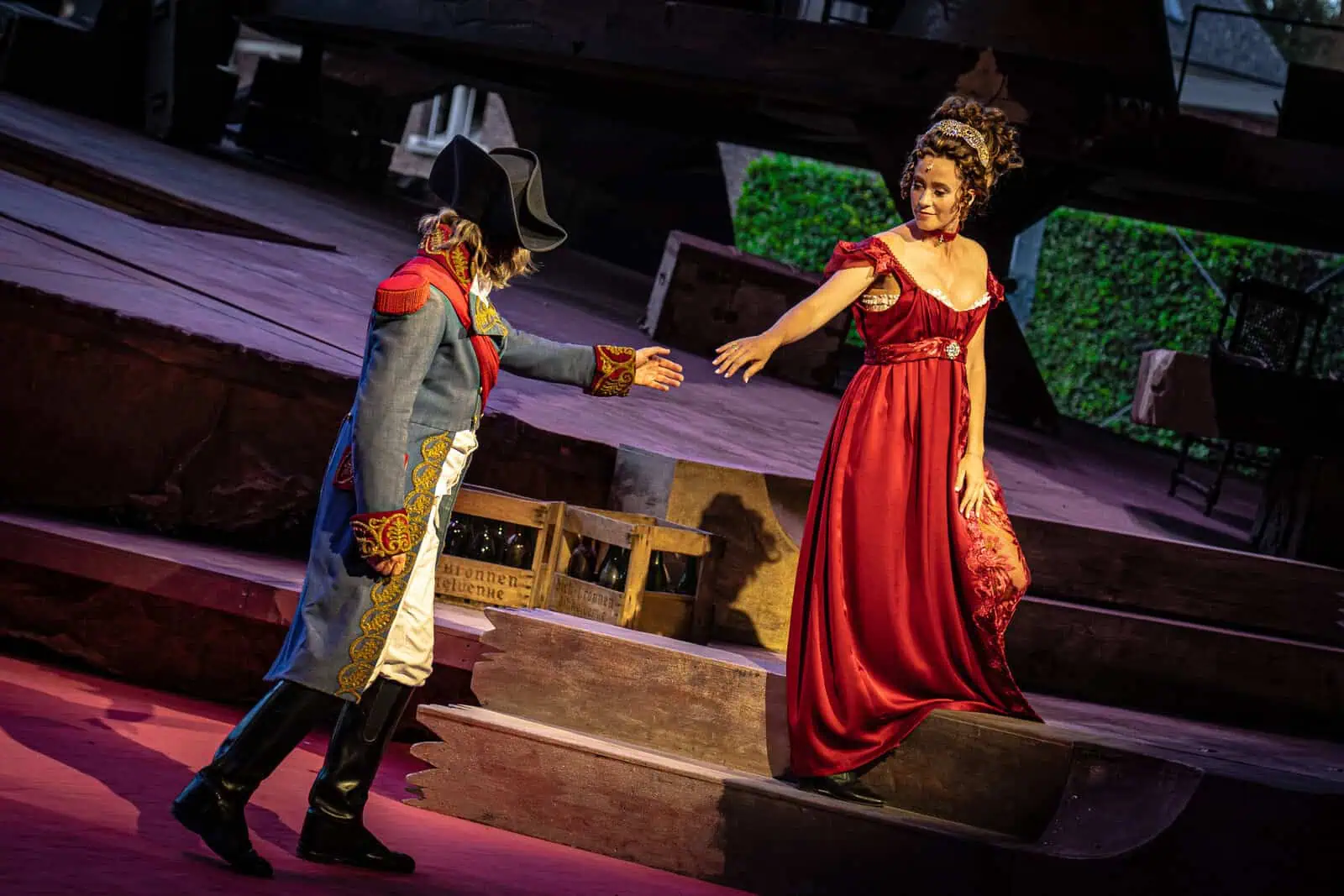
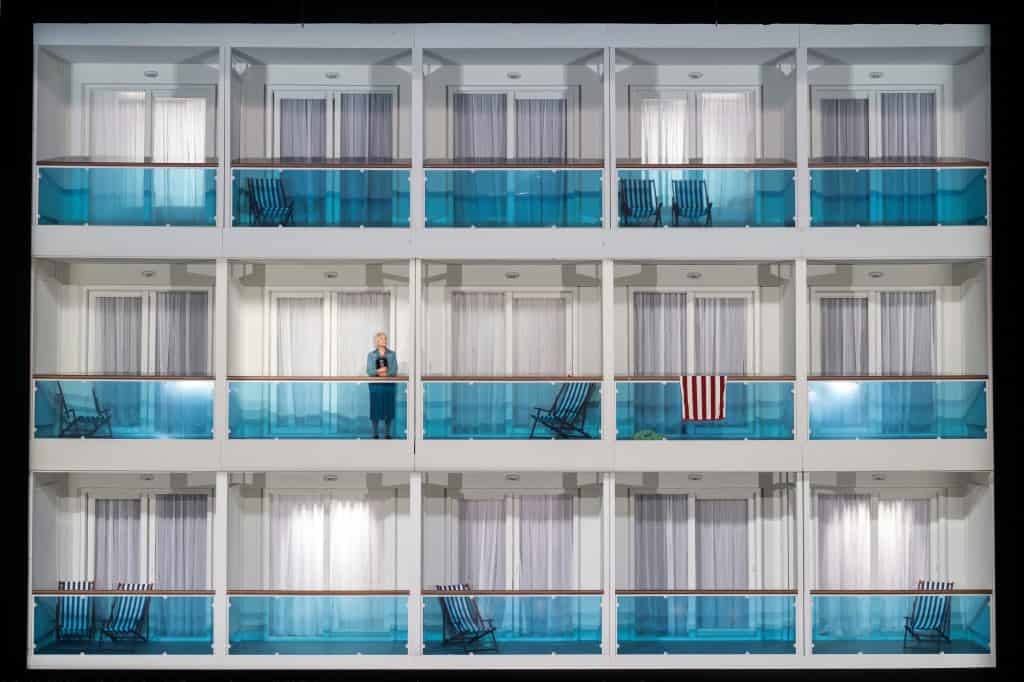
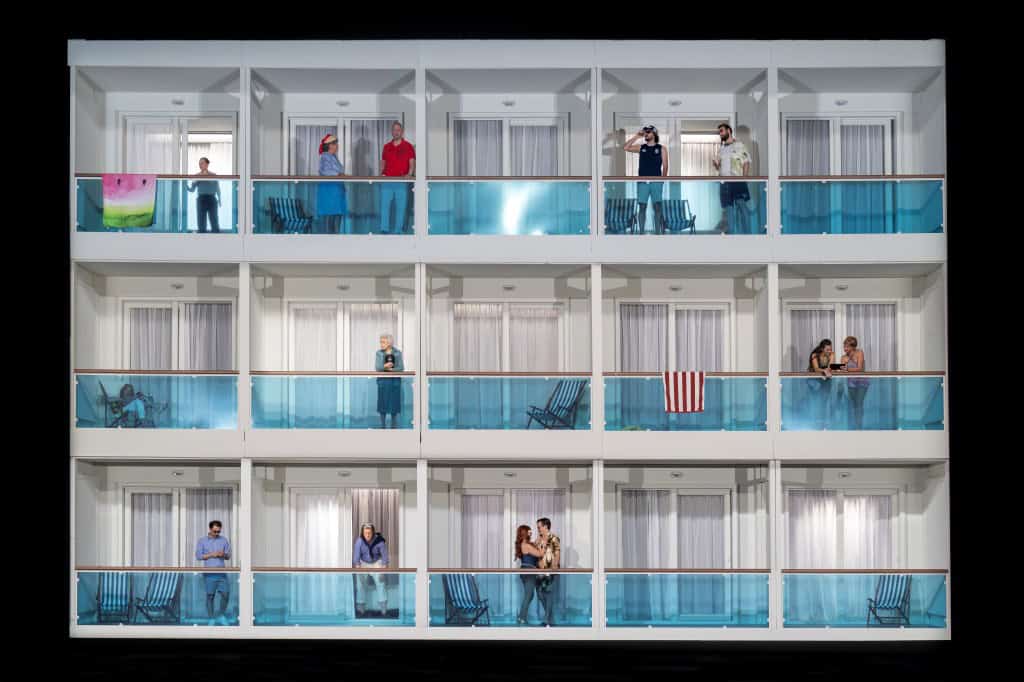
After we see on a front curtain during the opening measures undulating water as far as the eye can reach, the set of the first act comes into view: the side of a giant cruise ship. Passengers sit in their cabins or walk on the lower decks. First appears an old woman, representing a third narrative thread, one in which Lisa in the present, at an advanced age, travels back to Europe and aboard the ship sees herself as she once traveled away from Europe. We see how the older Lisa is startled when she sees her 'self' from 1960 coming out of her cabin. The 1960 Lisa then sees on a deck below her the woman who is or looks like Marta. Lisa is especially startled because, as far as she knows, Marta had been transferred to the 'death block' in Auschwitz. Her husband joins her, preparing himself for dinner and a dance. When Lisa lets him know what's troubling her, he becomes furious; as mentioned, not so much out of moral outrage but because he fears for their career prospects in their new homeland Brazil.
At the end of the first act we see the old woman climb over the ship's railing and disappear from view. Now a film projection is shown on the front curtain of a struggling and grasping woman underwater. Did the old woman we saw before commit suicide, or are these nightmares dthat cannot be washed away on top, but also exist beneath the sea surface? Lady Macbeth multiplied a thousand or a million times.
In this context, the design of the the ship is also interesting. David Hockney-like, bright colors, an ideal image of a 'beautiful' ordered society, the Hockney showed as a false reality. Two striking elements in the image are a red-and-white striped beach towel hanging over the railing and a red-and-white striped deck chair. Director Tobias Kratzer said in an interview he wanted to avoid showing barracks and striped camp clothing as we know them all too well from photographs. The red stripes might then still be references to camp images; but then 'improbably' cleaned up.
This also means that Auschwitz sometimes fades from view in this staging. In the first part, the transition from scenes taking place aboard the cruise ship to scenes in the concentration camp is often quite unclear. Yes, the libretto often jumps extremely quickly from 1960 to 1944 and back again; perhaps the cuts in this shortened version are responsible here – half an hour has been cut from the original version, including a prominent character, Katja, a young Russian partisan.
Why would those cuts have been made? I don't know the original version (although there are now already two recordings on CD and a DVD of the first fully staged version from the Bregenz Festival 2010), but I can imagine that the team that made these cuts, the director, the dramaturg, and the Russian-Jewish conductor Vladimir Jurowski, hesitated over a narrative element that was in line with the then prevailing anti-German Soviet propaganda, knowing what conditions were like in Russia itself, including regarding the composer himself.
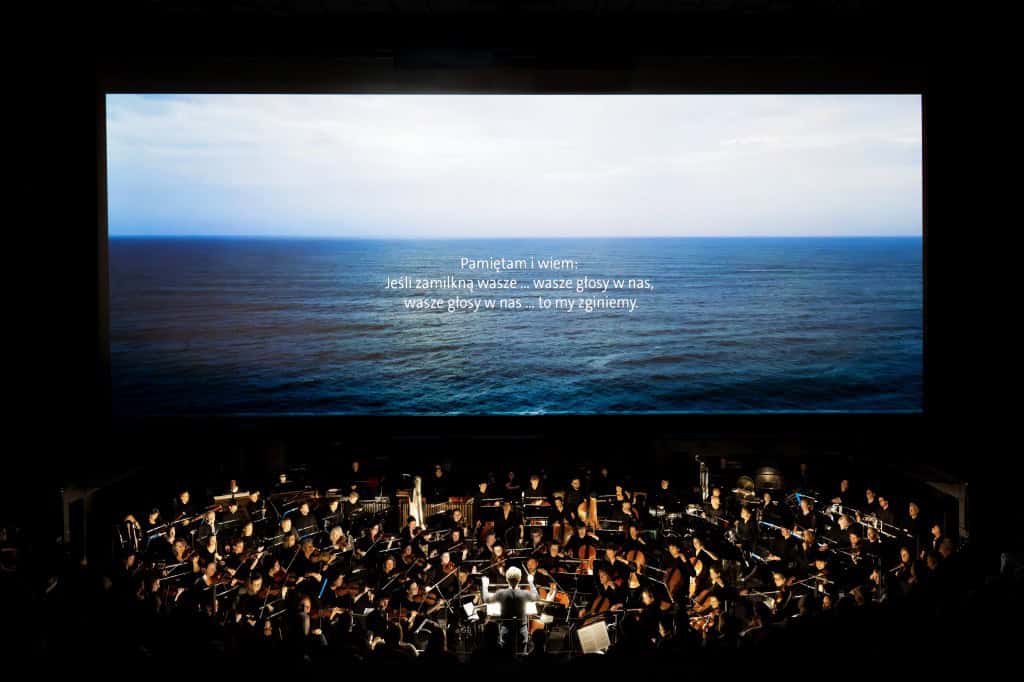
Is this staging not only a reflection of a general desire to wash away the past, but also a mirror of that desire? Characteristic is that during Marta's closing monologue with the text: "If one day your voices fall silent, then we will perish," a text in Polish is projected in the set (the same text?), against a background of a rolling ocean, the same undulating ocean we saw in the opening image. Interesting: by projecting the text calling for Auschwitz not to be forgotten in Polish, justice is done to the 'Polishness' of the entire opera, the nationality of Marta and of the original author of the story, Zofia Posmysz, the fact that Auschwitz is in Poland and to Weinberg's original nationality. But at the same time, the message is somewhat obscured; almost no one in the audience reads Polish. Is the director suggesting that we still don't want to hear the message? The text of the closing monologue is of course simply visible in the surtitles.
One cannot say that The Passenger has not been performed dozens of times in Germany and Austria, in large and small opera houses. There is no lack of interest and recognition.
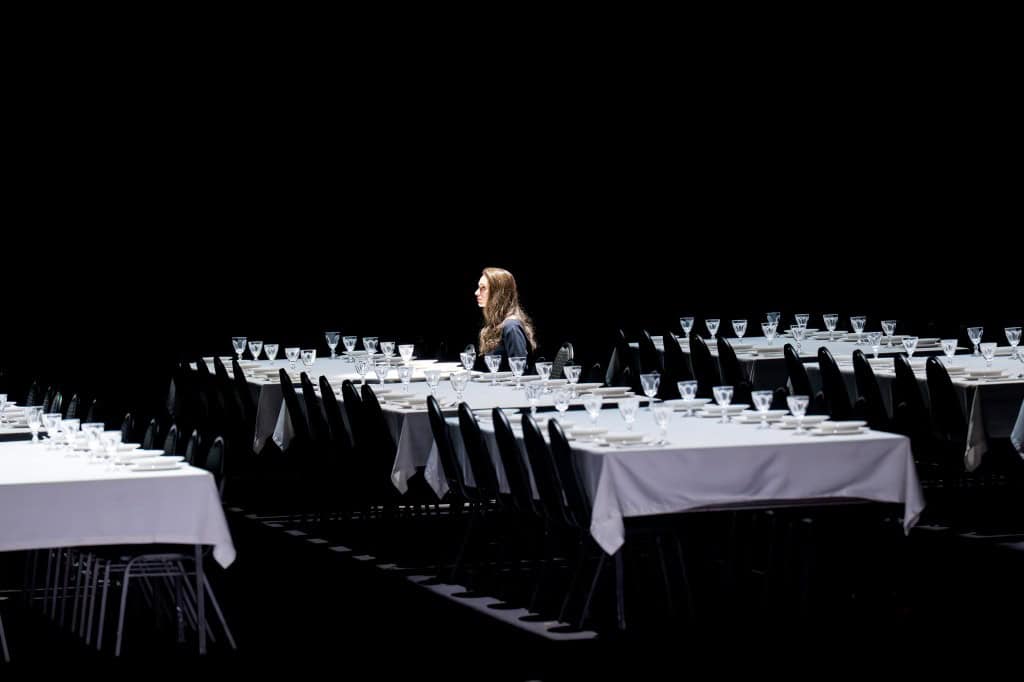
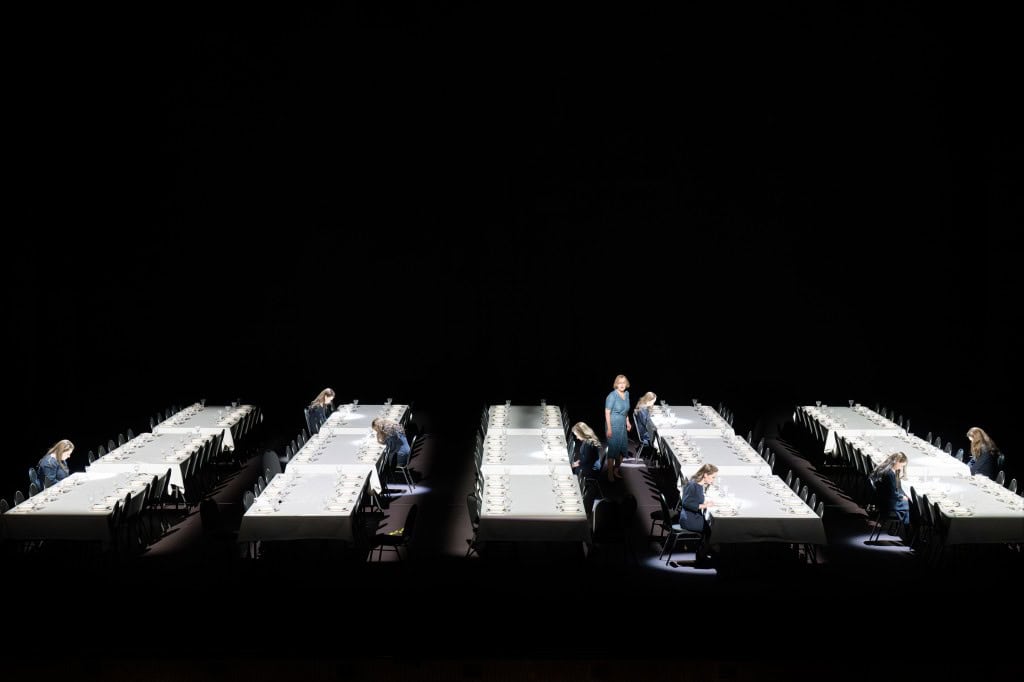
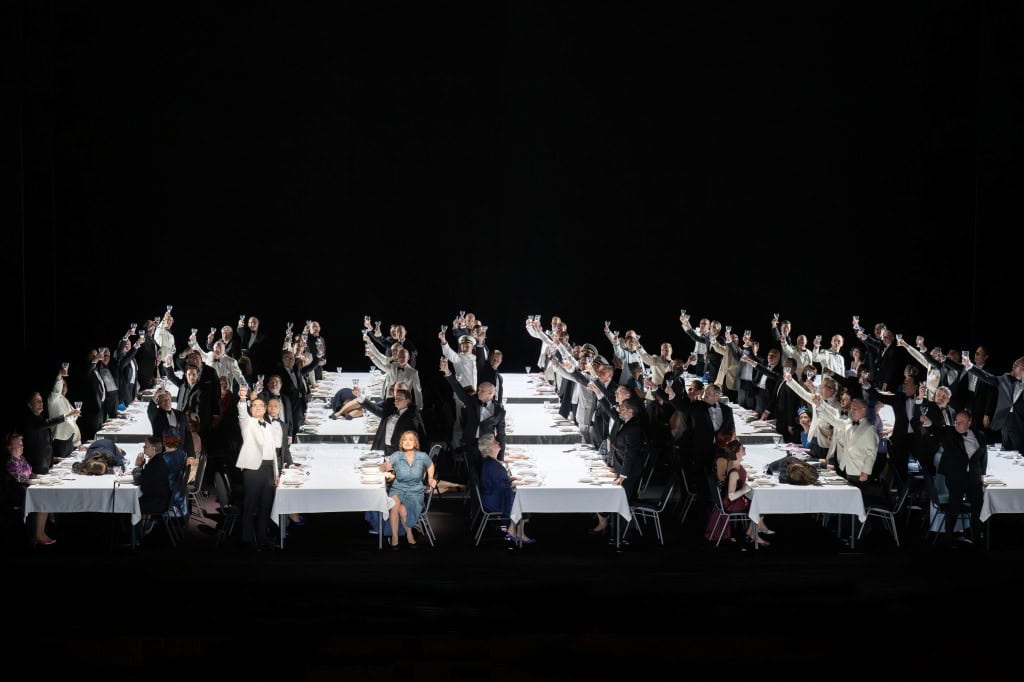
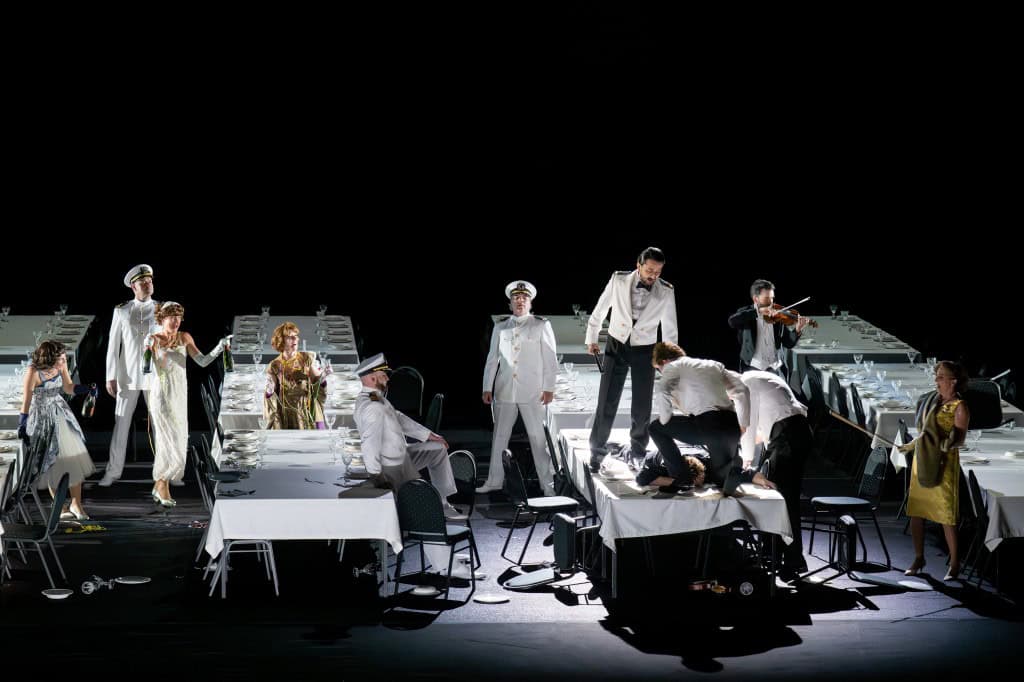
This second act indeed takes place in Auschwitz, alternating between the barracks and the dining hall of the SS staff, during preparations for a grand celebration. Here too the director refers rather indirectly to the concentration camp. On stage we see about fifteen tables arranged in width and toward the back, in a way that reminds us of the arrangement of the concrete blocks of Daniel Eisenman's Berlin Holocaust Monument, but in this scene they have neat white tablecloths over them because of the upcoming dinner; the director lets the characters obscure the true nature of the location, but in a sense does so himself as well.
Lisa, herself only 22, tries to gain power over the three-years-younger Marta, or to involve her in SS practices, or out of pure sadism, or, as this staging seems to suggest, for erotic motives. She does this by offering to arrange encounters between Marta and her fiancé Tadeusz. Both refuse, however. An encounter does take place when Tadeusz, who is a violinist, receives the order to come play the commandant's favorite waltz music at the celebration. But While Weinberg writes the party scene largely in three-quarter time, he now has Tadeusz play the chaconne from Bach's partita in D minor. Whereupon the assembled crowd descends upon him like the Furies in the Orpheus myth, and murders him.A staging detail: when the crowd takes Tadeusz's violin, the violinist playing the Chaconne (young violin star Niek Baar) continues playing and completes the Chaconne. In other words, art lives on (for a moment).
Just before the final scene, a character emerges from behind the stage pushing a cart with a 1960s model television on it, showing black-and-white film images that resemble footage from Nazi camps, or perhaps images from the Polish film made from Zofia Posmysz's original story. And so we do see—directly or indirectly—camp footage after all.
After the ocean image fades, a black curtain descends. While there was a solemn silence following the final measure of the first act, now loud applause broke out immediately. It is striking that conductor Adam Hickox has deliberately not looked toward the audience from his entrance at the beginning through to the end, thereby also preventing the customary opening applause at the start of both acts, which reinforces the solemn character of the performance.
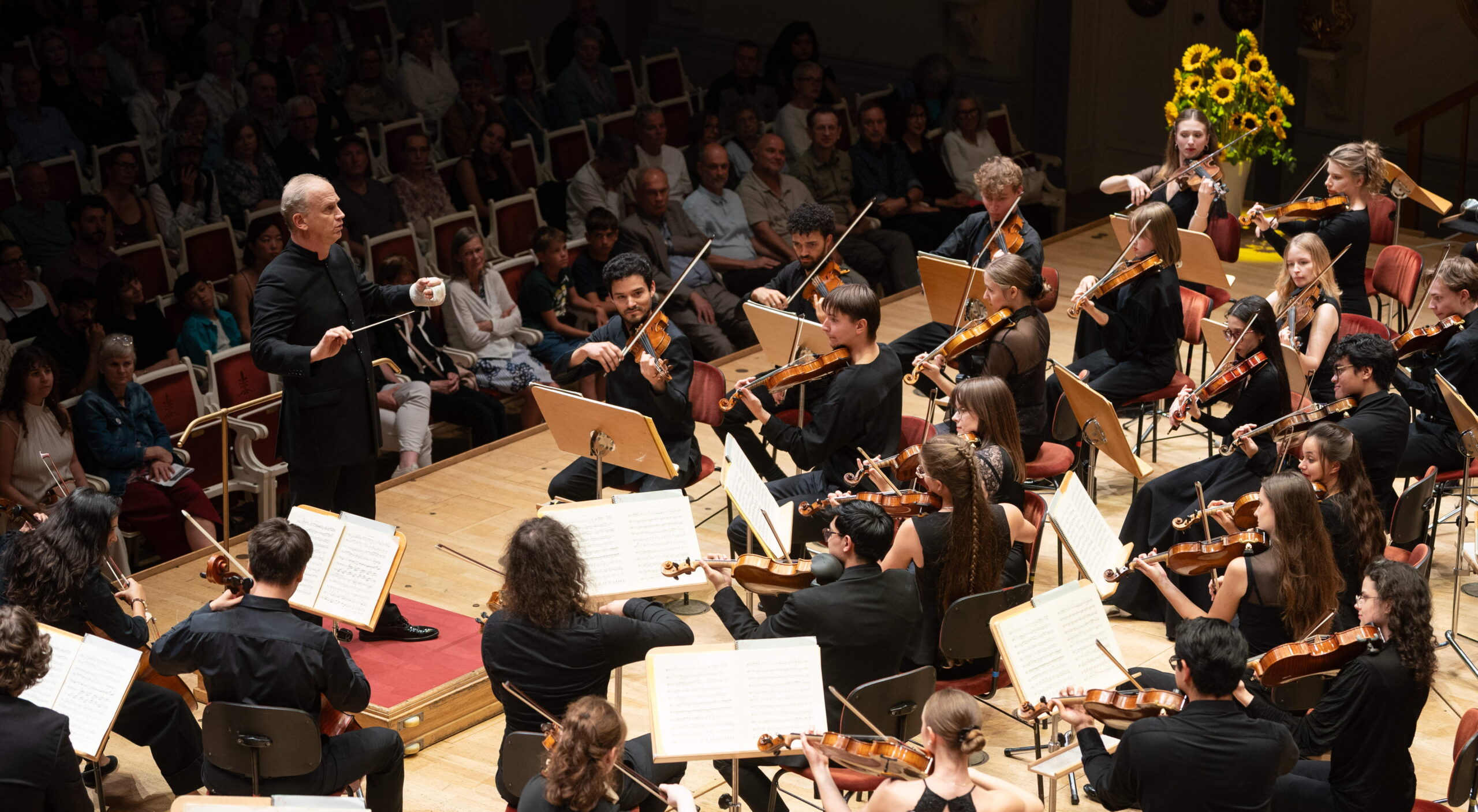
Hickox also demonstrates deep respect for the score, which he conducts beautifully and tightly, executed with great sensitivity to the contrasts between the satirical and lyrical passages, by the virtuosic Dutch Philharmonic Orchestra, and a strong chorus and soloists ensemble. Lisa is Jenny Carlstedt and Marta is Sylvia D'Eramo, both vocally and characterologically well-suited to their roles.
Lisa has in a sense the traditional mezzo role of the older woman with dubious character, Marta is the younger and more sympathetic lyrical soprano. The two male lead roles are also beautifully performed, tenor Nikolai Schukoff (Lohengrin at DNO in 2014) as the consciously somewhat superficial husband of Lisa, also kept superficial in the libretto, and Gyula Oredt in the more characterful role of Tadeusz, Marta's fiancé.
The singers of the six smaller solo roles are all dressed identically to Marta. Dark black, as Marta's alter egos or as a squadron of angels of death. At the same time, this eliminates the possibility of characterizing different characters.
Die Passagierin can still be seen on April 20, 23, 26 (matinee) and 29, and on May 2.
On May 2, the opera can be heard live from the Muziektheater on NPO Classical.
On May 4, The National Opera organizes, as part of the National Commemoration of the Dead and as part of the Theater after the Dam program, a panel discussion in Studio Boekman on Perpetrators and Memory, with Alette Smeulers, Stijn Reurs and Chris van der Heijden, and songs by Weinberg performed by mezzo-soprano Eva Kroon and pianist Jan-Paul Grijpink. Starting at 9:00 PM.
Basia Jaworski herself wrote a review of a DVD of the 2010 performance in Bregenz.