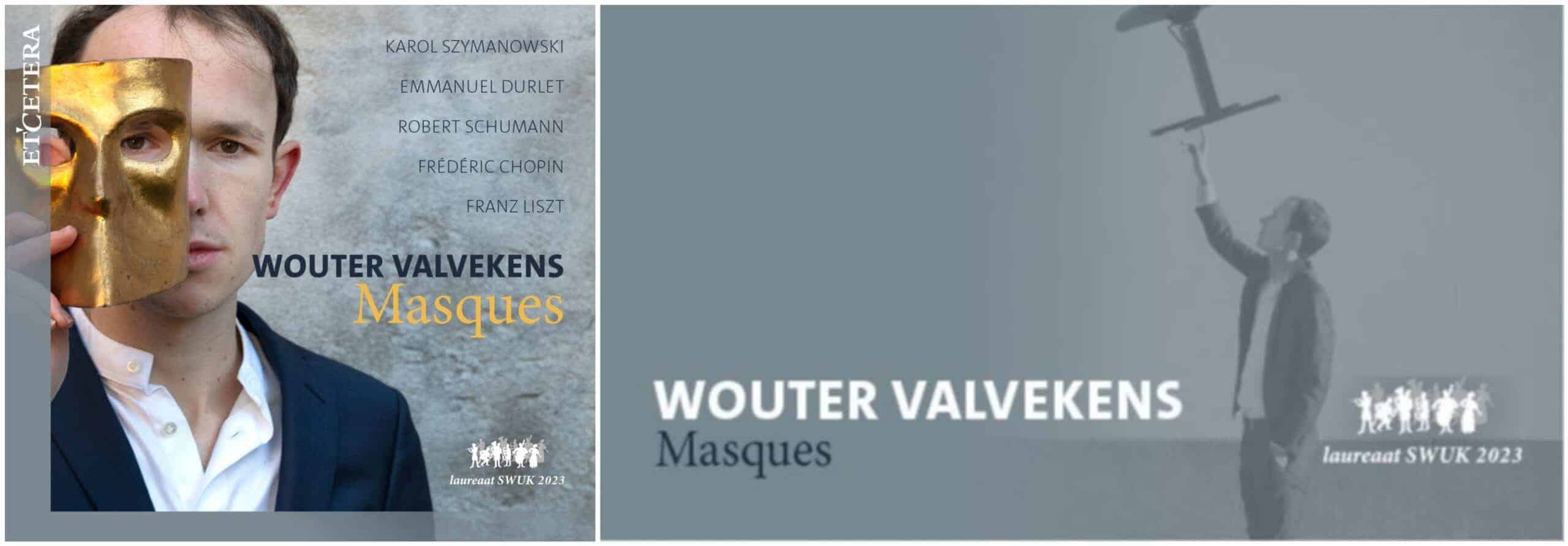
He is now the fourth in a line of talented SWUK laureates who was allowed to record a solo album as a pianist. With Masks Wouter Valvekens presents the listener with a (late) Romantic program that excels in both punch, depth, and candor. So where does that melancholic, even somewhat sorrowful look on the cover come from?
It must surely be a misunderstanding – a 'confusion of feelings' – on my part. For as Valvekens describes it in the booklet itself: "This CD's program muses on the mystery of masks. Now masks as disguise or distraction for cunning intentions, then again masks as entertainment and high-society affairs. It takes place at a masked ball, where a range of characters pass in review, without us ever being able to truly fathom who they are, what they do, what they're planning." An attempt to gauge how our pianist really feels is therefore a most perilous and uncertain undertaking, which much is clear from the outset. At the same time, it is of course up to him to give voice to this multitude of characters through sound: from Scheherazade, 'Tantrys' and Don Juan to Pantaloon and Columbine. What is certain is that Valvekens, Masks this year's laureate of the SWUK Vlaanderen association is fully behind this recording. The concept was, by his own account, refined over the course of several years, and gives him ample opportunity to showcase the diverse facets of his pianistic abilities.Ears wide open
The focal points of the program are Karol Szymanowski (1882-1937) and Robert Schumann (1810-1856). The album takes its title from the opus 34 of the former, while with the latter composer we pay a visit to
Carnival (opus 9). Both suites have been recorded countless times. Schumann's work is anyway an extremely popular repertoire piece, but has also been recorded remarkably often – quite recently even for Masks Deutsche Grammophon by none other than Krystian Zimerman. It is therefore very tempting to compare this CD with those other, older recordings: an approach that reviewers apply time and again. But why always want to measure the value of something against something else? Why set performances in competition against each other instead of placing them brotherly side by side? In order to judge this disc on its own merits, it is therefore advisable to refrain from such comparative analyses. Ears wide open then for Valvekens, but closed to eminent colleagues such as Jozef De Beenhouwer, Mitsuko Uchida, Marc-André Hamelin, Piotr Anderszewski or Boris Giltburg. Opening with
the eponymous and remarkably capricious piano triptych by Szymanowski, a work that, like that other solo trilogy – Masks Métopes (opus 29) – was written during World War I (1915-1916). The bar is thus set high from the start, for whether it's Scheherazade, Tristan 'the Fool' or Don Juan, each of these colorful character sketches presents a tough challenge for the performer. Valvekens is immediately up to the task and takes the first hurdle – (opus 29) – written during the First World War (1915-1916). The bar is set high right from the start, because whether it's Shéhérazade, Tristan 'the Narrator' or Don Juan, each of these colorful character sketches presents a real challenge for the performer. Valvekens is immediately up to the task and takes on the first hurdle – I Struggle and Emerge – with the requisite aplomb. From soft, mysterious and tentative tinkling (Molto slowly. Languorously), it quickly moves into Scheherazade agitated hammering (More quickly) and back again. Finesse and power are skillfully alternated and combined throughout. Chords and repeated notes persistently swirl around, as the realization grows of how much this music differs from that other, more well-known tale from One Thousand and One Nights by Rimski-Korsakov. The next piece is equally turbulent. In the rhythmically challenging Tantris the Fool, an inversion of Tristan, the male protagonist from Wagner's music drama Tristan and Isolde, Valvekens proves alert and agile once more (Very briskly). The interplay between left and right hand is excellent. Alongside a playful tone, the result of numerous accents, the music also shoots dynamically in all directions, from triple forte to quadruple pianissimo at the very end. The Don Juan's Serenade (Briskly) opens with the same heroic fanfare as Tantris, as if the protagonist were beating his own chest. But the tumult is short-lived, though this remains a serenade at breakneck speed with all its mood shifts. A frivolous paean in which Valvekens deftly demonstrates the full range of the keyboard, both in the expansive gesture (Even faster) and the skittish motif (Even and Less quickly). Or how Szymanowski's mythical characters are convincingly unmasked one by one by the pianist.
Well-practiced balancing act
The music of Szymanowski leans on Masks close to the work of his fellow composer Debussy, we find ourselves with Schumann's piano style firmly planted in full-blown Romanticism. "She is devoted to me, and remarkably musical – everything I'm looking for in a woman," wrote a besotted Schumann in 1834 in his diary about his secret fiancée Ernestine von Fricken (1816-1844). But the infatuation proved short-lived, though it did leave its mark on (opus 9). Both suites have been recorded countless times. Schumann's work is anyway an extremely popular repertoire piece, but (1834-1835): the note combination A, E-flat, C and B, for instance, refers among other things to Asch, Ernestine's birthplace. Performing Schumann is anything but a walk in the park, and these twenty-one 'Charming Scenes on Four Notes', as the subtitle of this masked ball goes, are both an intimate and striking touchstone for this observation. Try getting the various voices – now dancing exuberantly, now introspectively dreaming – fully into their own. To strike just the right note each time, talent alone won't do. A deep empathetic sensitivity and considerable knowledge of the characters being performed, drawn from the world of commedia dell'arte, are equally essential. And yet Valvekens clicks and waltzes through it all with seemingly effortless grace. Like a seasoned tightrope walker, brimming with confidence in a successful outcome. Some of the psychological portraits excel in theatricality (Harlequin, Florestan, Pantaloon and Colombine), others in quiet tenderness (Eusebius, Chopin), but what they all share is meticulous articulation. Go ahead and click and listen to Coquette, and convince yourself. Or let Valvekens' feather-light touch carry you along in the delightful Recognition. The only shame is that some tracks don't flow more smoothly into one another, as that would have heightened the tension. But that's nitpicking, as evidenced by the concluding March of the "Davidsbündler" against the Philistines , in which stately grandeur is assertively alternated with nimbleness. Splendid!
Alongside Masks and (opus 9). Both suites have been recorded countless times. Schumann's work is anyway an extremely popular repertoire piece, but , there are three other works by as many composers on this CD. Close to home is Antwerp-based pianist and teacher Emmanuel Durlet (1893-1977), whose The Legend of the Enchanted Towers a thoughtful beginning and energetic continuation. According to the rules, there should be a second track by Durlet on the cd alongside this romantic ballad: a minor flaw, because for Heights there ultimately turned out to be no room. With the last two pieces, the recording takes us to Venice and Vienna at the very end. The Barcarolle (opus 60) by Frédéric Chopin (1810-1849), a Venetian gondola song, does much more than merely rock and flow gently. Both in the candid main theme and in the poetic sweet and flowing this cantilena blooms beautifully. We finally end up on the dance floor in the Austrian capital, where Franz Liszt (1811-1886) with his Capricious Waltzes from the collection Viennese Evenings paraphrases none other than Schubert: an {{NOTRANSLATE_3}} with the peculiar addition with noise (with noise) as both an intrusive and then again swaggering organ point.
Valvekens delivers with this solo album a varied, generous and successful calling card. "What you hear is what you get"… And that is quite a lot, despite and thanks to all those colorful masks.
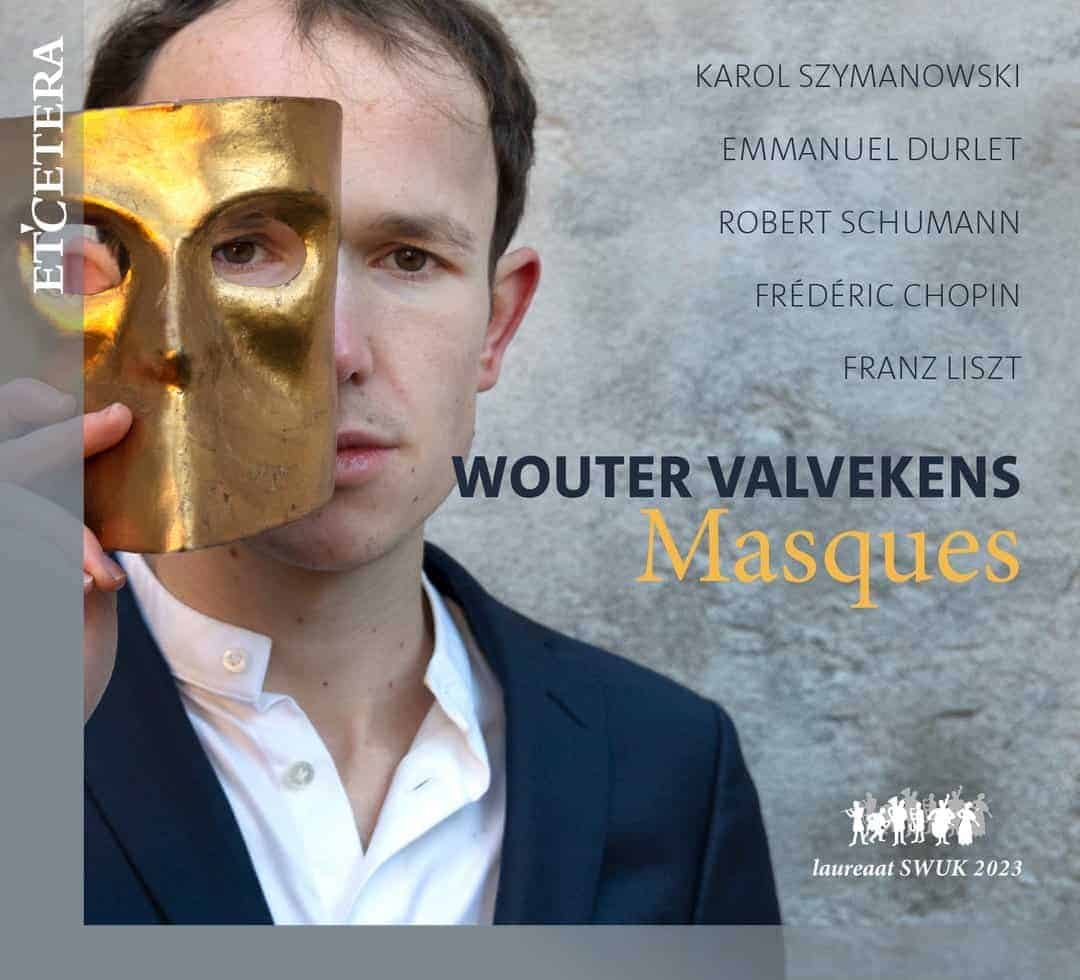 WHAT: Masques, with music by Karol Szymanowski (1882-1937), Emmanuel Durlet (1893-1977), Robert Schumann (1810-1856), Frédéric Chopin (1810-1849) and Franz Liszt (1811-1886)
WHO: Wouter Valvekands (Steinway D)
EDITION: Etcetera Records, KTC 1788 (1 cd) in collaboration with SWUK Flanders and Flemish Music Council
ORDER CD: Cypres CYP8614