Haste makes waste—a principle that applies to music as much as anything else. Just ask the Taurus Quartet. Their latest album reads as a convincing ode to this all-too-often forgotten wisdom.
In 2022, the Concertgebouw Brugge organized the third edition of its arts festival SLOW(36H), a celebration of slowness with the motto: the slower the experience, the more intense the memory. For this festival, as noted in the album's booklet, the Taurus Quartet was asked to create their own program, loosely inspired by a 2015 recording of the Keller Quartett, Singer and tranquil. The seed planted then has since grown into a recording project made up exclusively of slow movements. Not entirely unprecedented, but certainly a sustained attempt to pause, just for a moment, and stand still.
This journey through slowness brings together a colorful cast of composers. Ludwig van Beethoven (1770–1827) and György Kurtág (b. 1926) serve as the main anchors, but medieval polyphonists Guillaume de Machaut (ca. 1300–1377) and Pierre de la Rue (ca. 1450–1518) are also present, as are twentieth-century masters Anton Webern (1883–1945) and Giacinto Scelsi (1905–1988). Their music is lifted from its natural habitat and, in doing so, placed in a new light. It's a procedure where there are both gains and losses. You inevitably lose the original architecture of the string quartet or composition, but this is outweighed by the fascinating recontextualization that takes place. For instance, you discover that the Interrupted arioso from Kurtág's Officium breve in memoriam Andrae Szervánsksy (opus 28) in all its restraint ultimately has more in common with Machaut's Mass of Notre Dame than one might think. And this despite the many centuries separating the two compositions.
Respect and Tenderness
Slowness takes many forms on this album, but perhaps nowhere more convincingly than in the slow movements of Beethoven. These come from his late string quartets—in B-flat major (opus 130) and F major (opus 135)—and the second Razumovsky quartet (opus 59 no. 2). For the Taurus Quartet, this is familiar territory: the ensemble has several complete performances of these string quartets to their credit. And you can hear it. Playing softly while still articulating clearly and precisely is an art form, as we hear for instance in the Slow very much, singer and tranquil from opus 135. The album both begins and ends with this restrained movement. And what's striking even without listening is that such an agonizingly slow journey through the musical landscape also causes the musicians to slow their pace. The result? A performance that runs a full forty seconds longer than the initial version we heard. The moving Cavatina from opus 130 is, unlike the heartfelt Very slow from the second Razumovsky quartet, drawn out less than we've come to expect from most quartets. The Taurus Quartet's slightly sharper phrasing transforms this famous movement from a tearjerker into a message of hope—one that may well come closer to the essence of what Beethoven sought to express through this extraordinary music.
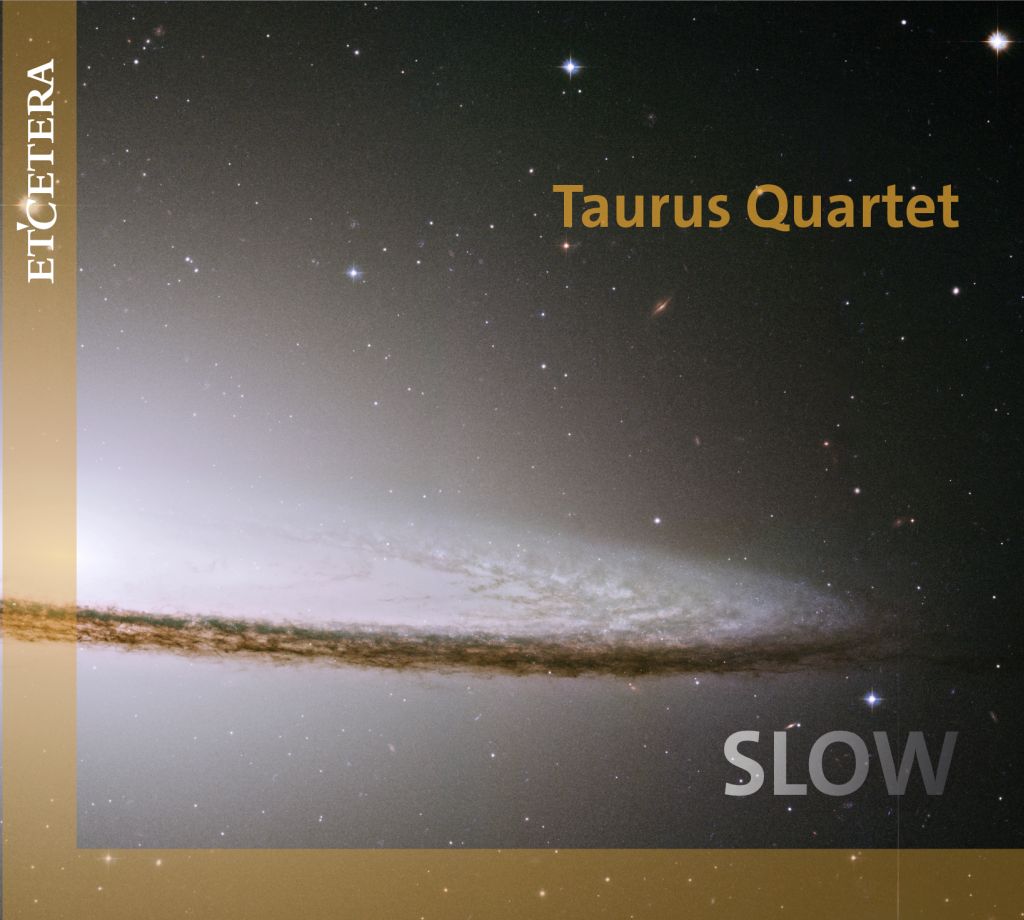
With SLOW showcases the Taurus Quartet's mastery of multiple musical languages. But more importantly, it demonstrates that the distance between these diverse approaches is far smaller than commonly assumed. The whispered fragility of Kurtág's Microludes —barely audible even—stands much closer to Beethoven's late quartets, which were themselves far ahead of their time. But the unexpected common ground between the modern compositions of Scelsi and the 5 Sentences for string quartet (opus 5) by Anton Webern are discoveries well worth making. Both works are brimming with tension and, in Scelsi's case, possess a particularly gripping dynamism. Add to this the transparency that shines through the polyphonic compositions of Machaut and Pierre de la Rue, and we get a recording that, despite its singular theme and structure, remains captivating from start to finish. In a society that actively seeks out and even glorifies speed, SLOW a welcome countervoice. Just as on this CD, the key is using slowness well. Or as French sociologist, anthropologist, and philosopher Pierre Sansot put it (in In Praise of Slowness): “Slowness, in my view, was tenderness, respect, the grace of which men and elements are sometimes capable.”