
German guitarist, composer, and storyteller Sönke Meinen is one of those rare musicians who seamlessly weaves technique and poetry together. His playing is virtuosic, yet never showy. His tone is warm, narrative, sometimes fragile – as if the guitar itself is breathing. During the Antwerp Guitar Festival, he presents a program that takes his audience on a journey through sound, silence, and personal stories.
A musician with three faces
"What drives me most as a musician is composing," Meinen says without hesitation. "Simply reproducing existing pieces doesn't satisfy me. When I write, I try to rediscover the guitar over and over again. That means no two pieces are alike – but what they all share is that they tell a story." That storytelling extends beyond the notes themselves. In his concerts, he weaves anecdotes and small observations throughout the music. "I see myself as a guitarist, composer, and storyteller. That trinity describes exactly what I want to do. It also keeps me from being pigeonholed. I'm not 'classical,' not 'fingerstyle,' not 'jazz' – I'm simply someone who tells stories through the guitar."
The teacher who lit the flame
The seed for all of this was planted by his first teacher, Emile Joseph, a name Meinen speaks with visible respect. "He was an incredibly inspiring man: cheerful, curious, full of humor. He showed me that classical music, jazz, folk, and pop could all exist side by side. He played mandolin in an Irish folk band, but also gave brilliant classical guitar lessons. That openness shaped my entire musical thinking." When Joseph became ill and had to stop teaching, Meinen lost touch with him. "It wasn't until seventeen years later that I got his address through his sister. I wrote him a long letter to thank him. We got to talk one more time – he passed away shortly after. I was invited to play at his funeral. That moment meant a lot to me. It was as if I could finally let him hear what he had kindled in me." "What's remarkable is that he once took me to a Tommy Emmanuel concert," Meinen recalls. "I was a teenager, and that performance changed everything. For the first time, I thought: *that's* what I want to do. Years later, I got to share the stage with Tommy myself – it felt like the circle was complete. Without Emile, that never would have happened."
A language without borders
Meinen's music is hard to pin down to a single category. It moves freely between classical, fingerstyle, jazz, and world music – and that's not a deliberate strategy. "It's always been that way," he says. "Even as a child, I played everything that intrigued me. Later, during my studies, my teachers and friends helped me forge all those influences into something personal. Still, it's a process that's never finished – and I hope it never will be. Music needs to keep evolving." His compositions come about in all sorts of ways. "Sometimes it starts with a chord that evokes a certain mood, sometimes with a rhythm or a melodic motif. Anything can be the starting point, as long as I take the idea seriously. There's no such thing as bad ideas – only ideas that haven't been developed enough." "Sometimes something emerges directly on the guitar, sometimes I work it out further on the computer," he explains. "I use notation software as a tool, but never as a limitation. What matters is that the idea has room to grow."
The magic of the 'rounded' feeling
How does he know when a piece is finished? "I feel it. It's purely intuitive. At a certain point, everything falls into place and the music flows naturally. Then I know: the story has been told. As long as I don't have that feeling, I keep tinkering. Sometimes for months. But when it's right, it's the most satisfying feeling there is." Still, his pieces often continue to evolve in concert. "A composition is alive. On stage, the timing changes, the breath, the dynamics. The notes stay the same, but the story grows with me."
Collaboration as dialogue
Beyond his solo work, Meinen is known for his duos with, among others, Reentko Dirks and Danish violinist Bjarke Falgren. Their album The Circle is praised for its warm, lyrical tone. "Bjarke is one of those rare musicians who opens an entire world with a single note. In some ways we're very much alike, but we differ in just the right places. I'm the more analytical composer, he's the intuitive improviser. That keeps things fresh and lively." According to him, successful collaboration requires above all trust. "Making music is intimate. You have to be willing to set your ego aside and play in a way that makes the other person sound better. That's the essence of ensemble playing."
The rhythmic side of the guitar
When you hear Sönke Meinen live, you understand how broad his sonic world is. For him, the guitar becomes more than just a melody instrument—it's also a percussive body. "The guitar is a tool full of tonal colors and sounds," he explains. "Dead notes, clicks, the whine of strings—these aren't mistakes, but part of its vocabulary. I use those sounds intentionally, just like the beautiful tone I learned in my classical lessons." He uses amplification and subtle effects to expand the guitar's expressive possibilities. "I don't see that as artificial, but as a way to let the guitar speak louder. It doesn't become louder, but deeper." "Technique is never an end in itself," he adds. "Everything I play—a note, a click, a breath—must have meaning. Otherwise, the magic disappears."
Between fingerstyle and classical
Meinen moves on the border between worlds. "At fingerstyle festivals, I'm often seen as the 'classical' guy, and at classical festivals as the 'fingerstyler'," he laughs. "Some initially look skeptical when I bring something outside the traditional repertoire, but usually that changes once they hear the music. I notice a new openness is growing, especially at festivals like Antwerp. That's encouraging. Ultimately, it's about curiosity and appreciation for handmade, personal music."
The power of the stage
Unlike many studio artists, Meinen is a born stage performer. "I love playing for people, sharing something. In the studio you can create an intimate sound, but live you can fill a room with energy. I try to find the balance between power and subtlety, between breath and intensity." "During a concert, I pay attention not just to sound, but also to atmosphere, light, and silence," he says. "And I love a bit of humor in between—it breaks the tension and makes contact with the audience more genuine." His concerts are more than musical performances; they're encounters. "The stories I tell in between aren't a prepared script. They're moments of connection. Music becomes more personal when you feel the person behind it. I want people to remember not just the music afterward, but also the warmth of the moment."
 An instrument as partner
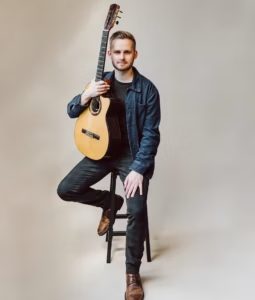
His main instrument for years has been a nylon crossover guitar by Austrian builder Christina Kobler. "It's ideal for amplified concerts: acoustically it sounds soft and warm, but through my pickups and effects it really comes alive. It feels like we've grown together." At home he also works with a steel-string Fylde guitar by Roger Bucknall. "A beautiful guitar with its own distinct character. That will definitely appear on an album soon." "I play with Savarez strings," he says with a smile. "They've never let me down." His favorite tuning—CGDGBE, with the three low strings like a cello—is key to his sound. "That tuning opens a new universe. It allows chords and resonances that are impossible in standard tuning. I haven't played in standard tuning for ten years."
Teaching as a reciprocal process
Meinen travels the world for workshops and masterclasses, from China to the United States. "What strikes me every time is that the guitar speaks a universal language. Wherever you are, everyone understands that love for the instrument. I learn just as much from my students as they learn from me. Some things you can't explain; they arise naturally, in encounter, in playing together." "Some things you can't explain," he says. "They arise naturally, in encounter and playing together. That reciprocal process, that non-verbal understanding, is the core of teaching for me."
The future: back to basics
After three duo albums, Meinen is working on a new solo program again. "Back to the roots," he says with a smile. "I don't want to start new projects for a while, but go deeper with what's already there. In winter I plan to compose as much as possible. Besides that, I'm working on a video course that will appear on my website next year." And how does he see the future of the guitar in a time when artificial music is becoming increasingly prominent? "I hope the guitar gets a new platform right now. It stands for something real, something handmade. Maybe the world needs that again."
Silence as the final note
At the end of our conversation, Meinen pauses for a moment. His voice becomes softer. "How terrible would a life without silence be? Then notes couldn't give you direction. Silence is the space in which music gains meaning—just like in life itself."
A guitarist who breathes stories
Sönke Meinen embodies a generation of guitarists who transcend the boundaries between styles. His music is personal, his tone refined, his attitude genuine. He doesn't play to impress, but to connect.
Or, as he puts it himself: "If someone leaves my concert feeling they wanted to hear just one more piece, then I'm happy."
Were you intrigued by this interview? Then come along Saturday, November 8th to listen to Sönke Meinen