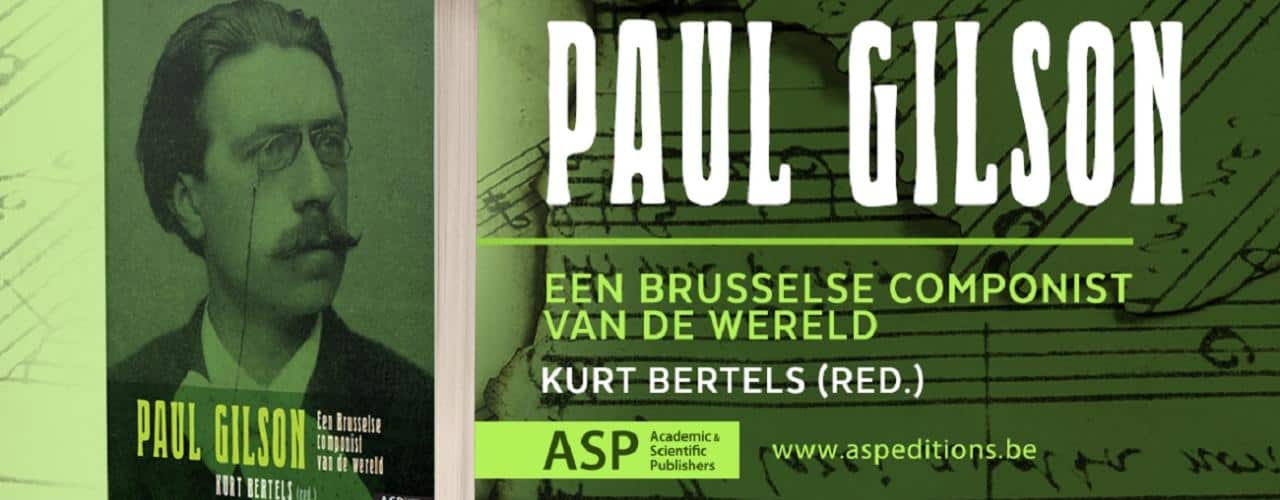
"Being a composer in Belgium – that's like setting off fireworks in your own basement," is a sentiment Paul Gilson (1865–1942) would certainly have endorsed. Rejected by the French-speakers, thwarted by the Brussels establishment, and smothered with affection by the Flemish – such was the battlefield on which the "father of Belgian wind band music" had to hold his ground.
That is the message of the first scientific study on Gilson that has just been published. The book, edited by saxophonist Kurt Bertels, opens a series on the artistic history of the Royal Conservatory of Brussels. It provides a vivid picture of the spirit of the times that shaped this composer's work.
Paul Gilson was born in Brussels in 1865 but spent his youth in the rural village of Ruisbroek. His first acquaintance with music was rooted in the most important pillar of musical life in many Flemish villages at the time: the brass band. He was still a teenager when he wrote his first composition. Back in Brussels (1882), he was almost immediately captivated by the melancholic energy of the Russian National School and the Romantic works of Richard Wagner. When he attended a performance of Russian composers at the Brussels Popular Concerts in 1887, he was completely blown away. A period of intensive correspondence with César Cui, Mily Balakirev, Nikolai Rimsky-Korsakov, Alexander Borodin, and Modest Mussorgsky followed. He owed much to the mediation of Countess Louise de Mercy-Argenteau, mistress of Franz Liszt. It is thanks to Gilson that pianist-composer Alexander Scriabin gave a concert in Brussels, establishing Belgium as the country that brought Russian music to the West.
And the celebration was just beginning. As a largely self-taught musician, he unexpectedly won the Premier Grand Prix de Rome in 1889 for his cantata Naïve. And three years later, with the symphonic cycle The Sea he launched the opening salvo of a promising career with operas, ballets, orchestral works (including wind band and brass band compositions), music theater, cantatas, and oratorios. He also wrote the first saxophone concerto in history.
But shortly after his breakthrough, he came under fire from the French-language music press, which took issue with his choice of texts and felt his work strayed too far from the "clarity and simplicity" dictated by musical Paris. By contrast, he was embraced by the Flemish press, and with that the nationalist fervor quickly spread. Composing was involuntarily pushed to the background, and Gilson avoided public opinion by devoting more time to writing a harmony handbook and teaching. He also served on and off as an inspector of Flemish and Belgian music schools.
Saxophone
What's striking is how Gilson's work demonstrates the saxophone's emergence as a solo instrument in classical orchestral settings. In Gilson's time, the saxophone was still a bold and revolutionary instrument that only received official permission in 1845 from French King Louis Philippe to be included in military music bands. This approval came after a musical showdown on the Champ de Mars in Paris, where the established woodwind and brass orchestra from the music academy Gymnase musicale faced off against the orchestra led by Adolphe Sax, which featured saxophones. Hector Berlioz later wrote: "The difference in sound, in fullness and in evenness of all tones compared to the thin sound of the other band was immediately apparent." Sax had won.
The saxophone later gained further acceptance thanks to Elise Boyer Hall (1853-1924), who took up the instrument on doctor's orders (to combat deafness) and became an acclaimed soloist in the classical repertoire in the United States. Her career caused quite a stir in puritanical Europe, where women were barely allowed to play instruments other than piano or harpsichord for reasons of propriety.
Gilson ultimately composed 300 works for wind band, ranging from simple tunes to grand symphonic works (10), three of which were for saxophone. The preference for wind bands didn't come out of nowhere in 19th-century Belgium. Besides the Théâtre de la Monnaie Orchestra (1772), which for a long time only performed from April to October, there was only one other symphony orchestra, the Royal Music Corps of the Guides (1832). In contrast, around 1,800 brass bands and fanfares were active in Belgium. Moreover, new instruments became relevant such as the cornet, tuba, and saxhorns. It's also noteworthy that brass bands deliberately chose contemporary music for their repertoire. Today's programmers could find inspiration in that approach.
WHAT: Paul Gilson, A Brussels Composer of the World
WHO: Kurt Bertels (ed.)
PUBLISHED BY: ASP Publishers, 2023 (ISBN: 9789461173973)
URL: www.aspeditions.be