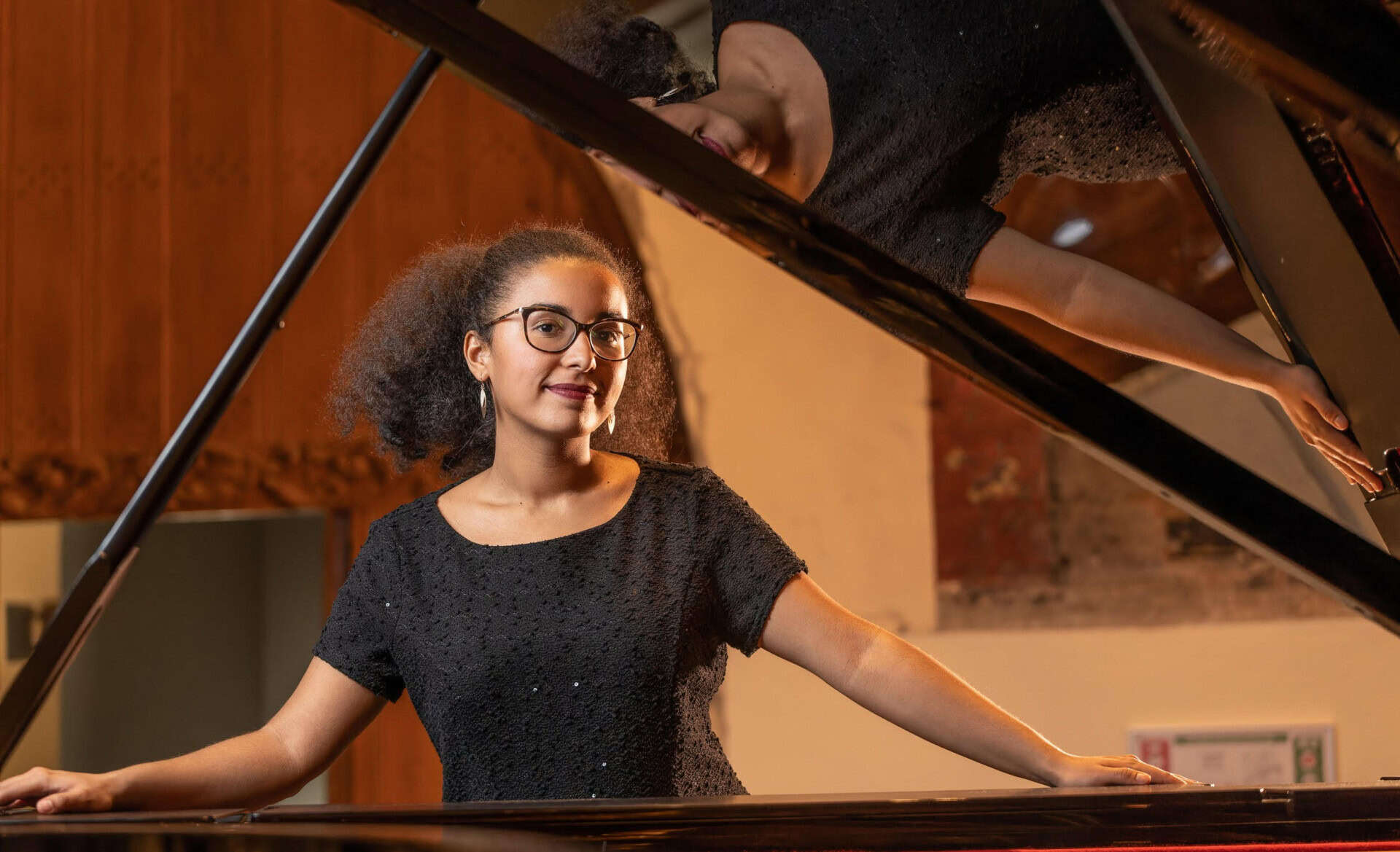
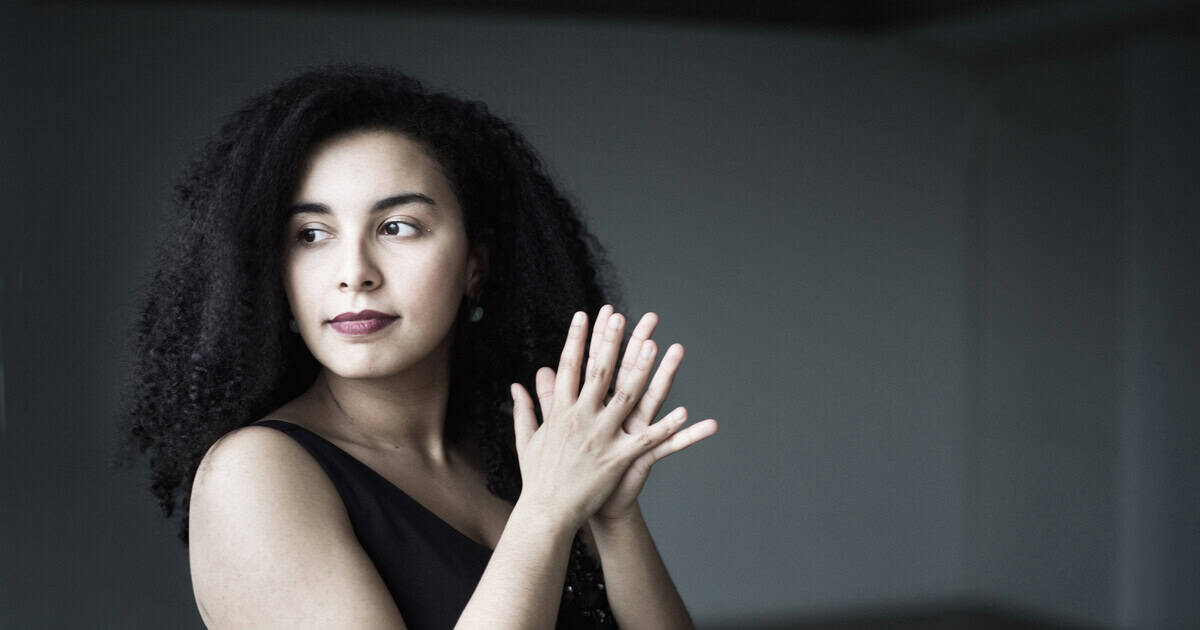
The young pianist Mirabelle Kajenjeri (b. 1998) belongs to that rare generation of musicians in whom refinement, curiosity, and elusiveness come together seamlessly. With Burundian and Ukrainian roots, and artistic training that took her from Brussels to Hanover and Vienna, she embodies a world in which music effortlessly blurs boundaries.
She received her first solid training at the Royal Conservatorium of Brussels under Mikhail Faerman, a foundation that gave her the maturity to later take the leap abroad. On the occasion of her performance on Friday, December 5 during the Music Chapel Festival at Flagey, she reflects in a conversation with Klassiek Centraal on identity, sound, freedom, and the search for her own voice.
An Identity in Sound
In her project Resonating Roots: My Story Through Sound Kajenjeri weaves traditional Burundian melodies with the classical recital format. Not as exotic ornamentation, but as an intimate, personal quest for who she is. For a festival in Cleveland that invites artists to showcase their uniqueness, she dove deep into her family's heritage. Her father helped her choose and understand the meaning of the melodies: "It was important that this program was truly mine."
Kajenjeri emphasizes that it is essential to understand and respect the traditions of others. "Just like in classical music, you take a work from another time and mindset and make it your own with respect," she says. Because Burundian music is strongly rhythmic—often carried by drums—she created simple piano transcriptions, with the audience poetically shaping the rhythmic foundation. She sang a few motifs herself, preserving the spirit of the original melodies. The concert became an emotionally charged experience. Although these melodies haven't yet been performed in Europe, she expects a European premiere to be just a matter of time. The project continues to resonate for her as a first moment in which audience, voice, and roots converged in one human experience.
Double Training, Double Breath
Kajenjeri was trained as both a pianist and violinist. Some called this a waste of time, but intuitively she knew that both instruments shaped her inner language. "From childhood, I felt that my expression was shaped by both instruments. It may have gone against expectations, but it was essential for my musical voice," she explains. Violin playing—in orchestra and quartet—lives on in her piano playing: a natural breath, a different way of phrasing and listening, an inner "sound toolkit." The piano remains an "orchestra of ten fingers," but her violin background adds an extra physical and mental layer that keeps the phrasing and tone of a string instrument present in her piano playing. She calls saying goodbye to the violin, her "instrument of the heart," one of the most difficult decisions of her training.
Mentors and Sound Discovery
At Hanover's Hochschule, Kajenjeri worked with Ewa Kupiec, who wouldn't let go until the exact timbre was found. The first lessons were intense and confrontational: Kupiec drove her to ultimate precision and asked her to find colors she had never consciously heard before. A lesson around Ravel's Mirrors proved decisive: "Ten fingers, hundreds of colors, depending on place, gesture and intention." That search for autonomy – being able to decide, listen and create without someone showing the way – she calls "the foundation of our craft".
In Vienna, she completed a postgraduate program with Anna Malikova, who builds trust and guides without transforming students. Kajenjeri explains: "With Malikova, I learned to consolidate my own voice and trust it completely." Malikova's warmth and her heritage from the great Russian school provided a counterbalance to the high intensity of Hannover. Vienna itself – a city steeped in attention to detail and musical history – provided daily, almost self-evident inspiration. She emphasizes: "A musician never builds herself alone; we are the result of the commitment, generosity and demands of everyone who guides us."
The Musik Kapel as an in-between space
Since 2024, Kajenjeri is Artist in Residence at the Musik Kapel Queen Elisabeth in Waterloo. Not conservatory logic, but a tailor-made environment that leaves room for autonomy, introspection and artistic growth. "The Musik Kapel is not a family, but a circle of artists where everyone retains their own identity." Few group lessons and much project-based work create short, intense connections.
What moves her most is the geographic and mental space: the silence of Waterloo, the proximity of the forest, and the calm that makes the transition from student to independent artist bearable. She calls the Musik Kapel a 'transition phase' between training and professional leap, supported by mentors like Frank Braley, Avedis Kouyoumdjian and many international guest teachers. "It is guided learning to fly."
Between recognition and discovery
In her recital programs, Kajenjeri balances between French finesse, Ukrainian lyricism and Burundian roots. The audience must always recognize something – a piece that evokes memory or emotion – to be open to the unknown. She points out that filling a hall sometimes lies in the programming: "An intelligent program is a bridge between comfort and curiosity." Improvisation plays a key role here. "Every classical score once began as improvisation."
Her experience comes mainly from gospel services where she plays and sings every Sunday, without sheet music: only chord charts, spontaneity and honesty. That freedom helps her remember that classical music once also arose from the spark of the moment.
Poulenc and the pleasure of the duo
On Friday, December 5, she plays Poulenc's "Concerto for Two Pianos" with Jonathan Fournel. She first discovered the concerto at age fifteen. During a solfège exam in Roubaix, she heard Poulenc's "Sextet" – a revelation she describes as "a coup de foudre." About the concerto, she says: "Percussive, dancing, ironic, lyrical and with humor. It was love at first sight." Together with Fournel, she forms a dynamic duo: "In a duo concerto there is both dialogue and fusion." She feels with Fournel a natural breath and musical sensitivity that align perfectly: "There is something effortless in our communication." The power of encounter Kajenjeri is active in projects around youth and intercultural dialogue. She sees how music opens doors. She tells how a seven-year-old child after Schumann's "Rêverie" said: "I was happy." And how a group of 17-year-old boys, initially dismissive, ended up with curiosity and exploring the inside of the piano – an unexpected link to their technical training. "Music can touch people in minutes." Doubt, growth and leaving behind a truth
There were difficult moments: letting go of the violin, the ruthless competition in Hannover, lockdown just at a new beginning. In Hannover, she felt truly small for the first time among pianists who worked day and night, and Covid suddenly threw her back on herself, in a new city, a new school, new pressure. But every period forced her to grow. She wants people to remember her music above all for a sense of honesty and truth.
 Bridges of sound and culture
Mirabelle Kajenjeri speaks with the same quiet complexity that characterizes her playing: thoughtful, warm, steeped in culture and identity. She connects worlds without merging them; she lets them resonate. Not in the search for one truth, but in the conviction that music is a bridge. Her message to young musicians is clear: "Your voice is already there. Learn to recognize it, shape it and dare to let it exist – curious, honest and technically equipped." Curiosity and the courage to follow your intuition are, in her view, the key to any artistic future: innovation happens naturally when it remains true to something inner. Where identity becomes sound When you hear Mirabelle Kajenjeri play, you notice how her many worlds are not merged into one story, but allowed to sound alongside each other. Burundian rhythms, Ukrainian lyricism, French clarity, the intensity of Hannover, the elegance of Vienna and the silence of Waterloo do not flow into each other to erase differences, but to create depth.
Doubt, Growth, and Leaving a Truth Behind
There were difficult moments: letting go of the violin, the relentless competition in Hanover, lockdown just as a new chapter was beginning. In Hanover, she felt genuinely small for the first time, surrounded by pianists working day and night, and Covid suddenly threw her back on herself, in a new city, a new school, new pressure. But each period forced her to grow. She wants people to remember her music above all for a sense of honesty and truth.
Bridges of Sound and Culture
Mirabelle Kajenjeri speaks with the same quiet nuance that defines her playing: thoughtful, warm, steeped in culture and identity. She connects worlds without merging them; she lets them resonate. Not in search of one truth, but in the conviction that music is a bridge. Her message to young musicians is clear: "Your voice is already there. Learn to recognize it, shape it, and dare to let it exist—curious, honest, and armed with technique." According to her, curiosity and the courage to follow your intuition are key to any artistic future: innovation emerges naturally when it remains true to something within.
Where Identity Becomes Sound
When you hear Mirabelle Kajenjeri play, you notice how her many worlds are not woven into one story, but allowed to resonate alongside each other. Burundian rhythms, Ukrainian lyricism, French clarity, the intensity of Hanover, the elegance of Vienna, and the silence of Waterloo flow together not to erase differences, but to create depth.
She builds her career with the same quiet determination: steady, curious, and unhurried. Her music becomes a space where stories, cultures, and generations touch one another, without her wanting to distill one single truth from it. Perhaps that's her greatest strength: inviting the listener to become familiar, just as she does, with an identity that isn't fixed but moves, resonates. In that sonic field between heritage and imagination, she finds the freedom that makes her playing so distinctive—a voice that grows ever clearer, richer, and more independent.
Where and when?
Friday, December 5, 8:15 PM, in Francis Poulenc's (1899-1963) "Concerto for Two Pianos" together with Jonathan Fournel and Les Métamorphoses conducted by Raphaël Feye.
See also https://klassiek-centraal.be/music-chapel-festival-2025-de-vier-elementen-in-klank-en-geest/