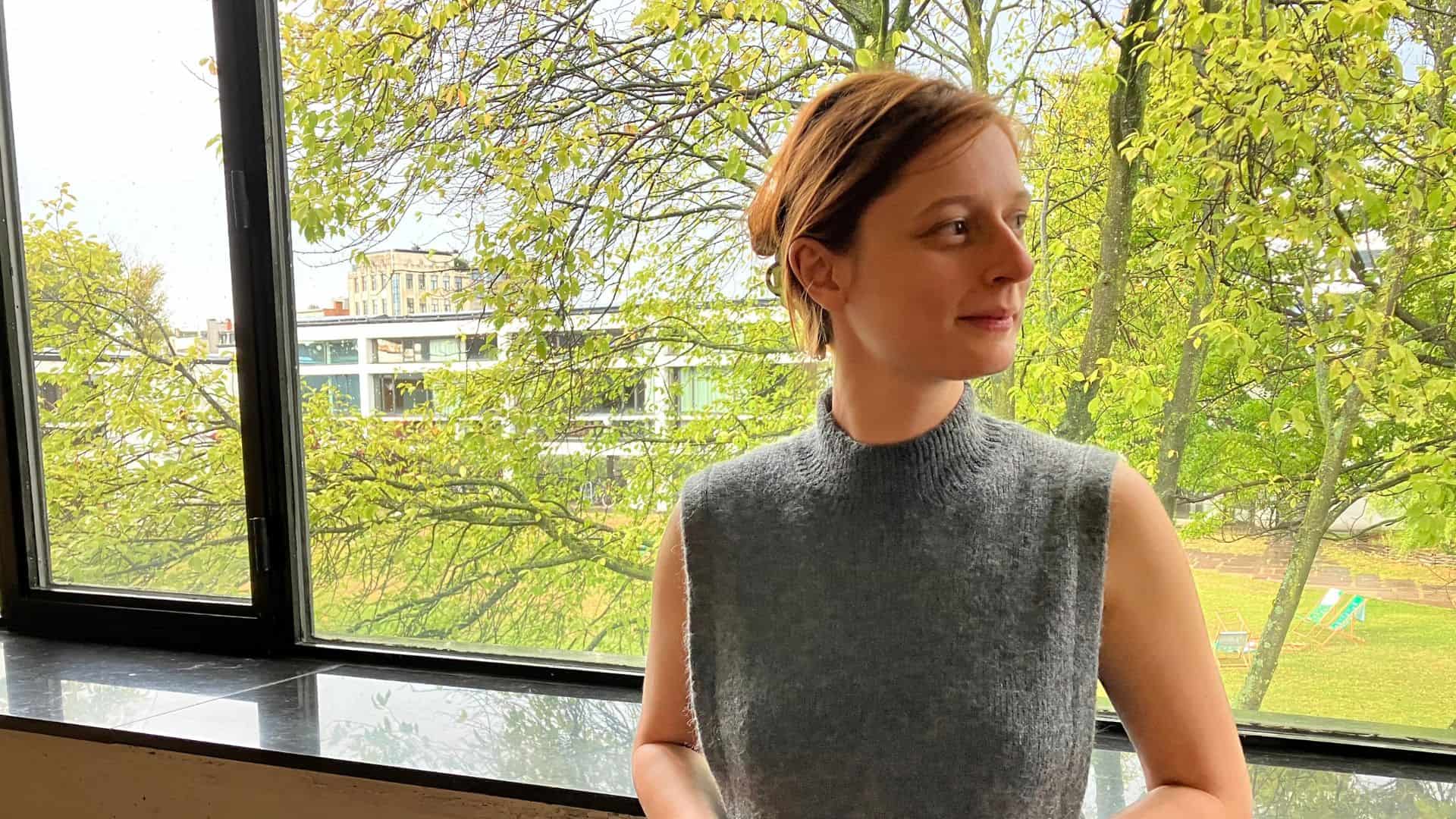
Pianist Marlies Cornelis had it up to here with the canon during her conservatory studies. From then on, she would do things her own way: telling stories at the piano in which feminine themes also have a place. And believe it or not, a vibrator and a Barbie doll can play a part in that. Yet she doesn't swear off virtuosic piano playing, as becomes clear from the works that Frederik Croene and Benjamin Windelinckx composed for her. With her concert at Festival 20:21 in Leuven, she wants to demonstrate her versatility—with or without that despised canon. Meet an independent pianist-composer.
'Marlies Cornelis thinks carefully about what she does, she has substantive ideas.' That's how introduces Maarten Beirens, artistic director of the Leuven Festival 20:21, describes the young pianist at her first major solo concert. That independent streak became apparent three years ago when Marlies (1997) put together a program featuring only works by female composers for her conservatory graduation project. A deliberate choice, she explains, preceded by a period of growing doubt and disappointment.
Brainwashed
During her conservatory studies at KASK in Ghent, she increasingly began to question the canon of established, widely acclaimed classical works. 'I think we're somehow brainwashed by that canon. If I was even allowed to like other music, I wondered. I could no longer listen to music in a relaxed way. After all, hadn't I been given the tools to analyze music and wasn't I supposed to always form a critical opinion? The canon blocked a lot in my head.'
'At my exam, I also noticed that the jury members weren't really listening anymore. Their comments had nothing to do with the music and even less with me. They only looked at the score and how it—according to them—had to be performed in a historically correct manner. It didn't help me get any further. After my first year of my master's degree, I was completely done with that canon. I wanted to break free from it, and then you almost automatically end up with women because you don't find them in the canon.'
In my twenties
'For my final exam, I looked for works that the jury probably wouldn't know, so they would listen without prejudice to a concert rather than an exam. Over the years, I had already made a list of pieces I wanted to play someday. It consisted mainly of works by women, sometimes discovered by chance on YouTube. And whether by coincidence or not, the three works I selected for my graduation project were— Fantasia by French composer Hélène de Montgeroult (1764-1836), 9 Preludes by American Ruth Crawford (1901-1953) and Music for Mallarmé by Romanian Ana-Maria Avram (1961-2017) – written when these composers, like me, were in their twenties. That's why I titled my program Twenty-Something (f.)It felt good to tell such a story.'
Her teacher Keiko Shichijo responded positively to her proposal. The jury also found it an interesting program. They surprised the pianist with an extremely high score: 19 out of 20. 'A year earlier I'd only achieved a 13. Surely I hadn't improved that much in a year? I think the jury listened differently.'
Discouraged
After graduating, she became somewhat discouraged. She doesn't feel that her focus on works by female composers had a lasting impact. 'I was able to perform my exam program and a new program with other composers a few more times at intimate salon concerts. But concert organizers ultimately showed little interest. And it takes an enormous amount of energy to have to promote yourself.'
So she decided to try a different approach. She asked contemporary composers to write pieces for her. This way she wants to align more with what she stands for today, rather than performing older works, even if they're by women. In that sense, the program she's now developing also fits perfectly with the Transit program of Festival 20:21, which gives a forum to contemporary voices.
Virtuosic
With her debut in Leuven, Marlies Cornelis wants to showcase her versatility. The first work, written by her partner Frederik Croene (1973), gives her the chance to present herself as a virtuosic pianist. 'Frederik still likes to return to the tradition of the 18th and 19th centuries, which form the foundation of piano playing for him. But at the same time, he wonders how you can still write virtuosic work today. That aligns with my interest: how do you relate to tradition? Normally he always performs his own work – it's exceptional that I get to do this now.' Schizophonia is a very virtuosic piece, where he has me play the piano as if it were a full orchestra. It's contemporary work, very layered, but very accessible with an easy-to-follow melody that I sustain with the middle pedal.'
The second work, composed by Marlies' classmate Benjamin Windelinckx (1999), also requires some virtuosity, but it aligns more with her interest in female composers. In in the round, a composition for piano and tape, Windelinckx has her engage in dialogue with Cécile Chaminade (1857-1944). A historical recording from 1901 has been preserved of this French composer's Air de Ballet. 'You hear her at work in that very virtuosic piece, but you also hear the noise of the recording. Benjamin wrote two miniatures based on it. I engage in dialogue both with the score and with the recording. The work ends with Chaminade's playing. I see it as almost literally bringing up a forgotten voice.'
Between the lines
Furthermore, Marlies performs two of her own compositions that are part of her still unfinished cycle Untempered Pianist (f.) – indeed a nod to Bach's Well-Tempered Clavier, or the canon. The first, My Little Sonic Bunny, is a piece for kalimba, electronics and vibrator.
'Indeed, the vibrator is the main act. It's another interrogation of the canon and an exploration of feminine themes. I play with that vibrator, a cute little bunny, on the kalimba. I place that small thumb piano between my legs—a reference to the fact that in the 19th century, the piano was considered most suitable for women because they had to sit quite upright and somewhat turned away from the audience. A cello, by contrast, was considered improper for women since it's placed between the legs. I'm also alluding to rock guitarists who see their instrument as an extension of their own body.' In this work too, she incorporates a recording, specifically the instructions she received when purchasing the vibrator at a sex shop.
Performance
Fragments from an interview can also be heard in Marlies' second composition, Feminine Endings I. We hear Ruth Handler, inventor of the Barbie doll and founder of the toy company Mattel, tell how she began developing breast prosthetics after her cancer diagnosis. 'That contrast fascinates me: the designer of the ideal woman who also shows herself to be very vulnerable. "I lost my feminity," she testified about losing her breasts. With this work, in which I place Barbie dolls between the strings of the prepared piano , I raise the question of how we look at women and beauty. Midway through the piece, I also look at my own breasts.'
With both of her compositions, we've gradually evolved into performance throughout the program. And that's the path Marlies Cornelis wants to continue down, solo or in collaboration. 'I really enjoy playing piano and I play it well, but I also want to share stories and bring interesting themes to the fore. Because sharing personal experience also makes it more accessible to the audience. And yes, maybe I do want to shake up and wake up the Transit audience a bit, which I sometimes find a bit too academic.'
_____________
- A longer version of this interview also appeared on the Woman at the Piano blog.
- Marlies Cornelis performs her program on Saturday, October 18, 2025 at 1:30 PM in STUK Studio.
- Twenty-Something (f.), Marlies Cornelis' graduation project, can still be heard on YouTube.
- More work by female composers can be heard during Festival 20:21 on Sunday, October 12 (Galina Ustvolskaya) and on Tuesday 14 October (Kaija Saariaho).