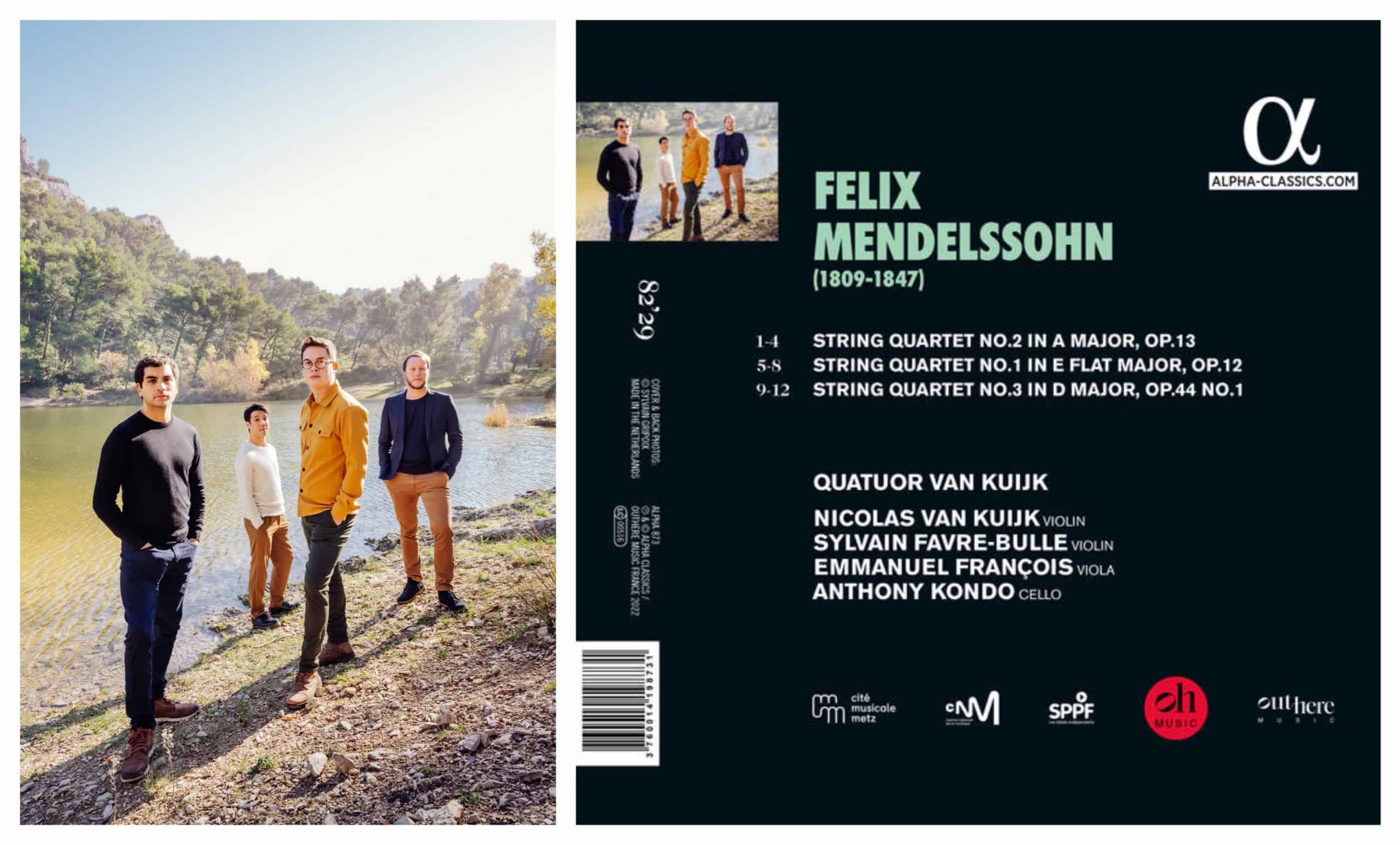
During the summer of 2015, they truly stood out at the string quartet week of the Festival Midis-Minimes. Today, the four gentlemen of the Quatuor Van Kuijk celebrate their tenth anniversary with the first volume of a complete recording of Felix Mendelssohn's (1809-1847) string quartet works. A recording with many highlights, though the overall picture has a few rough edges.
When the Quatuor Van Kuijk made their debut at the Brussels Conservatory in mid-2015, it generated high expectations. The French quartet took to the stage at the time as the fresh winner of the triennial Wigmore Hall International String Quartet Competition, one of the most prestigious competitions in the genre alongside competitions in Australia (Melbourne), Bordeaux, the Canadian Banff, Munich (the ARD-Musikwettbewerb), and Reggio Emilia (Premio Borciani). Their interpretation of none other than Felix Mendelssohn's gripping string quartet opus 80—his swan song from 1847—was a bull's-eye. Magnificent dialogues, dynamic contrasts, and perfectly timed energy alternated splendidly. Van Kuijk and company have pressed forward resolutely since then, though first violinist Nicolas Van Kuijk and his partner Sylvain Favre-Bulle did get new company: first with violist Emmanuel François, and since spring 2020 also with cellist Anthony Kondo. Over the past decade, the quartet has grown into arguably the most promising successor to their compatriots of the Quatuor Ebène. No fewer than 550 concerts in 140 cities—the already impressive figures on the ensemble's website speak for themselves.
 A sixth CD for the label Alpha Classics has now been added, recorded in the beautiful Salle de l'Esplanade, part of the Arsenal reimagined by Catalan architect Ricardo Bofill (1939-2022) in what is now'La Cité musicale-Metz'. This is the first volume devoted to what will ultimately comprise Mendelssohn's complete string quartet oeuvre, with the second installment already recorded in Metz in June of this year. As a starting point for their complete cycle, the Quatuor Van Kuijk chose string quartet opus 13, written by the 18-year-old Felix in autumn 1827 and thus indeed two years younger than the subsequent quartet in E-flat opus 12. It all sounds perfectly logical at first glance, but it isn't. Because if you want to provide a truly complete or more complete picture here, you can't really avoid an earlier string quartet in E-flat: a four-movement work that first saw the light in March 1823, which followed a set of fifteen fugues for this combination, but wasn't published until 1879 by Erler in Berlin. It appears that neither this earliest quartet nor the four short pieces collected under opus number 81 will be part of Van Kuijk's 'complete cycle.' We'll have to wait and see.
Beethoven's First Heir
Back to what this brand-new album actually has to offer, and that's still quite remarkable! To begin with, an excellent vigorous performance of opus 13, a work that is oddly and regrettably labeled with the wrong key both on the cover and in the accompanying booklet (A major instead of A minor), and which musicologists together with the string quartet in F (opus 80) usually consider among Mendelssohn's most successful examples. With this "tour de force"—quoting Stéphane Goldet, the writer of the accompanying text—the Hamburg composer demonstrated that his famous octet for strings from 1825 was no accident. Moreover, this quartet also proves to be a deep bow toward the late Ludwig van Beethoven, who died in March 1827, just as his late string quartets were being published. In this regard, Goldet points out, among other things, a little secret: a solemn, unison motif at the end of the slow introduction of opus 13 ("Adagio"), which Mendelssohn borrowed from the very beginning of the middle section of the piano sonata "Les Adieux" (opus 81a), titled "Absence", would have borrowed. In a footnote, she further disputes the nonetheless common assumption that Mendelssohn would have used this specific motif for the first time in Question, the opening song of his cycle opus 9, and more specifically at the words "Is it true?"—but that the string quartet might actually have come first is clearly refuted by Felix himself in a letter to his friend, Swedish composer Adolf Lindblad (1801–1878).
Moving and consoling all at once—that's what Mendelssohn has in store for his listeners at the beginning of his 'first' string quartet in A minor. An intimate, deeply felt plea in which the Quatuor Van Kuijk immediately strikes an excellent balance. This "Adagio" is not only a discreet stepping stone toward what will become a fairly turbulent half hour of music, but also a coda, as the composer unexpectedly revives this argument near the very end of the quartet. In the "Allegro Vivace" that follows, the four musicians create an equally captivating and intense musical experience that also matches the composer's dynamic demands perfectly. A skillful and promising bit of teamwork that seemingly effortlessly continues in both middle movements ("Adagio non lento" and "Allegretto con moto – Allegro di molto"). The striking blending of voices in the ambiguous slow movement convinces just as much as the noticeably pulsating, somewhat agitated, and grandiose "poco più animato." Thanks to the intermezzo, the third movement, the performance continues to build. This is vintage Mendelssohn: a naive, subtle, yet above all very gracefully plucked and bowed "Allegretto," with a playful trio in between. A delightful dream from which we are suddenly awakened by the opening of the finale—an ominous tremolo ("Presto"). Concluding in "Adagio non lento," this forms the crown of a sublime string quartet."A remarkable page, the most complex ever written by young Mendelssohn" sounds with awe in Jean-Alexandre Ménétrier's Guide to Chamber Music (Fayard, 1989, p. 575). "Mendelssohn demonstrates here a mastery, an originality of form and substance without equal in Europe in 1830, and asserts himself as Beethoven's true heir." During the succession of urgent passages, the Quatuor Van Kuijk opts to maintain momentum rather than occasionally play in a more declamatory and thus more expressive manner. It's a legitimate and certainly consistent choice, one that makes the meditative conclusion all the more powerful.
Boring schoolboys versus virtuoso enthusiasts
In April 1829, Mendelssohn crossed the Channel for the first time, heading to England and Scotland. There, the budding twenty-year-old completed another string quartet on September 14. At least on paper, for back home he let it be known that some fine-tuning was still needed here and there. This opus 12 was published roughly simultaneously with opus 13 in the autumn of 1830, albeit by different publishers, and today stands somewhat in the shadow of its younger brother. Beethoven's string quartets, both from the middle and late periods (opus 74 and 127), remain significant sources of inspiration for Felix, not least through the concise intro ("Adagio non troppo") and the lyrical "Allegro non tardante" that follows. But the storm that frequently surfaced in opus 13 has subsided, making way for a predominantly harmonious tone. The fluid phrasing of the empathetic Quatuor Van Kuijk is very much in line with how the composer laid them out in this almost carefree opening movement. With the "Canzonetta," the most remarkable movement resounds, in which a simple and somewhat archaic-sounding tune is interrupted by a trio that is typically Mendelssohn—namely, extremely light-footed. The melody is performed by the four gentlemen strictly in tempo and in a rather schoolish manner ("Allegretto"). With the intention of making the contrast with the spicy interlude ("più mosso") as great as possible? There's certainly something to be said for it, but it sounds rather boring as a result. Then the thoughtful "Andante espressivo," strikingly intoned, and especially the sparkling finale ("Molto allegro e vivace") leave a very different impression! Wave after wave and turn after turn, the quartet keeps up the pace lively, without sacrificing precision for a moment, until a quotation from the first movement—the coda—lets the work fade out. Bravo!
On March 28, 1837, wedding bells ring in Frankfurt. The marriage between Mendelssohn and Cécile Jeanrenaud (1817–1853) also ushers in a particularly productive compositional period, during which chamber music will certainly receive its due attention. No fewer than three quartets flow from his pen in relatively short order (1837–1838) and will be grouped under opus number 44. What today is registered as the first string quartet was actually completed last, in the summer of 1838. The premiere was given on February 16 of the following year, and was in the capable hands of violinist Ferdinand David (1810–1873) and his colleagues from the Gewandhaus Orchestra in Leipzig. Do you ever wonder why this quartet in D major, like its two counterparts, is heard so seldom in concert halls today? It seems that even Schumann's string quartets (opus 41), which were inspired by Mendelssohn no less, enjoy more favor on the concert stage today. It certainly won't be due to the enthusiasm of the Quatuor Van Kuijk. This is clearly audible from the opening measures of the "Molto allegro vivace." It couldn't be otherwise, you might think, with such an unannounced burst of joie de vivre as the first theme. Absolutely right, but again the quartet manages to rein in the enthusiasm effectively, and that for more than 12 minutes, as the recapitulation is also observed. The same applies to the flawlessly virtuosic "Presto," which is indeed played "con brio" and with a great sense of timing. In a different way, the classical minuet ("Un poco allegretto") and the slow movement ("Andante espressivo ma con moto") also testify to brilliant execution. In the minuet, there are of course the undulating figures in the first violin that stand out, whereas in the "Andante" both violins intertwine with each other in an equally ingenious and transparent manner, creating a magnificent Song Without Words effect.
It's certainly a shame that the undeniable care taken in the ensemble playing hasn't carried through everywhere in this release. The incorrect key signature for opus 13, which was already mentioned. But beyond that, there are also several slips in the CD booklet. Where, for example, is the second footnote in the English translation? While in the German version, the final footnote is missing. Fortunately, these are only minor drawbacks that pale in comparison to the polished and decisive way in which the actual musical score is rendered. And that is ultimately still the essence!
{{NOTRANSLATE_1}}{{NOTRANSLATE_1}}{{NOTRANSLATE_1}}{{NOTRANSLATE_1}}{{NOTRANSLATE_1}} 4.5/5
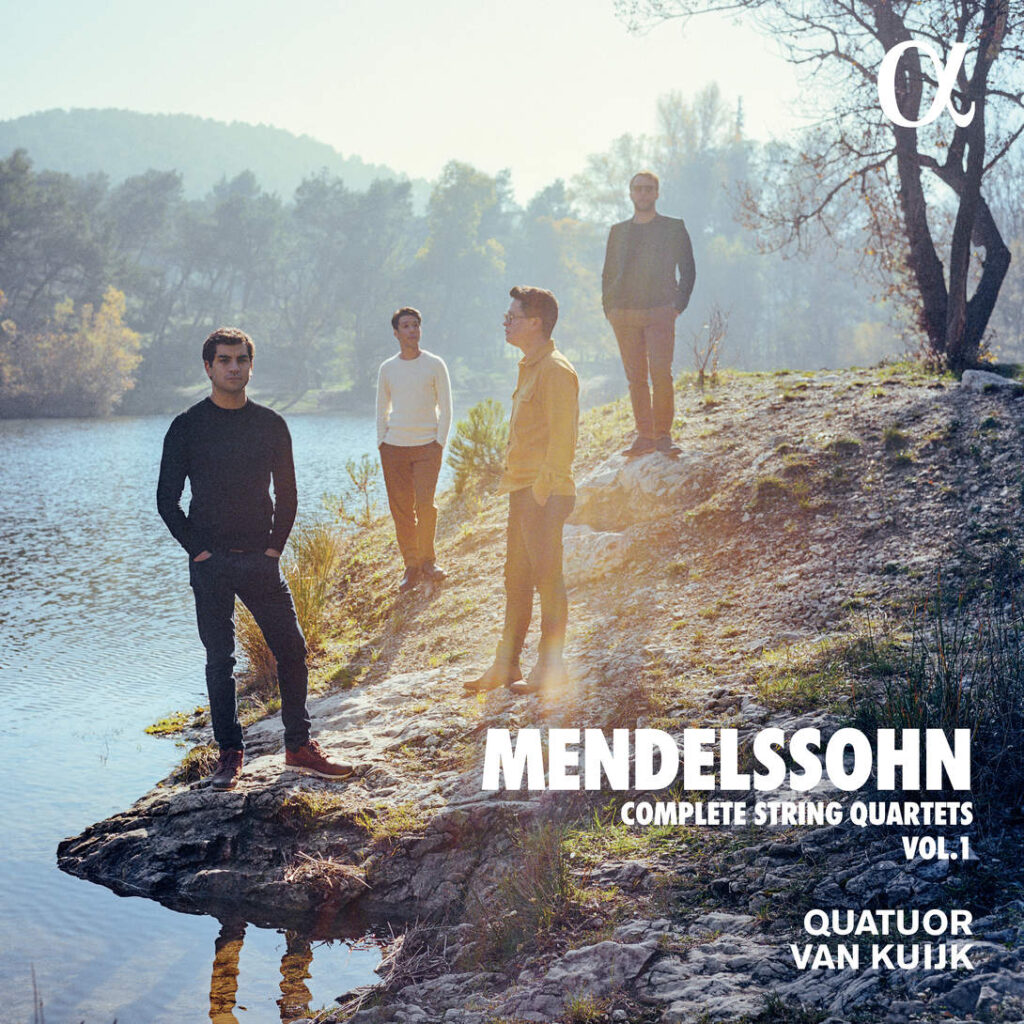
- WHAT: Mendelssohn. Complete string quartets. Volume 1. String quartets opus 12 in E-flat, 13 in A minor and 44 no. 1 in D
- WHOQuatuor Van Kuijk (Nicolas Van Kuijk [violin], Sylvain Favre-Bulle [violin], Emmanuel François [viola], Anthony Kondo [cello])
- LABEL: Alpha Classics, ALPHA 873
- ORDER: Cypres CYP8614