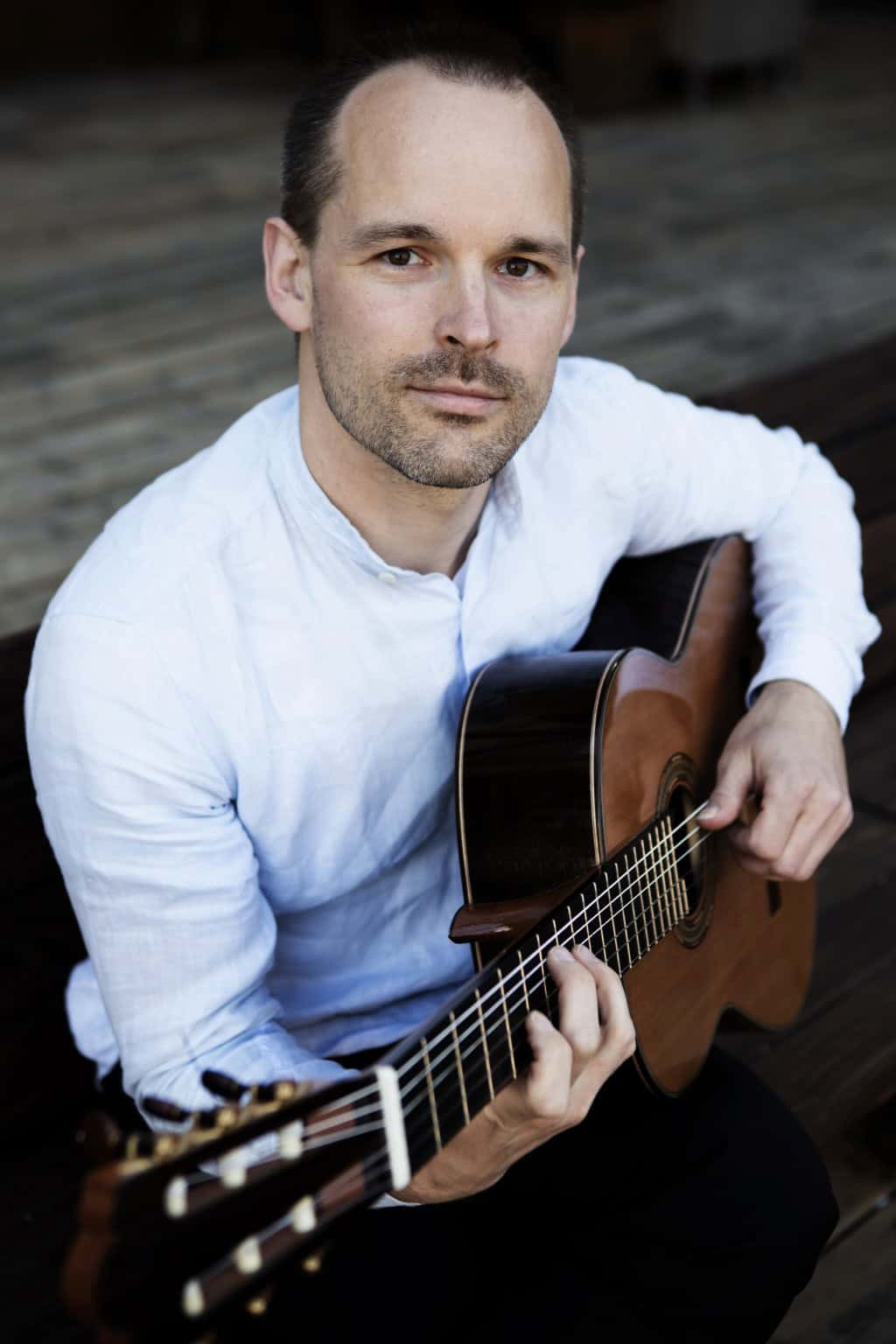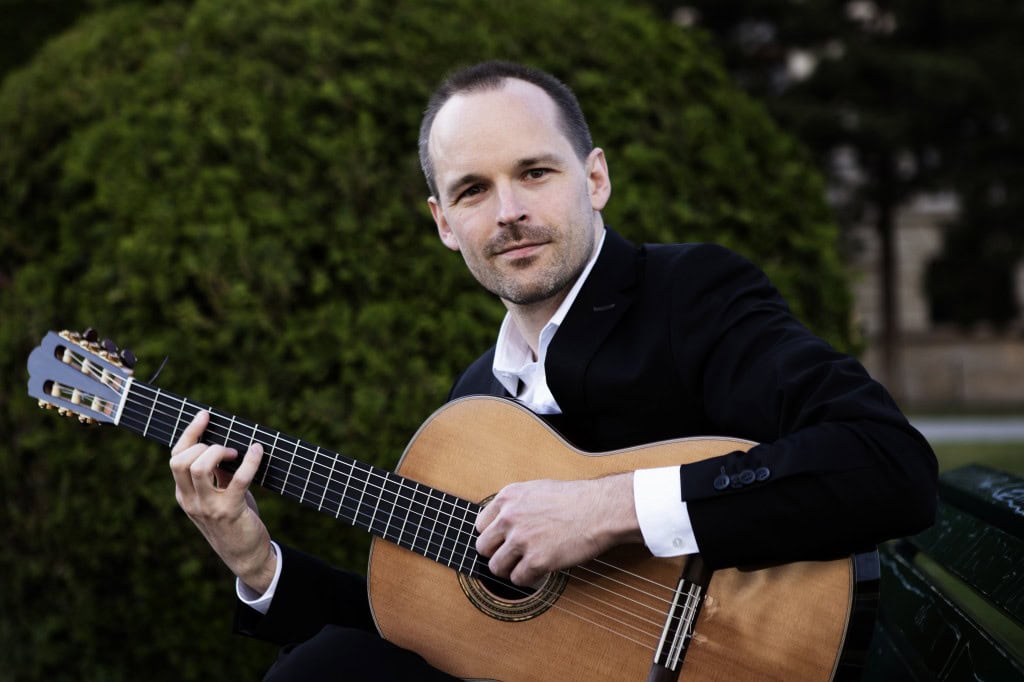
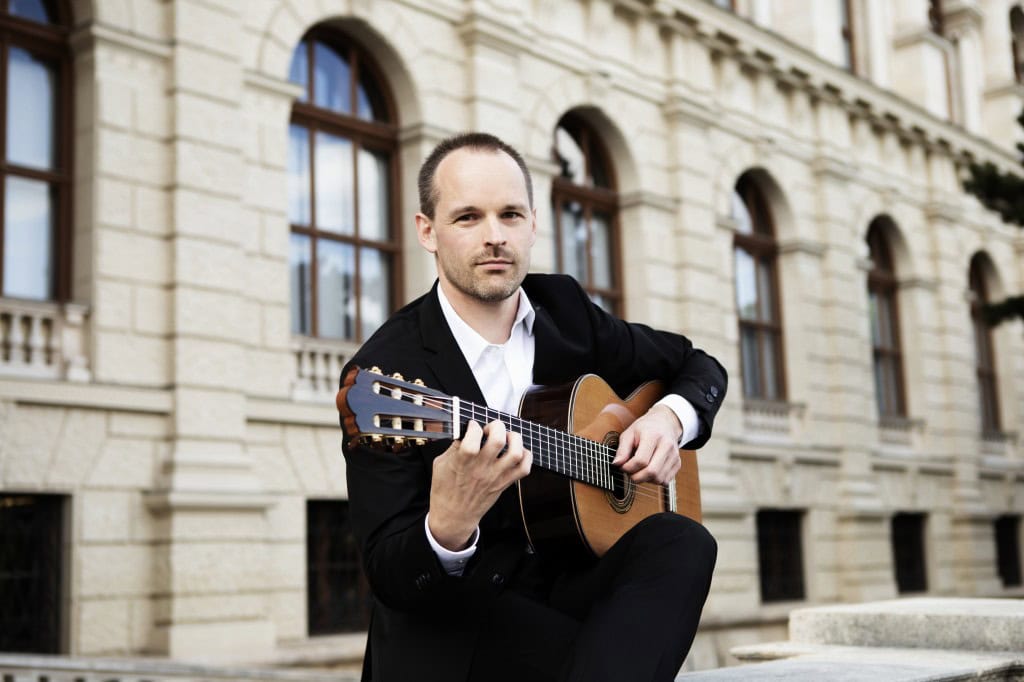
Austrian guitarist and composer Florian Palier is one of the most compelling voices in today's European guitar world. In his music, order and spontaneity merge, craftsmanship and imagination intertwine. Klassiek Centraal spoke with him on the occasion of the Antwerp Guitar Festival about sound, silence, travel, teaching, and the art of remaining free within a structure.
Music as a Mother Tongue
Florian Palier grew up in a world where music was as natural as breathing. His father, Johann Palier, is himself a celebrated guitarist and composer. "My father would often practice while I fell asleep as a child," Florian recalls. "For me, music was simply part of life – I actually had to learn at school that not every child grew up with music at home." "There are hardly any childhood memories without music," he says. "We constantly played and sang together as a family. Music was just part of everyday life."
His father remained his teacher for years, and that intensive collaboration was both a gift and a challenge. "At some point, of course, I had to break away to find my own voice." That early familiarity with sound shaped him, but also challenged him. "I studied with my father for a long time, and he was a wonderful teacher. Still, like every young musician, I had to find my own path at some point." That search took him far beyond classical boundaries. As a teenager, he discovered jazz and rock; later he traveled for months through Indonesia, Malaysia, and Morocco, where he immersed himself in Gamelan and the Gnawa tradition. "Every new style I learn enriches me. The guitar is the perfect instrument for that – it speaks all the languages of the world." Today, history repeats itself: "My son Emilio is ten months old, and I play a lot for him – often Bach. It's remarkable to see how music also becomes a natural part of his world."
The Composer: Architect of Emotion
Palier composes regularly, and in doing so, he seeks the interplay between intuition and construction. "Composing is both creative and technical. Inspiration and organization must be in balance."
His ideas can emerge from a single sound, an image, or a literary impression. "A bird's call, the wind, a line from Proust – anything can be a starting point." "Rilke has also influenced me strongly, and in visual art especially the serene world of Jan Vermeer. The way they capture time and light inspires my musical language."
He sees structure not as a limitation, but as a framework that enables freedom. "Forms can support freedom. Look at Renaissance composers like Luys Milán – they moved freely within very strict rules. I find that fascinating." When a work is finished, for him it's rarely a matter of feeling alone. "Often there's a deadline," he laughs. "But ultimately I know rationally when the architecture is right. Still, as a performer of my own pieces, I retain the right to change things later."
Improvisation: The Art of the Moment
For Palier, improvisation is not a side note, but an essential part of his musical thinking. His fascination began through jazz and grew into a fundamental conviction: "Improvisation is freedom. In music as a time-based art, in each moment there is precisely that one right note." He quotes Goethe: "Only what the moment creates, that can he use." Sometimes improvising is an inner dialogue, sometimes a reaction to the space or the audience. "Anything goes. Sometimes it's a color, sometimes a thought. Improvisation lives in the now – what it says can never be repeated." "In a sense, improvisation is like the spoken word, while composition is more like deliberate prose or poetry," he says. "Both are essential." The line with composition also blurs. "In some pieces I leave passages open, and when I publish them, I later notate my own improvisation as a suggestion for other performers."
The Quest for Sound
Palier's tone is remarkably clear and warm – never effect-driven, but rich in nuance. "The sound is an inner conception that I try to realize through my body. That remains an endless journey of discovery." "Tone arises from a complex interplay of body, fingernail shape, string, and space," he explains. "The most important thing is always the inner sound conception – the image I want to realize."
He works closely with guitar maker Michael Cadiz, an American living in Graz. "It's remarkable to see how his instruments develop."
Experiments with tuning and playing technique are part of this process. "Especially in contemporary music, I use alternative tunings – it opens new worlds."
Recording practice has helped him refine his sound further. "My brother Benedikt is a sound engineer; together we've spent hours experimenting. But the quest for one's own tone is a lifelong process – with each new experience, your idea of sound changes."
The Teacher Who Never Stops Learning
Alongside his concert career, Palier is a passionate teacher at various conservatories, including those in Graz and Klagenfurt. "Teaching enriches me enormously. Every student requires a different approach, and that keeps me sharp." This certainly applies to his experience at the Musikuniversität Wien. "Each student has their own path, and to explain something in different ways, I must keep learning myself. That's what makes teaching so valuable." He tries to bring his students a balance between technical mastery and personal expression. "Technique is not an end in itself, but a means to say what you want to say. The most beautiful moments are when someone finds their own voice." On his travels, he notices how culture influences musical experience. "A student in Asia or South America approaches music differently than someone in Europe. We all carry our own sound landscape within us."
The Stage as Meeting Place
He pays great attention to dramaturgy: "A good program tells a story. Programming also depends heavily on context – some works fit certain venues better than others. And I only play pieces I truly believe in." He pays great attention to dramaturgy: "A good program tells a story. And I only play pieces I truly believe in." The atmosphere of the audience has a direct influence on his playing. "Whether I can see the audience or not changes everything. Acoustics also play a major role – they determine how the music breathes." A performance in Taipei left a particular impression on him. "After the first piece, I greeted the audience in Mandarin, and five hundred people responded in unison. That warmth and discipline were impressive."
Inspiration and the Future
Palier's inspiration extends far beyond the guitar. Musically, he admires, among others, Mendelssohn's Fourth Symphony, Berg's Wozzeck, Zemlinsky's Lyric Suite, and the voice of Omara Portuondo.
He talks enthusiastically about a recent performance of Die Fledermaus at the Theater an der Wien. He also recently visited the exhibition Gothic and Modernity at the Wiener Albertina: "The expressive power of Käthe Kollwitz and Edvard Munch deeply moved me, as did the refined symbolism of Lucas Cranach." In literature, Proust and Thomas Mann are his enduring guides.
He thinks about the future of the classical guitar with nuance. "I love the classical repertoire, especially when performed with fresh eyes. But I also crave innovation. Both can exist side by side – if done well." "Besides, there's so much beautiful repertoire from the past that is played too rarely," he adds. "I hope we'll be bolder in that regard too." His next project is already in the works: a fifth solo album, devoted to music that shaped him as a child. "Now that I'm a father myself, that takes on special meaning. As if the circle is closing."
A Life in Development
When Palier looks back on his journey as a musician, he mentions his studies in Vienna and his teaching positions in Graz and Klagenfurt as decisive moments. "There I learned that music is not just a profession, but a way of thinking," he says. When asked what he hopes a listener experiences after his concert, he smiles: "That someone says: 'I didn't know that was such a beautiful piece.' Then I've opened something."
The Power of Silence
At the end of our conversation, Palier returns to something that permeates his music: silence. "Silence is the blank canvas on which I paint my musical image." This thought resonates in his playing: the rest between notes is never empty, but charged with meaning. It is precisely there, in the space between structure and freedom, that his art breathes.
Florian Palier will be a guest on Saturday, November 8 at the Antwerp Guitar Festival, where he will share his unique sound world – a balance between thinking and feeling, between order and improvisation. A musical voice that reminds us that silence is sometimes the deepest note.