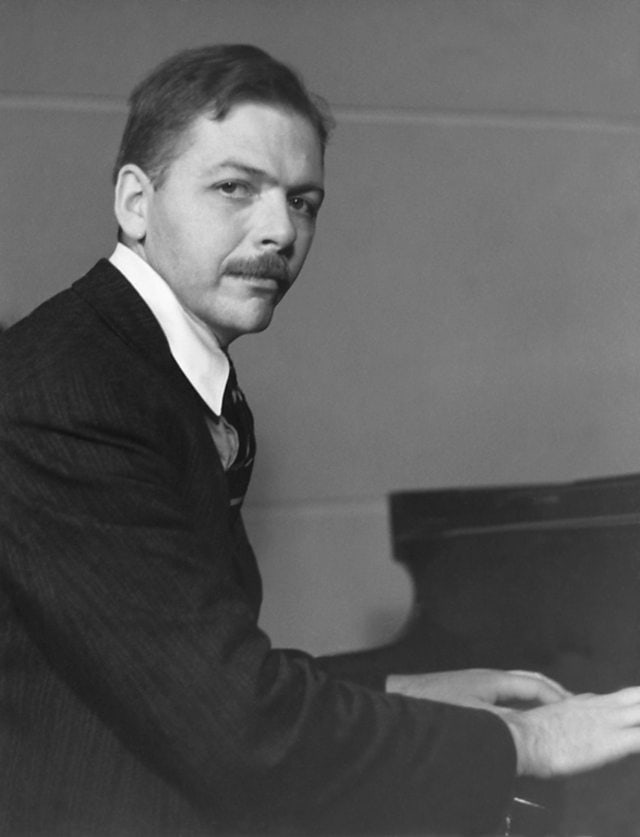
Victor Hely-Hutchinson (1901–1947) belongs to that generation of British composers who consciously grappled during the interwar years with the question of how tradition and symphonic form could reinforce each other. Stylistically, he stands in the tradition of the English musical renaissance that began around 1900, a movement in which composers such as Edward Elgar (1857–1934), Ralph Vaughan Williams (1872–1958), and Gustav Holst (1874–1934) sought to find a recognizable national voice and folk music roots.
Hely-Hutchinson shares this fascination with English melodic richness and combines it with refined symphonic architecture, giving him a unique place within the British tradition of symphonic thought. His name today is chiefly associated with one work, the "Carol Symphony" from 1927, but anyone who listens carefully to this piece hears more than a curiosity from the Christmas repertoire. Here speaks a composer with a keen sense of form, orchestral color, and musical continuity.
A composer with a sense of context
Born in Cape Town and trained at the Royal College of Music and Oxford, Hely-Hutchinson developed into a musician firmly rooted in British musical culture. His education and aesthetic place him squarely within the same tradition as his more celebrated contemporaries, though he chose a more restrained, craft-oriented approach rather than overt innovation. He stood close to the late-Romantic tradition, yet was equally sensitive to the rediscovery of folk music and modal harmonies that played such an important role in his time. Like Vaughan Williams, he saw traditional melodies not as nostalgic material but as a living source for symphonic thought.
His later work as a conductor and music official at the BBC reveals a practically minded musician—someone who knew how music sounds, functions, and resonates in the concert hall. This also places him in the line of English composers who actively shaped musical life, rather than positioning themselves merely as 'a composer at the desk.' That experience is clearly audible in his compositions: they are clearly written, carefully proportioned, and always focused on musical coherence.
The "Carol Symphony": concept and ambition
The "Carol Symphony" was created in 1927 and is structured as a sequence of four connected movements performed without pause. Traditional English Christmas carols form the thematic foundation, but Hely-Hutchinson deliberately avoids a loose suite or orchestral collage. Here he follows a characteristically English approach in which folk music is not cited for its color but incorporated into a classical form that gives the work its strength. The result is a contemplative yet dramatically coherent journey through familiar melodies that lodge in the ear but gain new meaning in a rich symphonic context.
A poetic journey through Christmas sounds
The first movement opens as a solemn, stately procession of sound, in which O Come, All Ye Faithful unfolds like a radiant Christmas light ray through brass and strings. The theme shines warm and clear, like a winter sun gleaming across a snow-covered landscape, sometimes softly whispering, sometimes exuberantly jubilant, yet always elegant and carefully crafted. Motifs weave together like twinkling lights through the harmony, variations unfold like sparkling snowflakes gently descending, while the structure remains firm as an ancient cathedral bearing the Christmas spirit. Behind the apparent simplicity of the melody lies a masterfully designed symphonic tapestry in which Hely-Hutchinson subtly guides the listener through a world of rhythmic movement, stately splendor, and warm Christmas joy.
The second movement is a lively scherzo in which God Rest Ye Merry, Gentlemen and fragments of other carols dance like playful snowflakes through the orchestra. Rhythmic leaps and cheerful accents give the orchestra vibrant energy, with woodwinds twinkling like Christmas lights and strings rhythmically shimmering. It's a musical winter market full of movement and contrast, where Christmas joy resonates in every note. The short motifs and lively interplay between the various sections of the orchestra create a sense of playful adventure, as if walking through a snow-covered village while Christmas music drifts through the air.
The third movement dims the jubilation and unfolds in contemplative winter stillness, carried by the ethereal, medieval-sounding Coventry Carol with a central interlude of The First Nowell. The melody sounds like a whisper across a quiet, snow-covered meadow, where the night gently falls and stars reflect on the ice. The orchestration is fragile and transparent, with soft woodwinds and velvety strings subtly accentuating the Christmas atmosphere. It is a moment of introspection and warmth in which the listener can feel the serene magic of Christmas night, without sentimentality, just the pure, heavenly sound of old melodies in a new symphonic form.
The fourth and final movement brings all thematic lines together in a jubilant finale. Here We Come A-Wassailing opens as an exuberant, joyful procession, with the orchestra sparkling and Christmas joy palpable. As the themes from earlier movements—the stately O Come, All Ye Faithful, the sparkling scherzo, and the nocturnal Coventry Carol—return one by one, the music swells into a rich, symphonic tapestry of light, warmth, and harmony. The conclusion radiates festive brilliance, like a sun rising above a silent, snow-covered world, leaving the listener with a sense of satisfaction, Christmas joy, and deep admiration for Hely-Hutchinson's masterly symphonic craftsmanship.
Sparkling Melodies in the Christmas Night
Victor Hely-Hutchinson was not a composer of grand gestures, but of subtle masterworks, where craftsmanship, sensitivity, and a deep respect for musical tradition converge. His "Carol Symphony" is a symphonic walk through a winter landscape of sound, where familiar Christmas melodies glitter like twinkling snowflakes and soft orchestral colors breathe life into the magic of the season.
Those who listen to this work attentively discover a rich tapestry of tradition and imagination, a symphony that takes the listener from solemn processions to playful winter fun and serene, snow-covered nights. It is a work that not only captures the Christmas spirit, but speaks to the heart—a musical embrace full of warmth, light, and joy.
The "Carol Symphony" deserves to be heard more often, not merely during the Christmas season, but as a full-fledged voice within the English symphonic tradition. Let yourself be enchanted by its rhythmic sparkle and deep serenity—a work that can move, surprise, and inspire time and again.