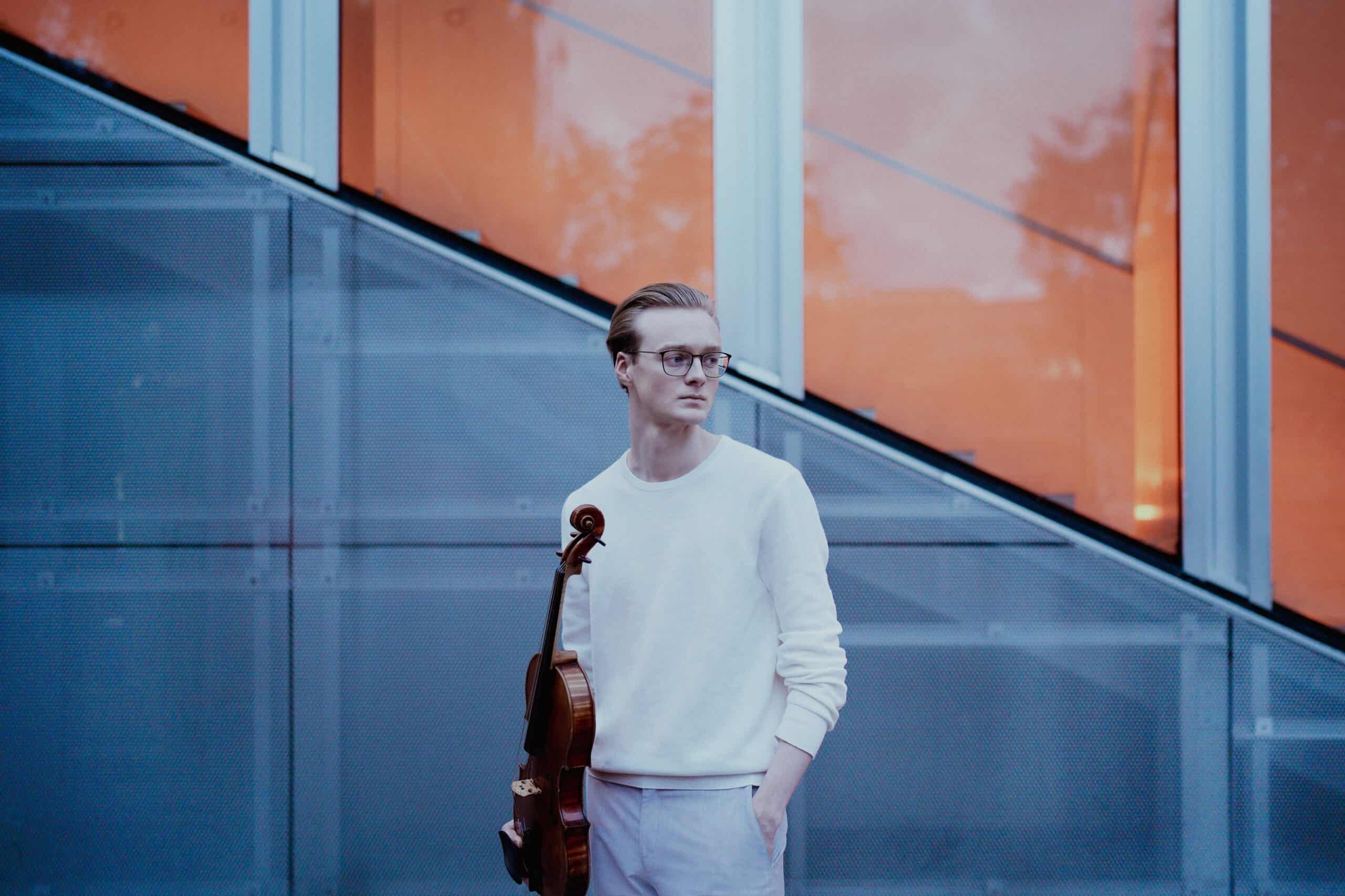
This conversation was sparked by a concert in the Kleine Zaal of the Concertgebouw in Amsterdam on January 16, where Sào Soulez Larrivière performed alongside his sister Cosima Soulez Larrivière. What struck me most wasn't just the effortlessness of their musicmaking, but the way the music seemed to unfold in the moment itself: attentive, listening, sparkling in dialogue. It was a form of musicmaking that lingered, and that invited deeper listening. From that shared enthusiasm grew a conversation in which Sào Soulez Larrivière further unfolded his vision on music, the viola, and the concert as a meeting place.
An ally between strings and silence
Sào Soulez Larrivière speaks about his instrument as if it were a conversation partner. "The viola is my voice and my confidant," he says, immediately adding that the instrument also has a will of its own. This tension between intimacy and autonomy characterizes not only his relationship with the viola, but also his broader musical attitude. As one of the most remarkable violists of his generation, he moves effortlessly between tradition and innovation, always driven by one core idea: music is communication.
This conviction took shape along a path that didn't obviously begin with the viola. Soulez Larrivière started as a violinist and only later came into contact with the instrument. During his time at the Yehudi Menuhin School in England, he began exploring the viola in chamber music and orchestral contexts. The switch was initially anything but straightforward. "The instrument felt unfamiliar because of its size, weight, and even the different clef," he recalls. The stubborn stigma surrounding the viola also made itself felt. Yet slowly grew the realization that this was his musical home. "Over time, I realized that this really was the instrument for me. I fell in love with its sound and what it represents."
What attracted him most was the communicative character of the viola. "It's naturally an instrument for ensemble playing and dialogue," he says, "but at the same time it has enormous potential and unique versatility as a solo instrument." Through the viola, he discovered, in his own words, "a deeper way of listening" and ultimately "a more authentic musical identity."
A decisive chapter in this development began with his studies under Tabea Zimmermann. That period has permanently shaped his musical thinking. What he takes from that collaboration can't be captured in technical instructions, but in an attitude. "Above all, humility," he emphasizes. "Remaining honest about the music, and equally honest with yourself as an artist." It's a lesson he also recognizes in his encounters with musicians like Nobuko Imai and Steven Isserlis.
That same honesty underlies his vision of concert practice and programming. For Soulez Larrivière, musicmaking fundamentally revolves around creating an experience. "For me, it's about storytelling," he says. "How you shape a concert, how you frame the music, and how you communicate with the audience." In his view, the audience doesn't just want to hear the repertoire, but also "meet the person behind the instrument." That opens the door to new perspectives on familiar works, placing music in different contexts, bringing new compositions to life, and experimenting with forms and technology. "The possibilities are virtually unlimited today."
His instrument plays a central role in this. Soulez Larrivière plays a 2013 viola by Frédéric Chaudière, an instrument he engages in conversation with anew each day. "Every day is different – a new space, different acoustics, temperature, humidity," he says. "We really have to discover each other anew every day. It's a constant process of dialogue and searching together." This ongoing attunement is, in his view, part of the artistic truth of musicmaking.
As a violist, he deliberately positions himself in the middle. "The viola is the middle voice, the mediator," he states. In chamber music, that means constantly listening in two directions. "It's my favorite place to be: learning how to respond, how to support, and how to subtly introduce my own ideas into the musical conversation." This middle position is not a compromise, but an active, creative role.
Limitations as opportunity, arrangement as adventure
Soulez Larrivière also approaches the viola's limited traditional repertoire from that same positive mindset. "This is exactly where you can thrive," he says. "Limitations create opportunities." They stimulate arranging, commissioning new works, and genuine innovation. In this way, the performer becomes co-responsible for shaping the repertoire of their instrument. In his own arrangements, he always starts from a personal connection to the work. "First and foremost, it has to be a piece I truly love," says Soulez Larrivière. Then comes the question of how the musical essence can be preserved within the range and character of the viola – a process that requires technical ingenuity and extensive experimentation.
That narrative way of thinking also manifests itself in programs such as LoCoMotion, which brings together works by Paul Hindemith (1895-1963), Steve Reich (b.1936), Julia Wolfe (b.1958) and György Ligeti (1923-2006). "Music always speaks for itself," he says, "but my role is to provide a context that helps the audience experience the music more deeply." In this case, the idea of movement forms the connecting thread: Hindemith writing his sonata on a train, Reich's repetitive motorics, Ligeti's radical approach to loops. "It's about finding these connections and weaving them together into a story."
In his interpretations, Soulez Larivière continually seeks a balance between historical awareness and personal voice. "I try not to let myself be too influenced by recordings or tradition alone," he says. "I want to approach the score with a fresh perspective, an open ear and curiosity." At the same time, context remains essential: knowing who the composer was, when and why a work was written. Certain music remains an enduring source of inspiration. "There are works I always return to," he says, particularly the cello suites and the sonatas and partitas for violin by Johann Sebastian Bach (1685-1750). He is fond of citing Brahms, who wrote that Bach "managed to capture on a single staff, for a small instrument, an entire world of the deepest thoughts and most powerful feelings."
A special place in his artistic life is occupied by collaboration with living composers. Working on new music, such as Julia Wolfe's Cloth, opens a different perspective. "It is an extraordinary privilege to work directly with composers on their own music," he says. "You enter their creative world and gain insight into how they imagine sound and structure." Bringing a piece to life together with its creator is, in his view, an intense and enriching process, fundamentally different from interpreting historical repertoire.
Music as a breathing encounter
Thus unfolds the portrait of a musician for whom the viola is a place of encounter. In the middle of the sonic field, listening and directing, Sào Soulez Larivière continually seeks connection—between voices, between musical periods and between music and audience. His viola is not merely an instrument, but a conversation partner, a refuge, and an invitation to shared discovery. In his hands, a musical landscape emerges where tradition and innovation meet, where the personal and the universal find resonance, and where the audience does not merely listen, but is drawn into the process of making music together. Thus Soulez Larivière demonstrates that classical music need not be a distant heritage, but a living, breathing experience—an encounter, renewed each day.