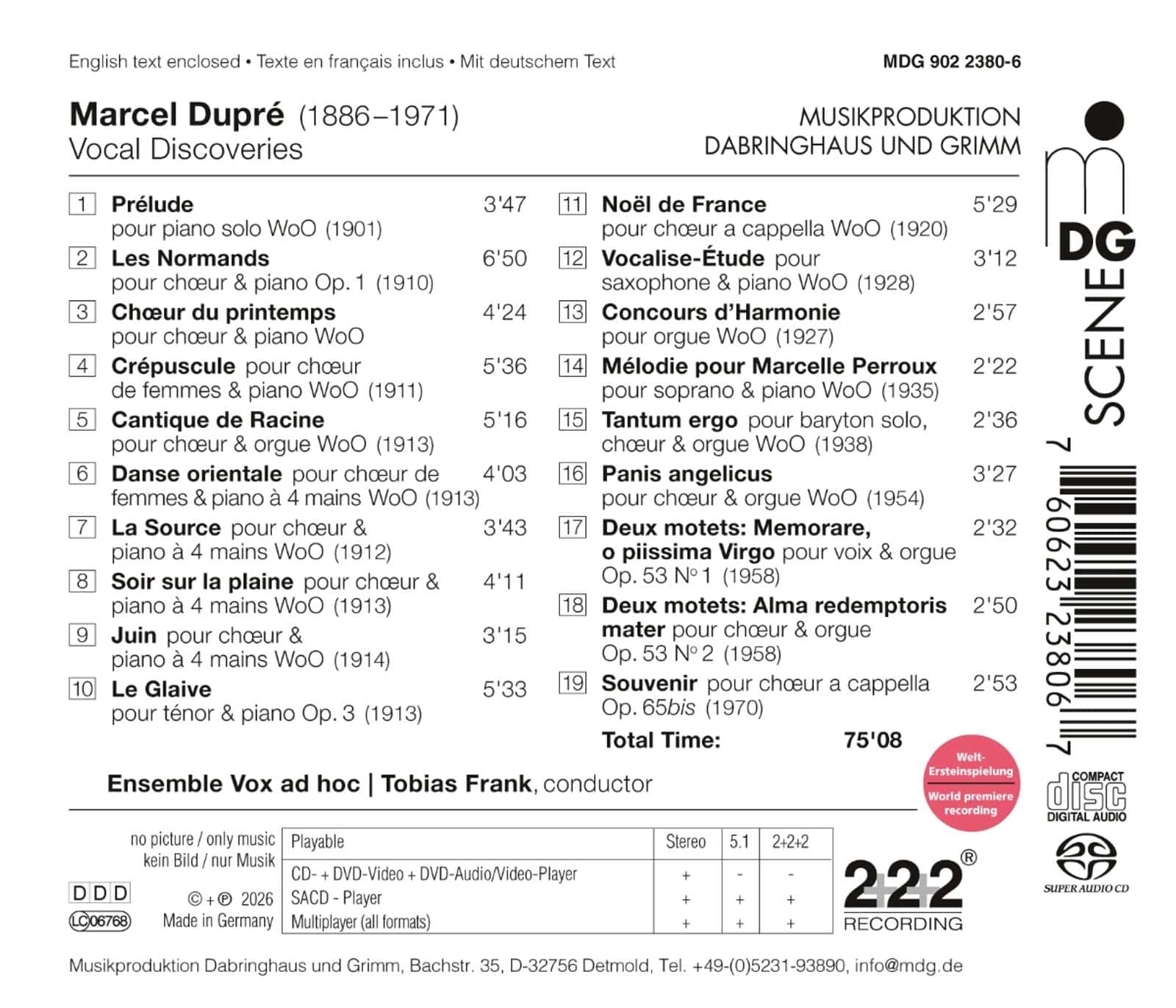
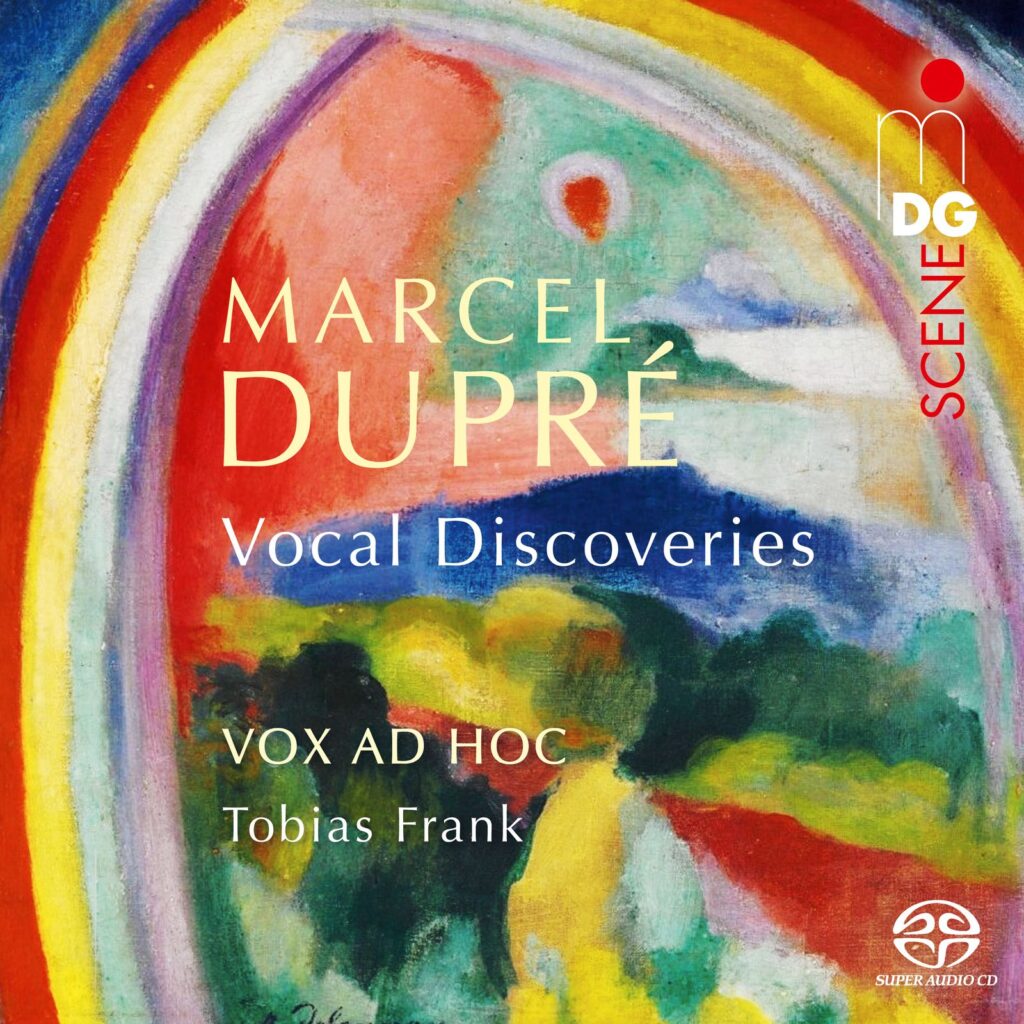
Marcel Dupré is one of the greatest virtuosos of French organ music; as a student and later successor of Widor, he led the great tradition of French organ romanticism into the modern era. Tobias Frank and his ensemble Vox ad hoc present a hitherto completely unknown side of Dupré: vocal works with piano or organ accompaniment, solo or purely a cappella, which until recently lay modestly and largely unnoticed in the archives of the French National Library. Marcel Dupré grew up with choral music: his father's choir rehearsed weekly in the living room of his parents' home. And so his earliest compositions were characterized by what he heard there: Bach, but also Beethoven and Rossini are unmistakably present in the Prélude from 1901, which precedes op. 1 of this entire collection of gems.
Most of the predominantly secular choral compositions were written during Dupré's student years. On the one hand, they reflect that time, not least through the choice of often mythological or patriotic subjects. The exoticism that was popular in the late Belle Époque is also reflected, for example, in the Danse orientale. The program offers interesting color shifts because some songs are performed by soloists – the solo part of the Vocalise-Étude is performed by saxophonist Christian Segemehl. Later, these are mainly occasional works up to his final composition, the deeply personal Souvenir, an a cappella vocalise "Andante nostalgico" from 1970.
Tobias Frank has immersed himself in Dupré's oeuvre more than perhaps anyone else – for over 20 years he has been researching the composer's untapped legacy, to which he has virtually exclusive access thanks to a personal relationship. It is fascinating to hear the unity of this succession of such diverse works on this SACD, which follows Dupré's compositional path – certainly also a result of the personal dedication that can be heard in every note.
Reviews
"All without exception excellent singers who truly sing choral music and not as soloists, with almost no vibrato, thus quite instrumentally guided. They unite to form a lively, very stable, robust, as it were steel-bright and luminous choral sound; the articulation is very flexible, so that the ever-moving, ever-lively and vibrant choirs are filled with this joie de vivre… Everything is captured by the sound engineering in the Himmelfahrtskirche with excellent spatial precision and superb tonal balance between piano and choir." (Klassik Heute)