
Franz Schubert, who scarcely ever owned a violin of his own, created music of remarkable intimacy for this instrument. He was no virtuoso in the conventional sense, but rather a master of the soul-stirring language of sound. Like his piano works, his pieces for violin and piano also open up that realm of "the beyond" where the earthly transcends into transcendence. In their dialogue, the opposing worlds of the violin—the "fractured tone"—and the piano—the "bound melody"—converge into a lyrical unity that doesn't "represent" anything, but simply "is".
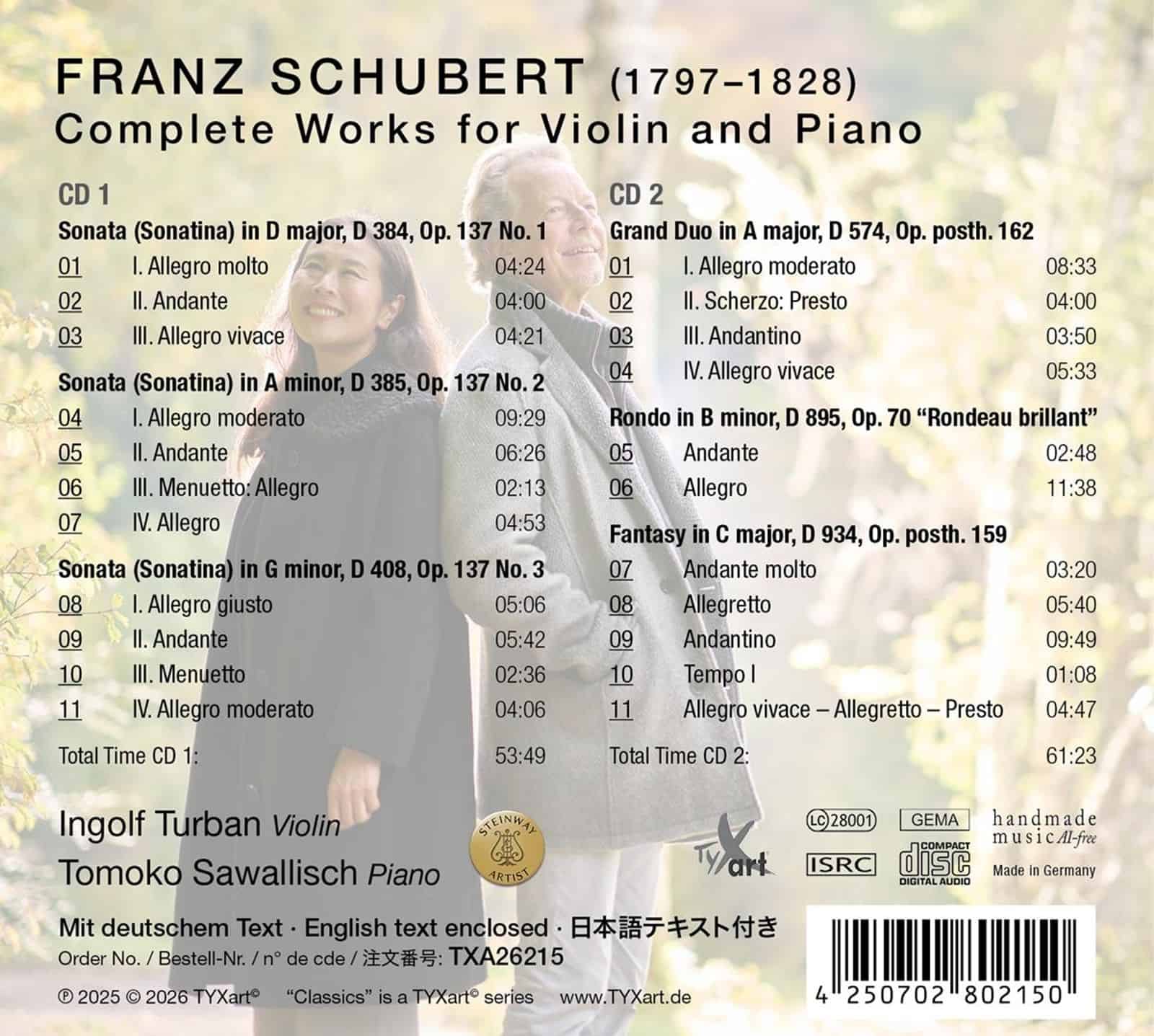
Between 1816 and 1817, Schubert composed four sonatas in which he drew inspiration from Mozart while forging his own path. Behind the cheerful facade of the so-called "sonatinas" often lies profound gravity. The young composer transforms the classical form into a space of floating harmony where melody takes the place of motivic development—music as sensation, not as construction. In the A Major Sonata of 1817, this principle reaches pure lyricism: heaven and earth touch without ever meeting.
Ten years later come two late masterworks: the Rondeau Brillant in B Minor (1826) and the Phantasie in C Major (1827). Both are dedicated to the young violinist Josef Slavík, whose virtuosity inspires Schubert to mentally penetrate to the Brilliant. A mysterious abyss lurks behind the shimmering surface of the rondeau—Paganini's "demonic spirit" appears transfigured as an angel's voice. In the Fantasie, Schubert finally transcends all formal boundaries. The work, which weaves the song "Sei mir gegrüßt" into its structure, becomes a musical symbol of farewell and redemption. Virtuosic gestures are transformed into existential expression; the song of love resonates as a distant memory—between dream, death, and transcendence.
This music is not a concert piece, but a poetic revelation: Schubert's "music of the spheres," in which the "here" and the "there" become one.