With the surrealistic opera The Turn of the Screw (1954) by composer Benjamin Britten, De Munt brings a psychologically thrilling production in chamber opera format. Both the story and the staging develop under the direction of British conductor Ben Glassberg and director Andrea Breth in a cinematographic format. The story of an English country house – and its young, tormented, innocent inhabitants – hides a mystery in which nothing is what it seems.
In 1898, the world was at the beginning of a new musical era in which composers such as Arnold Schoenberg would shake musical traditions to their foundations with a provocative, new tonality. Society created new perspectives in terms of creativity and realism. This new reality was also the source from which Henry James's psychological horror novel, The Turn of the Screw, drew its inspiration. The story of the psychologically tormented children and their governess was a reflection on the new anxieties of society, in which mental reality gave way to a surrealistic analysis of what lay beyond what one saw. In 1954, British composer Benjamin Britten would ultimately set out to translate this complex story.
Twelve tones
Britten needed no more than that to musically express the illustrious, unseen diabolical nature of Bly House. The Screw-theme consists of three chromatic tetrarchords (three intervals, or tone sequences). This all creates an ominous sound that floats through the story like a leitmotiv. This creates an omen in sound form, a threat that transcends the reality of the moment – the unseen fear of the secret of Bly House. The story revolves around an underlying threat from beyond the grave – the deceased servants Peter Quint and Miss Jessel – and that is the red thread that connects reality with the supernatural. The past hovers around in the form of Britten's personal sound world.
Cinematographic fear
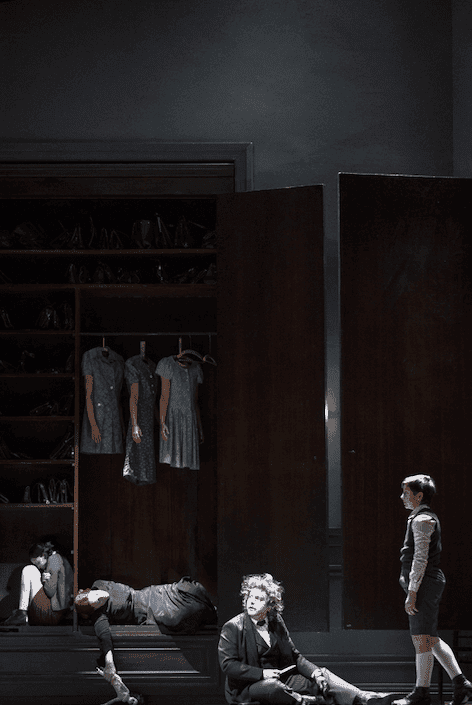
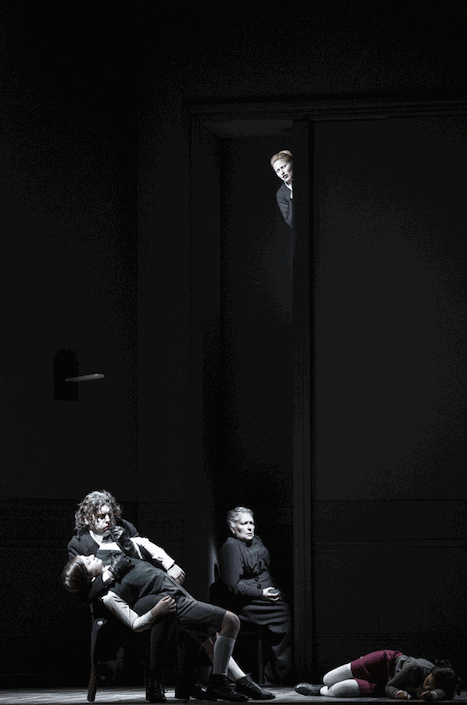
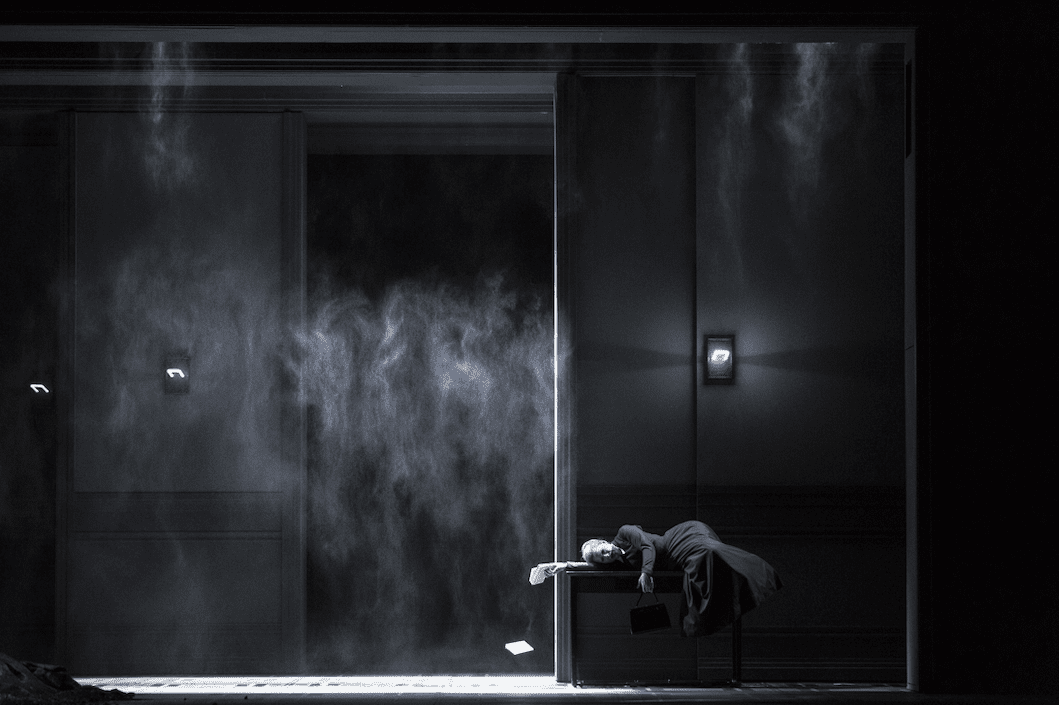
The visual language used by De Munt is a communicative feat of strength. Central to it is a space that appears multidimensional through fragmentation, with secret niches and corners, and a stage divided into harsh spotlights - it becomes a story within a story. Cinematographic language speaks to a layered opera like The Turn of the Screw. The staging is certainly a bullseye.
The voices are just as vivid as the physical space. Soprano Sally Matthews (Governess) comes through powerfully and the quality of her hysteria and fears is audible. Mezzo-soprano Carole Wilson (Mrs. Grose) surprised with a hefty dose of realism in her timbre that lifted credibility to a higher level. She allowed herself to challenge her vocal range capabilities, thereby alternating qualitative rawness with the usual refined opera style. In these kinds of operas (and their accompanying productions), it is refreshing to break away from the usual smooth line. Beauty is certainly audible, but also depth in all possible vocal emotions. This, alternated with the ominous yet childishly rhyming singing of the two young roles – Flora (soprano Katharina Bierweiler) and Miles (boy soprano Henri De Beaufort) – creates a disconnection from reality that directly draws a line to the psychological horror of the story: two young children tormented by the terrible ghosts of the past. These two phantoms, Miss Jessel (Soprano Giselle Allen) and Peter Quint (tenor Julian Hubbard), are an unfortunate curse on these two young spirits. This opera is not meant to be sung beautifully à la Bel Canto, but in the spirit of classical singing culture to scream out fear and emotion.
With the chosen singers, this has already established an important link to the story that makes this production a finished product of physical and emotional substance. Everything clicks, everything sounds, and with this The Turn of the Screw by De Munt creates a thrilling scenario that develops like a Hitchcock-style thriller and other cinematographic masters. It is a double-edged sword – both visually and musically.
- WHAT: Benjamin Britten's The Turn of the Screw (1954)
- WHO: De Munt/La Monnaie
- WHEN: From 29 April to 6 May 2021 via livestream
- PRODUCTION: De Munt/La Monnaie, viewed 29 April 2021
- BROADCASTS: Klara on 22 May 2021, Musiq3 on 22 May 2021
- PHOTOS: © Bernd Uhlig