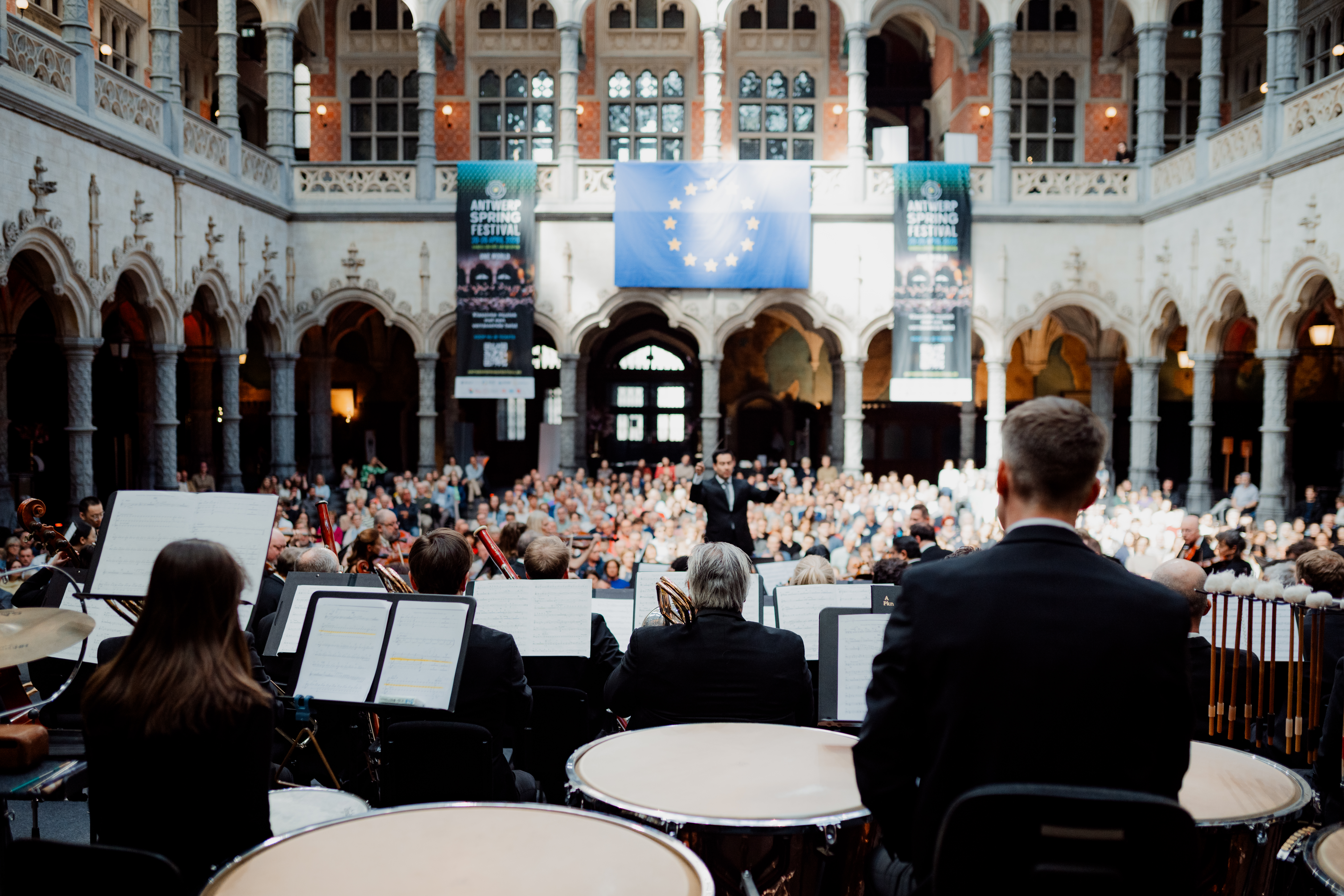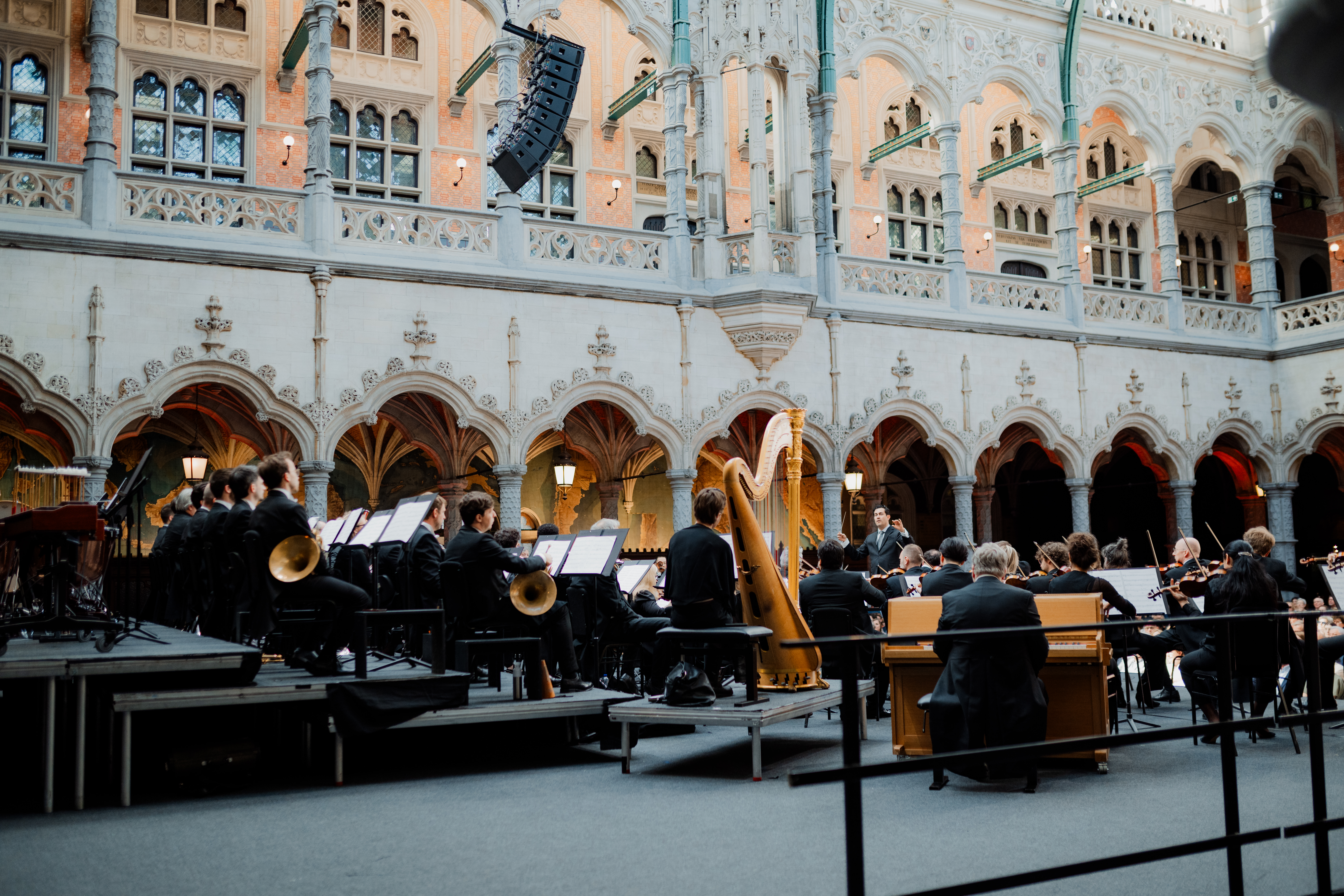
With the closing concert "From the New World" the Antwerp Spring Festival crowned its fifth edition with a performance that was not only thoughtfully programmed, but ultimately proved to be an impressive musical experience. In collaboration with Opera Ballet Vlaanderen, on Sunday 26 April a journey was undertaken that led from the Caribbean soundscape via Afro-American traditions to Dvořák's European perspective on the "New World" – a line that in the Handelsbeurs Antwerpen came impressively into its own both in terms of content and acoustics.
Under the passionate direction of Diego Matheuz, the Symphony Orchestra of Opera Ballet Vlaanderen confirmed its very high level. What immediately struck one was not only the technical mastery and homogeneity, but especially the intensity and pleasure of the ensemble playing: here stood an orchestra that performed with clear commitment to the repertoire. Matheuz proved to be the ideal partner as a charismatic conductor who coupled structure and clarity with an infallible sense of expression and tension building. Conductor and orchestra formed a particularly tight match.
The opening with Margariteña by Inocente Carreño (1919-2016) immediately set the tone with a sparkling and colorful performance that carried more than mere exotic charm. In this work, rooted in the atmosphere and rhythms of the island of Margarita, Carreño combines dancing energy with a refined sense of orchestral color. The orchestra managed to convincingly grasp that dual layering: lively, rhythmically sharply profiled passages were alternated with more contemplative moments, without the line of tension being lost. The orchestration sounded clear and differentiated, with a natural breathing space between the different groups. Particularly striking was the melancholic middle section, in which the music temporarily withdrew and made room for more introspection. The solo passages from, among others, the first violin and cello were delivered here with a beautiful ease and expressive nuance. Characteristic was the organic way in which contrasts were worked out: exuberance and refinement did not oppose each other, but flowed logically into one another. Thus Margariteña not only gained color, but also a clear form and inner coherence.
With Ethiopia's Shadow in America by Florence Price (1887-1953) came a work that can not only be heard, but also read as an impressive musical narrative. Price evokes here a trajectory from African origin to the Afro-American reality, with elements from spirituals, late-romantic tradition and its own thematic material interlocking. Matheuz and the orchestra approached this with audible care for structure and layering. The different sections – contrasting in character but thematically connected – were clearly profiled and logically built up, with attention to detail without losing sight of the whole, with particularly the contrasting episodes – from restrained lyricism to more explicit drama – sharply articulated. The warm string sound and the nuanced woodwinds provided a rich, but never heavy sound image. At the same time, the underlying tension remained beautifully controlled. Striking were the seriousness, the dedication and the conviction with which this repertoire was approached: not as a rare addition, but as a fully fledged symphonic work. The emotional charge was not exaggerated, and thus worked all the more effectively. The result was a reading that convinced both in terms of content and musically, and which left the impression that this work indeed more than deservedly has its place in the repertoire.
It is to the festival's credit that it made room to discover both Price and Carreño: music that not only intrigues, but also decidedly invites further exploration.
Against this background, the Ninth Symphony, From the New World, by Antonín Dvořák (1841-1904) took on the weight of a culminating point, in a performance that unhesitatingly ranks among the most memorable I have been privileged to hear of this work. From the very first measures there was that self-evident drive: the opening section received a fluent and organically breathing tempo, in which the melancholy was not spun out, but gave direction and generated tension. What particularly struck here was the intensity of the ensemble playing – an orchestra that not only played with extreme precision, but audibly invested in every phrase. Small accentuations, subtle shifts in dynamics and phrasing: these are details that often go unnoticed, but here made the difference and gave the score a special liveliness.
The Largo was for me one of the most moving moments of the concert. The buildup was exemplary in its simplicity and natural flow, with tempi that allowed space without ever stalling. The famous solo of the cor anglais sounded restrained and noble, almost fragile in its directness, and was supported by an orchestra that accompanied with exceptional attention and gentleness. Here one heard musicians who listened to each other, who breathed together – a quality that is difficult to force, but all the more striking when it is present.
The Scherzo then retained its elasticity and rhythmic sharpness, light-footed but never superficial. And then the finale, launched attacca, as an inevitable release of what preceded. Here everything came together: playfulness in the tempi, an almost tangible pleasure in playing and a technical mastery that seemed effortless. The energy worked infectiously, without forcing, and carried the whole to a conclusion that both convinced and moved.
What made this performance so special for me was not only the high level, but the way Matheuz employed that level in service of the music. No effect-seeking, no exaggeration, but a thoughtful, deeply felt reading in which detail and the larger arc continuously reinforced each other.
What made this closing concert exceptional was the coherence between programming, performance and experience. Here no concept was illustrated, but music was brought to life – with conviction, imagination and craftsmanship. The Antwerp Spring Festival thereby confirms itself as an initiative that not only programs, but also truly realizes memorable concert moments.