

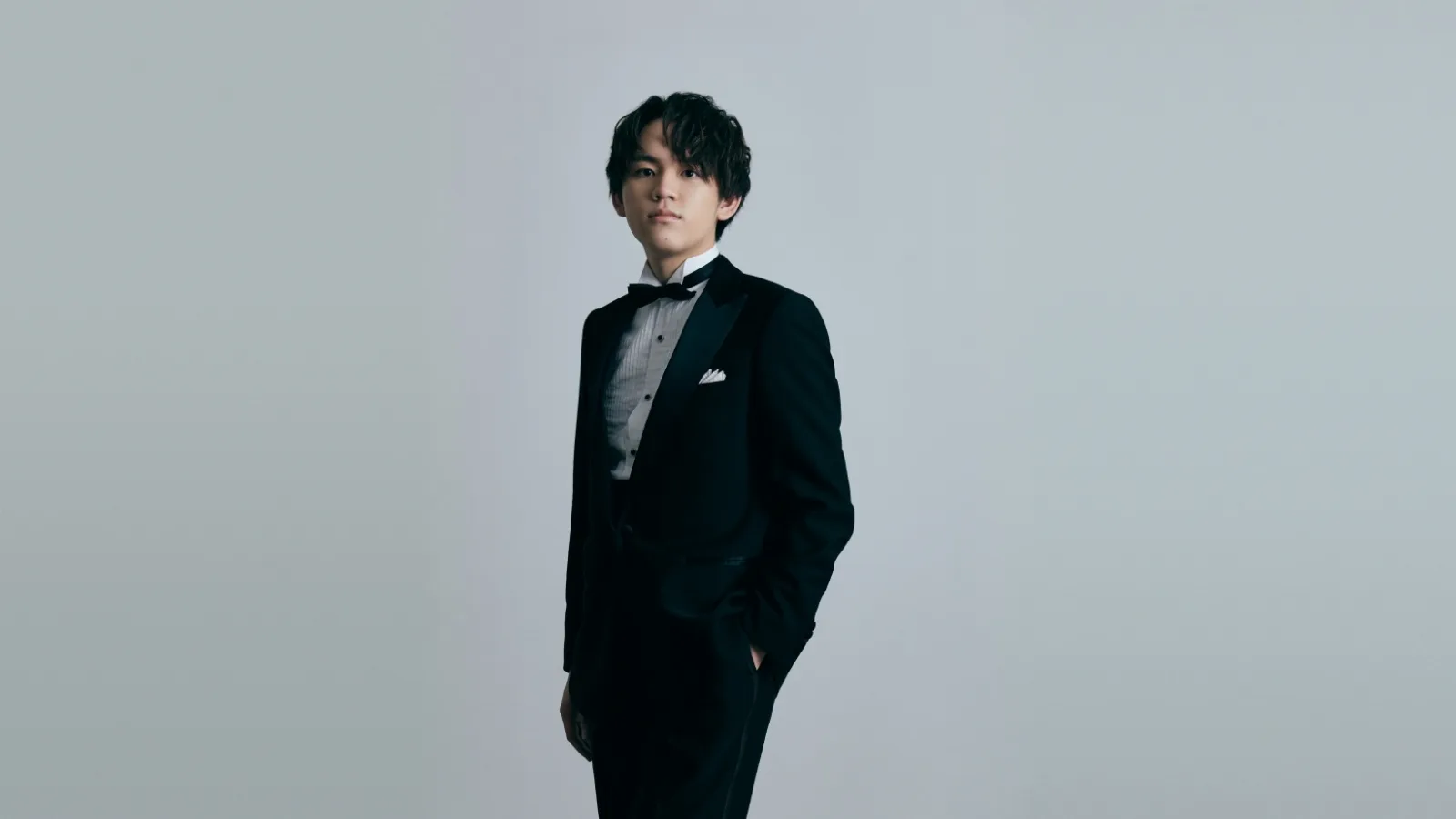
Johannes Brahms (1833–1897) and Pyotr Ilyich Tchaikovsky (1840–1893) embody two faces of Romanticism. Where Brahms combines structure and harmonic richness with restrained expressiveness, Tchaikovsky seeks drama in melodic lines, pronounced contrasts and orchestral climaxes. The Belgian National Orchestra placed both composers side by side at Bozar, under the direction of Mikko Franck, with Masaya Kamei as soloist.
A pianist to watch
Masaya Kamei, who took fifth prize at the 2025 Queen Elisabeth Competition, made an impression with his performance of Brahms’ Second Piano Concerto. His playing showed penetrating musicality and dazzling control. Especially in the lyrical and more introspective passages, he showed that his qualities reach further than virtuosity alone.
The first movement received a classical, controlled interpretation. Kamei kept the musical line clear and did not opt for pronounced dramatic accents. The horn gave the opening a beautiful colour, after which piano and orchestra further developed their interplay. The balance was good: the soloist came forward clearly without overpowering the orchestra. The warm string sound and the well-groomed woodwinds also stood out.
In the second movement, Allegro appassionato, the music took on a more turbulent character. The deep sound of the strings gave the interplay weight, while the rhythmic accents provided extra tension. The interaction between piano and orchestra made this movement one of the strong moments of the performance.
The Andante was the highlight for me. Olsi Leka’s cello solo was given all the room to sing and was carefully framed by piano and orchestra. Here the beauty of Brahms’ music fully came into its own. The ensemble playing was particularly successful, and Kamei conveyed the lyricism of the movement without exaggeration.
In the concluding Allegretto grazioso, his approach appealed to me somewhat less. The attack sometimes sounded hard, especially after the restraint of the preceding movement. Perhaps youthful enthusiasm got the better of him here. It did little to diminish the overall impression: Kamei is a pianist with pronounced musicality and great potential.
It was a pity about the applause after each movement of the concerto. It interrupted the coherence of the work, whose four movements together form a larger musical arc.
Tempi too broad, too little tension
After the interval came Tchaikovsky’s Fifth Symphony. The fate motif that runs through the four movements gives the work its dramatic coherence. In Mikko Franck’s interpretation, that coherence was insufficiently expressed.
The first movement sounded too slow and too heavy. The chosen tempi did not yield the depth I had hoped for. The climax was also unconvincing: at louder moments Franck suddenly accelerated the tempo, without this sufficiently arising from the musical line. The orchestra did not always seem to follow along.
In the second movement, Andante cantabile, the warm string sound and the well-groomed playing of the woodwinds came beautifully into their own. The lyrical passages were given much room but did not quite carry me along. I missed the inner movement that could have given the long melodic lines more direction.
The third movement, Valse, was one of the better moments. It began lively and its rhythmic character initially came across well. By considerably slowing the tempo towards the end, however, Franck lost some of the lightness.
In the finale the limitations of this interpretation were most evident. The sudden accelerations at the climaxes made the build-up less convincing, so that the final release lacked the inexorability that can make this symphony so gripping for me.
The orchestral balance was also not always optimal. The horns sounded somewhat uncertain at certain moments, and the pizzicati were barely audible from my seat in the stalls, as if too little attention had been paid to them. Towards the end of the finale, the timpani were in turn too prominently present. Set against this were the warm sound of the low strings and the well-groomed playing of the woodwinds.
After the storm
The evening left a mixed feeling. Thanks to Masaya Kamei, Brahms’ Second Piano Concerto was an impressive introduction to a pianist whose further development I look forward to with interest. With Tchaikovsky, what remained above all was the disappointment over an interpretation that, despite the broad tempi, did not achieve the expected depth and dramatic intensity.
I had braved storm Austin on Friday, but for Tchaikovsky’s Fifth Symphony I would probably have enjoyed a CD recording by Ferenc Fricsay, Yevgeny Mravinsky or Karl Böhm more. Their interpretations form for me a reference point for the dramatic power this work can unfold.