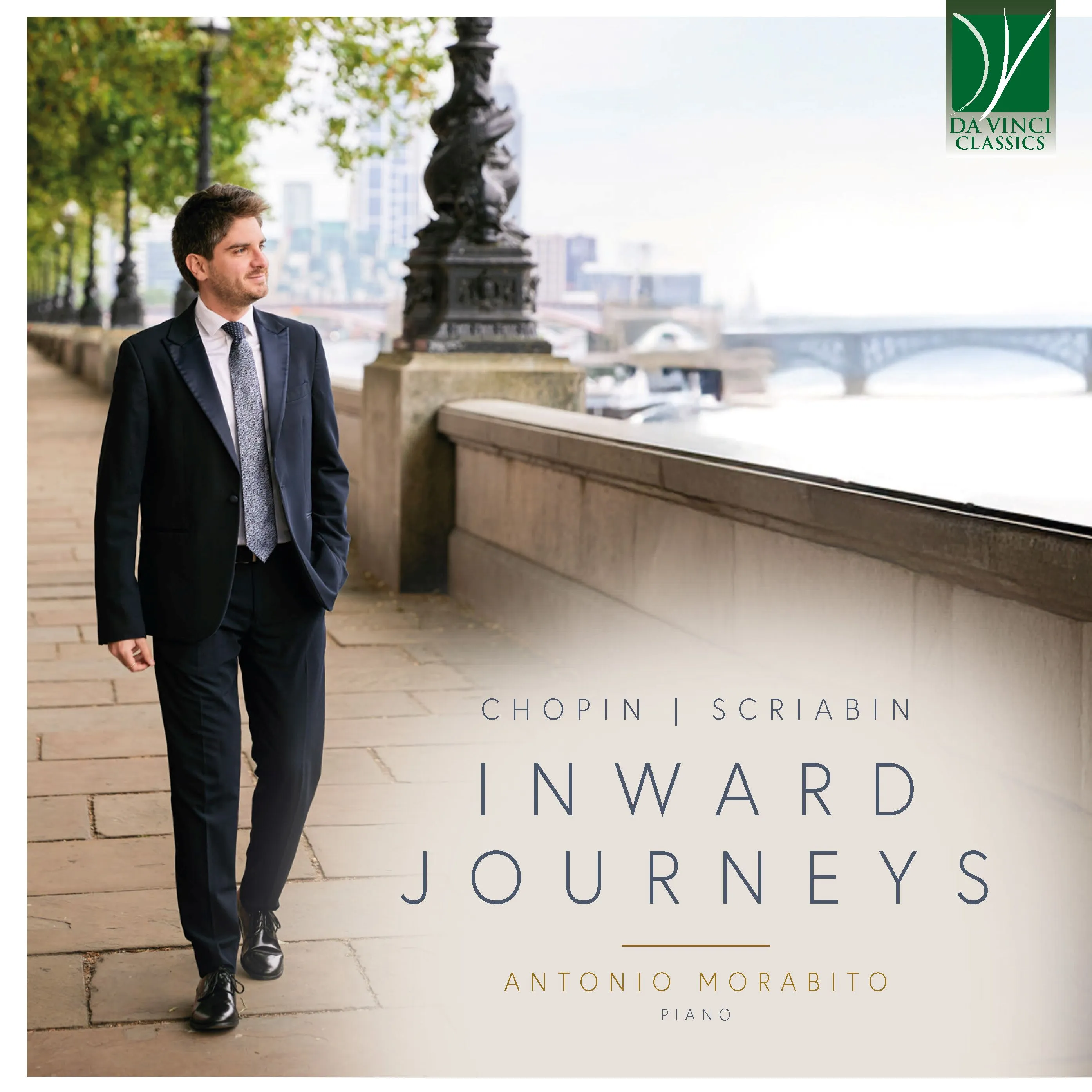
The piano miniature grew in the Romantic era into a fully fledged art form. Frédéric Chopin (1810-1849) raised the short piano piece to a high level, with music in which lyricism, melancholy and virtuosity come together. Alexander Scriabin (1872-1915) also found in this concise form an important means of expressing his personal musical ideas. The Italian pianist Antonio Morabito brings both composers together on his album Inward Journeys, released on Da Vinci Classics.
The intimacy of the piano miniature
The program opens with Chopin's four Mazurkas, Op. 30. For the composer, who spent most of his adult life in France, this Polish dance form remained closely tied to his homeland. In his mazurkas, Chopin transcends the purely danceable character of the folk dance. The typical rhythms take on a personal form, in which melancholy and a refined sense of harmonic colour come together.
Morabito gives each of the four mazurkas its own character. He plays with the alternation between the rhythmically danceable and the more subdued. Subtle tempo shifts lend his phrasing suppleness. When the tempo or volume increases, however, his touch regularly turns harsh. This contrasts with the light touch and restraint he shows elsewhere in these pieces.
Next come the Nocturnes Op. 32 and Op. 55, in which Chopin fully exploits the lyrical possibilities of the piano. The melodies unfold like singing lines above a mobile accompaniment. In Op. 32 a melancholic mood prevails, which Morabito gives shape to without sentimentality. His touch is flawlessly clean and delicate, and he also captures the depth of this music. In the first nocturne, the deep tones at the end give the performance an extra distinction. The second also has a melancholic melody, but through the chosen tempi the music retains a clear forward momentum.
The Nocturnes Op. 55 take on a more introspective character. In the first, in F minor, a light dance-like rhythm remains present, while the music at the same time keeps a contemplative undertone. The second, in E-flat major, also sounds restrained, but places more emphasis on lyrical depth. Morabito takes the time to let the melodies come into their own. His phrasing is also well judged: he lets the music breathe and then builds the tension again. In the faster passages the melodic line remains beautifully intact.
With two waltzes, the program returns to the danceable character of Chopin's piano music. Alongside the posthumously published Waltz in E major, B. 44, we hear the remarkable Waltz in A minor, discovered in 2024 and attributed to Chopin. The manuscript was rediscovered in the Morgan Library & Museum in New York. The short piece has only 24 bars, which are repeated in full.
Morabito makes the contrast between the two waltzes beautifully audible. The Waltz in E major begins somewhat menacingly, but gradually that tension gives way to a looser, more elegant movement. It seems as if the music gradually frees itself from its initial threat. The new waltz in A minor sounds darker and, in its brevity, is overwhelming. Morabito gives both pieces sufficient rhythmic space and an eye for their expressive nuances. Thus they form a fitting conclusion to the Chopin portion, following the rhythmic liveliness of the mazurkas and the more contemplative atmosphere of the nocturnes.
From Chopin to Scriabin
After Chopin, the musical perspective shifts to Russia. The two Nocturnes Op. 5 by Scriabin show a composer still strongly rooted in the Romantic piano tradition. Chopin's influence is clearly recognisable in the lyrical melodies and the choice of familiar genres. At the same time, Scriabin already reveals a more personal harmonic language.
Morabito gives this music a pronounced character. In the first nocturne he carefully builds the drama. The rhythm intensifies, the attacks grow stronger, and the menace in the low tones also increases. After this build-up of tension, the music returns to calm. In the second nocturne he lets the melody speak above all. With a controlled build-up and a light, well-shaped touch, he gives the lyrical line full scope.
The kinship with Chopin emerges even more clearly in the two Impromptus à la mazur, Op. 7. The reference to Chopin's mazurkas is unmistakable, but Scriabin gives the dance form a very distinct character. The music sounds harmonically more adventurous and acquires greater inner tension. Morabito retains the danceable character, while at the same time allowing the more restless and pronouncedly personal side of Scriabin's music to come to the fore.
The two Preludes Op. 27 are small gems. Morabito brings out an intriguing contrast between the registers: the low tones acquire a menacing heaviness, while the higher notes have a more searching character. This creates a dark atmosphere that remains strongly present in both pieces.
In the two Poèmes, Op. 32, this expressive world is further explored. Morabito plays strongly with contrasts and performs both pieces with great commitment, without lapsing into bravura. One feels how much love and involvement he invests in this music. That makes the two Poèmes penetrating closing pieces of the Scriabin portion.
An encounter across the boundaries of time
Morabito proves to be a pianist who immerses himself in this repertoire with great engagement. His playing is most convincing where he leaves room for the lyricism and expressive nuances of the music. The occasionally harsh attack in more forceful passages remains, however, a point of attention.
The recording sounds strikingly direct. As a listener, you feel as if you are sitting right next to the pianist, so the nuances of his playing come very close. Inward Journeys offers a captivating listening experience, in which Morabito convincingly reveals his personal affinity with Chopin and Skrjabin.