

Due to wars at external borders, growing nationalism and increasingly complex political decision-making, Europe today often seems like a project in permanent crisis rather than a continent with a shared cultural ambition. Public debate about the European Union usually concerns defence budgets, migration quotas, energy tariffs or economic competitiveness. Rarely about imagination. Perhaps that is precisely why it is meaningful that artists are again trying to show what Europe can also be: not a collection of institutions or treaties, but a space in which cooperation, creativity and shared culture are central.
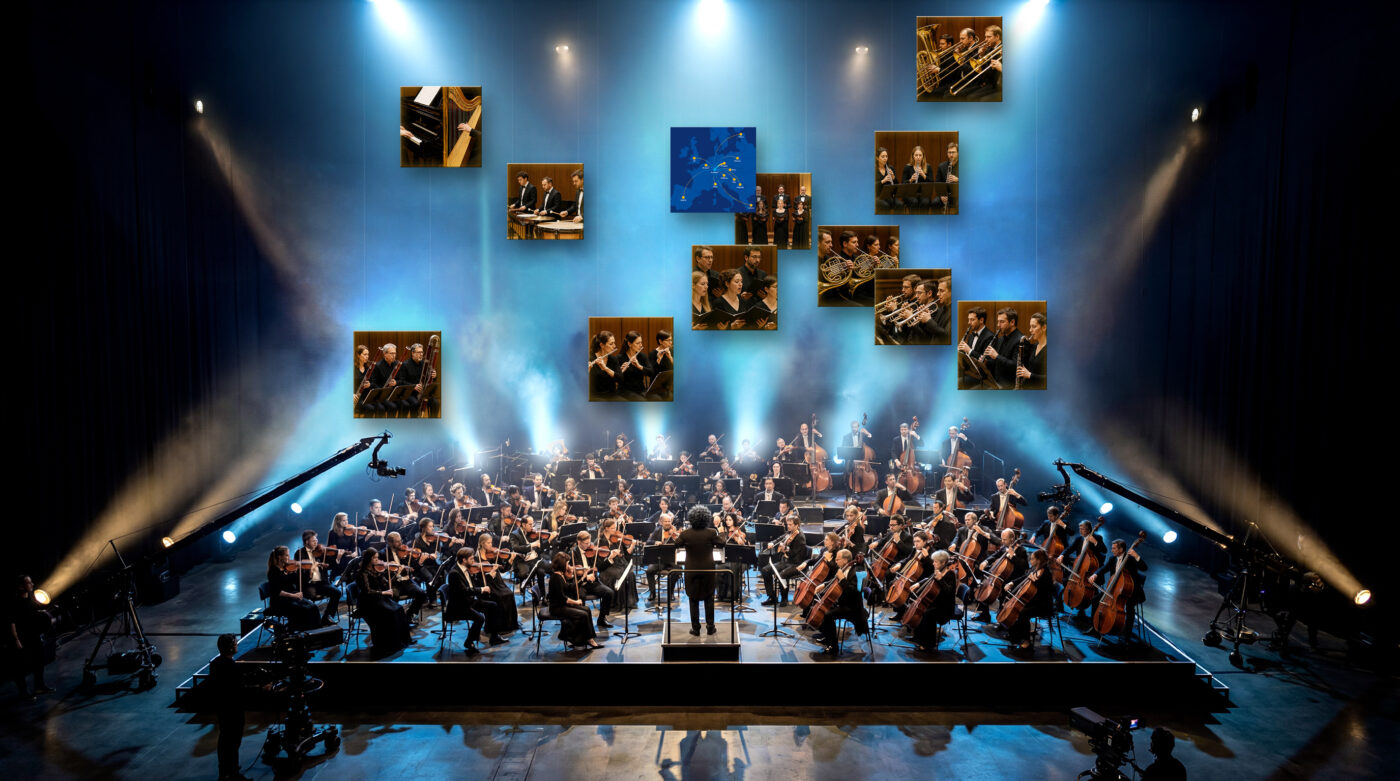
 With Europasinfonie, on 18 June 2027, one of the most ambitious cultural experiments of recent years becomes reality. Twelve symphony orchestras and choirs from across Europe will then form one virtual ensemble together that will perform a concert live, despite the fact that the musicians are in different countries. Via a network with extremely low latency, the ensembles can rehearse and perform simultaneously as if they were in the same concert hall. What seemed like science fiction just a few years ago is being deployed here as artistic reality. Not a pre-recorded video project, not digital montage afterwards, but a real live concert in which distance is temporarily abolished by technology.
That makes Europasinfonie much more than a technical experiment. Of course, the technological component is impressive. Researchers from Hochschule Anhalt, Technische Universität Berlin and specialized audio studios, among others, are working on systems that reduce network delays to an absolute minimum. In symphonic music, after all, a fraction of a second can mean the difference between perfect ensemble and complete disorientation. But ultimately, this project is not about fibre optic cables or software systems. It is about the question of how people, scattered across different countries and cultures, can nevertheless form a common artistic language.
And that is precisely where the deeper symbolism of this initiative lies. While political Europe increasingly struggles with division and mutual distrust, artists here are trying to tell a different story. Not a story of efficiency or economic logic, but of synchronisation. Music becomes here almost literally an exercise in European cooperation. Each orchestra retains its own identity, its own sound colour and tradition, but must at the same time become part of one larger whole. It is difficult not to recognise in this a metaphor for the European project itself.
The composition of the ensemble underscores that ambition. Major institutions such as Brussels Philharmonic, the Athens State Orchestra, the Dresdner Sinfoniker, Sinfonia Varsovia and Orchestra Sinfonica di Milano participate, alongside choirs from Salzburg and Brno and ensembles from Estonia, Hungary and Serbia, among others. The latter is not insignificant: countries outside the classical core of the European Union are also part of this artistic network. Europe is presented here not as an administrative bloc, but as a cultural space that transcends borders.
Central to the project is also an international composition competition that started on 2 May 2026 and invites composers from around the world to create new works for this exceptional concert form. This is explicitly not about existing scores that happen to be performed digitally. The organisers are looking for compositions that artistically reflect on distance, virtual presence and real-time interaction. A large string orchestra will be physically present in the concert hall, while other sections will participate remotely via large LED screens. This forces composers to think fundamentally differently about space, timing and orchestration. The selected composers will be announced on 30 September 2026 in Dresden, following a jury session on 28 and 29 September.
The possibilities of this are artistically highly intriguing. How do you write music for an orchestra that literally spans a continent? How do you use physical absence as a compositional element? Can delay itself become part of a musical structure? These are questions that recall the great avant-garde movements of the twentieth century, when composers began to integrate new technologies into their work. Except that the experiment is now taking place not in a closed academic context, but in a project with an explicit public and symbolic character.
It is also striking that Europasinfonie explicitly wants to support young composers. At least one of the three composition commissions will be awarded to an artist under 35 years of age. This seems more than a symbolic gesture. The classical music world has been struggling for years with the question of how it can remain relevant in a digital and fragmented society. Innovation rarely arises from cautious preservation, but from projects that dare to break open the traditional concert format. Europasinfonie does precisely that: it redefines not only where musicians are located, but also what a concert can mean today.
Perhaps that is ultimately the greatest merit of this project. In a time when technology is often presented as a source of isolation and fragmentation, Europasinfonie uses digital innovation precisely to enable collectivity. The project starts from a strikingly optimistic thought: that technology does not necessarily have to drive people apart, but can also create new forms of proximity.
"Twelve countries. One orchestra." It sounds on paper like a simple slogan, perhaps even a somewhat naive utopia. But precisely for that reason it feels unexpectedly relevant today. While Europe increasingly speaks in the language of conflict, control and crisis management, this symphony tries again to make another register audible: that of cooperation, listening and shared rhythm.