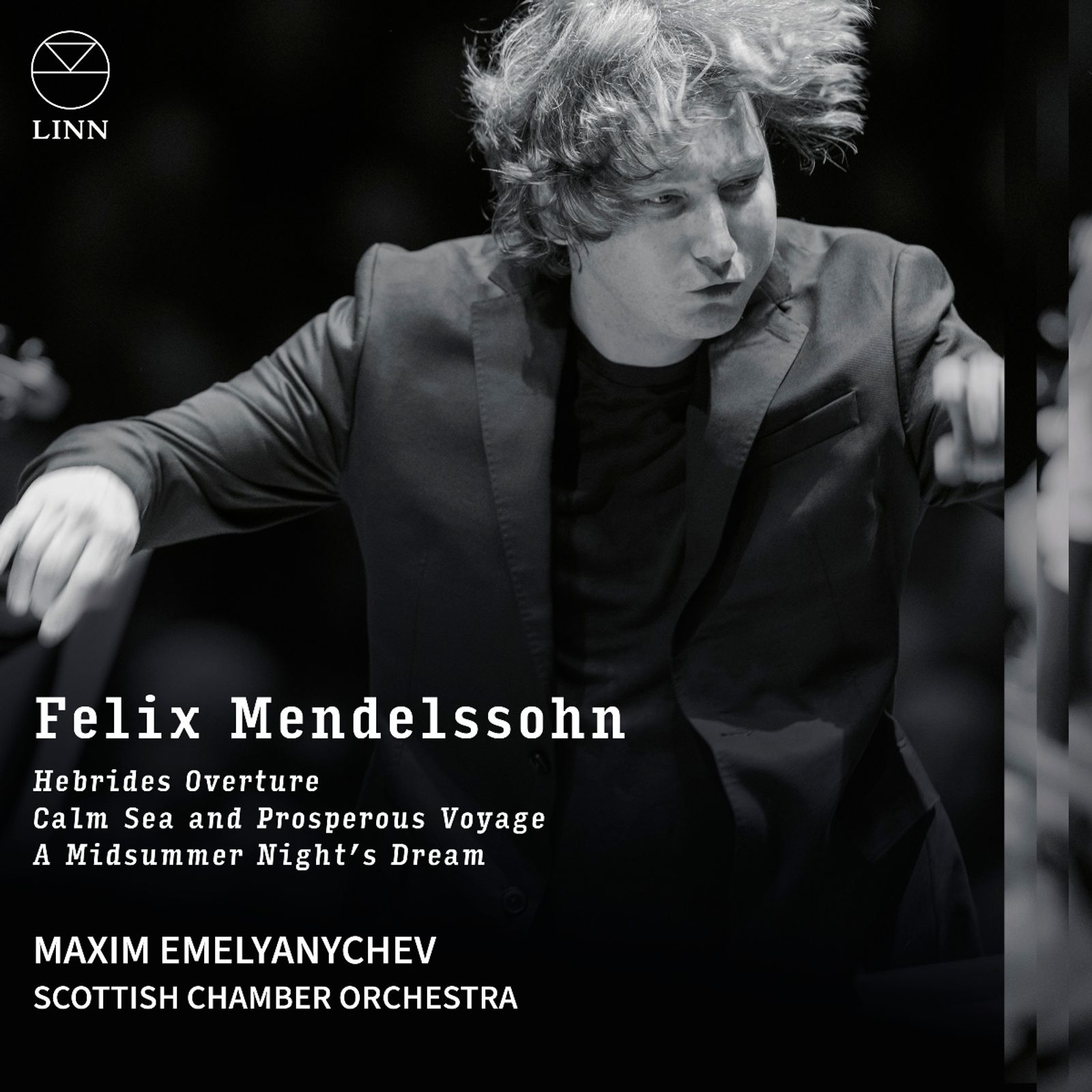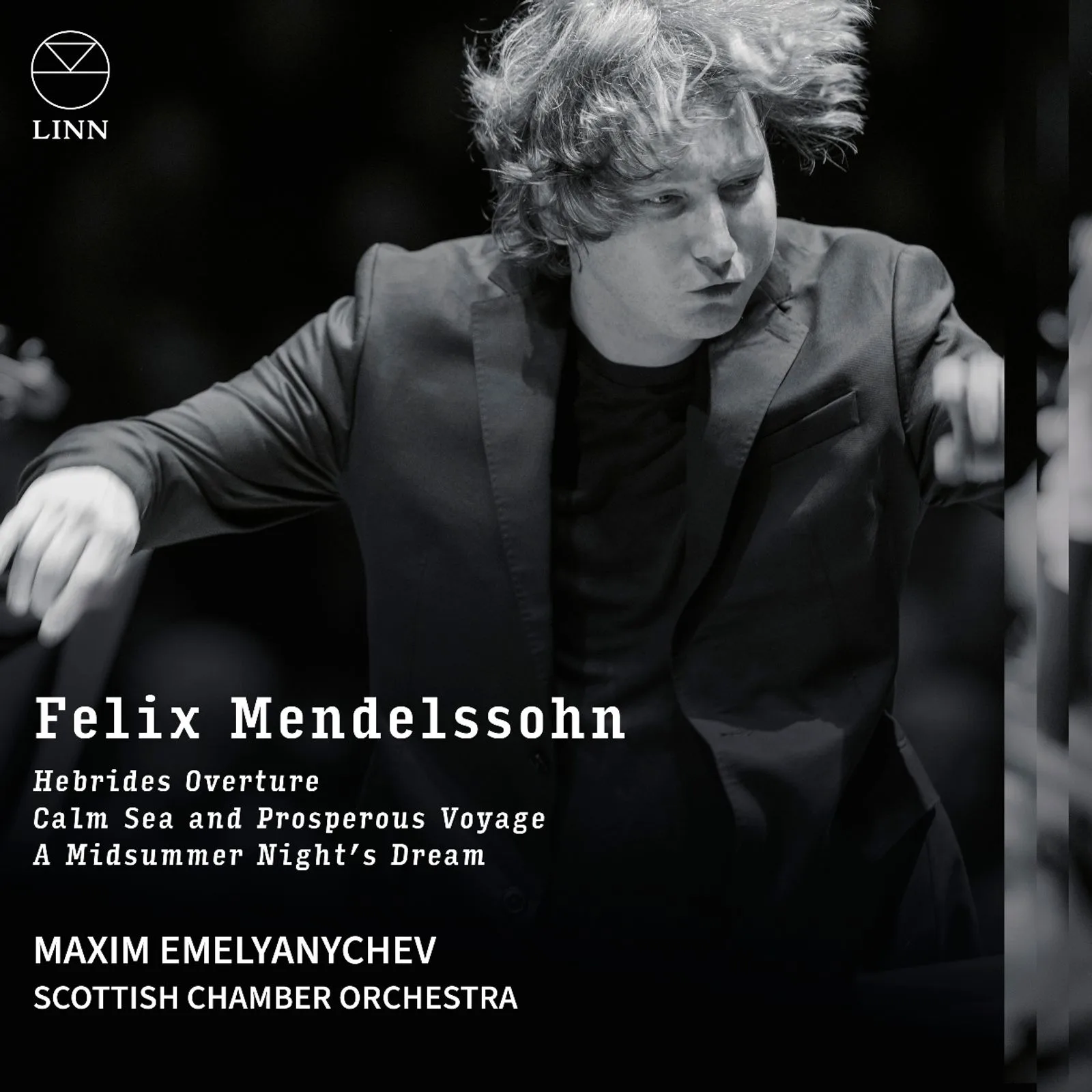
No well-known symphonies by Felix Mendelssohn (1809–1847) on this CD, but two overtures and a selection from his incidental music for A Midsummer Night’s Dream. It is an appealing programme in which the composer reveals himself from various angles: as a musical interpreter of nature, as an admirer of Goethe, and as a composer inspired by Shakespeare. The Scottish Chamber Orchestra and its chief conductor Maxim Emelyanychev approach these works with a great sense of colour, movement and detail.
The menace of the sea
The Hebrides Overture, also known as Fingal’s Cave, originated after Mendelssohn’s journey through Scotland in 1829. The composer was deeply impressed by the rugged landscape and the sea. That experience resonates in the music from the very beginning. Emelyanychev keeps the rolling motion constantly palpable and thus allows the menace of the sea to come fully into its own. At the right moments he sharpens that menace, after which the orchestra again gets room for the lighter, more agile passages.
The woodwinds in particular sound wonderfully fresh and, with their finely worked accents, continually bring new nuances. Meanwhile the strings keep the underlying movement lively. The brass also has its place, without ever dominating: every instrument fits seamlessly into the whole. After an acceleration, Emelyanychev lets the music come briefly to a standstill, only to build up gradually again with dreamy woodwinds. Don’t be mistaken: it is a spirited performance, yet the music is never hurried. The conductor keeps the various lines constantly in balance and turns this overture into a gripping musical narrative.
From windless calm to a happy voyage
A very different atmosphere is found in Meeresstille und glückliche Fahrt, inspired by two poems by Goethe. The work opens very quietly. From the warm string sound Emelyanychev builds up calmly, while the woodwinds gradually join the musical course. The melody unfolds without haste, and the mood of the windless sea is rendered strikingly.
Then a lovely flute solo announces the turn. The other instruments respond with subtle accents, after which the music gains more and more motion. The journey gets under way and Emelyanychev lets the energy increase gradually. The strings and woodwinds in particular make an impression, but the brass too, especially towards the end, is given a well-measured role. The conductor shapes the growing dynamics convincingly and then brings the music back to rest in a natural way. Where the Hebrides Overture mainly evokes the turbulence and menace of the sea, the emphasis here lies on the gradual transition from stillness to motion.
The magic of Shakespeare
The greater part of the CD is devoted to A Midsummer Night’s Dream. Mendelssohn wrote the overture at the age of seventeen, inspired by Shakespeare’s comedy. Some years later, at the request of the Prussian king Frederick William IV, he composed the incidental music, reusing his earlier overture. On this recording we hear, alongside the overture, a selection from that music, including the vocal parts. That Hilary Cronin and Rowan Pierce appear as soloists and the Scottish Chamber Orchestra Chorus is also involved makes the programme all the more appealing.
The overture opens with a fine contribution from the horns and flutes, after which the strings enter with great momentum. Brass and timpani also add to the lively course, but it is again the immaculately clean flutes that draw the attention. Emelyanychev has an excellent sense of structure and of the placement of accents. He also deliberately chooses silences and lets the music speak for itself at those moments. The restrained ending, in which everything is again reduced to flutes and horn, is beautifully realised.
The Scherzo is then pure pleasure in playing: light-footed and with an infectious drive. In the March of the Fairies the fairy-tale world takes on a somewhat more mysterious character. The brass and strings provide a faintly threatening undertone, while the triangle adds a subtle touch of colour. The flutes again lend their own accent to the whole.
In the Song with Chorus the soloists are clearly present against a background of ominously deep strings. The choral contribution remains strikingly subtle. Not a massive sound, but rather a group of enticingly singing elves leading the listener into the fairy-tale world. The Intermezzo is performed with great feeling. The woodwinds provide a fascinating variety of colour, after which the music takes on a more exuberant character, without the whole descending into exaggerated festivity.
The Notturno remains for me one of the most beautiful moments in the incidental music. The horns sound pure and musical here, supported by the gentle accompaniment of the strings. These give the passage extra depth, after which the woodwinds take over the musical conversation. The calm and the way the different instrumental groups complement one another make this passage a highlight. Emelyanychev shows here how much expressive power Mendelssohn could achieve with an apparently simple orchestral set-up.
Even the world-famous Wedding March, which through countless performances has almost become a musical cliché, sounds strikingly fresh and refined here. The brass make a fine contribution to the festive sound. In the Finale the drive of the strings from the overture returns. The chorus sings with restraint, the flute adds its own touch, and the soprano solo is given every room to unfold above the choral sound.
A familiar quality
I have already heard Emelyanychev and the Scottish Chamber Orchestra live several times in Mendelssohn, and much of what I know from those concerts is present in this recording. The same liveliness, the attention to the smallest details and the natural way in which the conductor keeps the various orchestral groups in balance are also present on CD.
A small drawback is the intelligibility of the sung texts. The soloists and the choir sing very softly at times, rightly so, but combined with the equally subtle orchestral accompaniment the words are not always easy to follow. This does little to diminish the musical quality of the vocal contributions, but on this point the recording could have been somewhat clearer.
Emelyanychev has an eye for the broad lines, but never loses sight of the smaller details. From the threatening wave-like motion of the Hebrides Overture to the hushed beauty of the Notturno, this recording lets Mendelssohn be heard in all his orchestral colours. Those who know mainly the symphonies will find here a surprising and colourful introduction to another side of the composer. Those who have long cherished Mendelssohn's incidental music will hear it here with fresh ears.