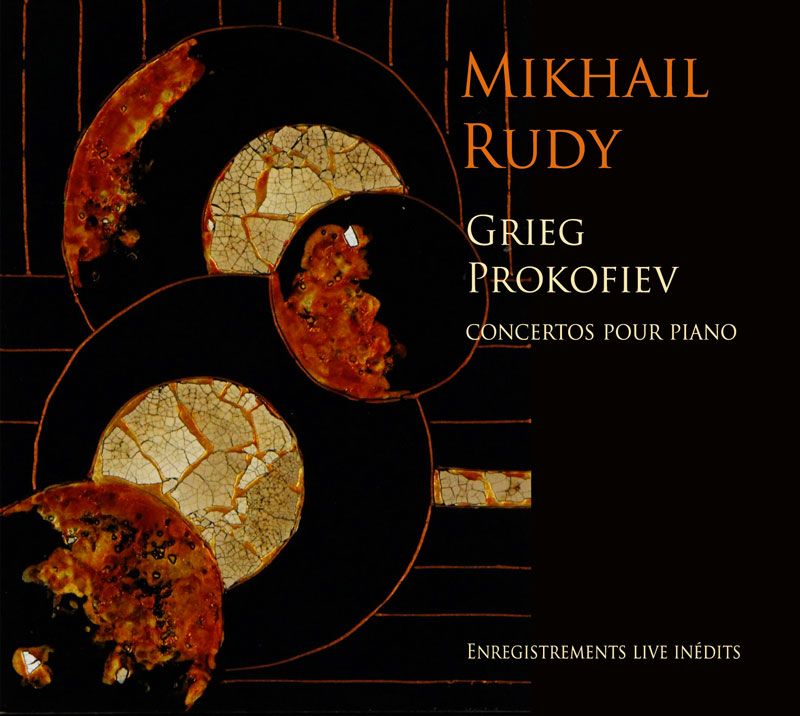
Mikhail Rudy and Mariss Jansons have been a familiar musical duo for me for decades. Their joint recordings of Sergei Rachmaninov's piano concertos are among the performances I particularly treasure. I was therefore very curious about this release, which brings together Edvard Grieg's Piano Concerto in A minor and Sergei Prokofiev's Second Piano Concerto in G minor, with five shorter works for solo piano in between. The St. Petersburg Philharmonic Orchestra is an important musical partner here.
Lyricism with bite
Edvard Grieg's Piano Concerto (1843–1907) opens magnificently. From the very first bars, the fine interplay between Rudy and Jansons stands out. Both give each other full room, while the orchestra supports the piano part with great care. There is a clear drive behind this first movement, a fire that propels the music forward throughout, and that is what I enjoy hearing in this score.
At the same time, there is ample space for lyricism. The woodwinds and piano find each other in passages with an almost dreamlike character. The moments where the horn joins the piano, including during the glissandi, are also beautifully handled. The warm string sound provides a pleasant foundation. Jansons also allows the music to slow down briefly at subtle moments. These small interventions heighten the sensitivity and melancholy without losing sight of the overall line.
In the cadenza, Rudy shows his versatility. His playing is technically impressive, but the virtuosity never stands on its own. He approaches this passage as a deeply felt musical drama, with strong attention to the build-up of tension. When the orchestra re-enters, the music is initially brought almost to a standstill. That moment is cleverly executed, after which an acceleration towards the close rounds off the movement with the necessary energy.
The second movement forms a beautiful contrast. The warm, lyrical strings open the music with a questioning character, after which the woodwinds and horns sensitively join in. A hushed, dreamy atmosphere emerges. When the piano takes over the melodic line, it seems to weave effortlessly into the orchestral sound. This interplay gives the passage an almost weightless character. Even when the piano part later takes on a more solemn character, the restraint continues to set the undertone.
The finale begins again with fire. The rhythm is pointed and the orchestra follows Rudy closely. The shift from the preceding movement is striking: the music regains momentum and a distinctly energetic character. When the lyricism returns, there is fortunately once again ample attention to the dialogue between piano and orchestra. The fast passages towards the end are delivered with conviction and lead to a dazzling conclusion.
Five musical miniatures
Between the two concertos are five solo works that give Rudy the opportunity to showcase different facets of his pianism. With La mort d'Isolde, Franz Liszt's (1811–1886) piano transcription of Richard Wagner's Tristan und Isolde, an intensely dramatic tone is set immediately. Rudy opts for a powerful attack and delivers the work with great commitment. Personally, I would have preferred this passage somewhat more restrained and subtle, but the performance is formidable. Especially towards the end, the music attains an almost suffocating intensity. The deep undertones are at times rather emphatically present.
One of the two nocturnes from Frédéric Chopin's (1810–1849) Op. 27 then leads to a very different world. After the dramatic intensity of Liszt, this music sounds remarkably hushed and intimate. Rudy lets the main melody sing beautifully and also treats the lower notes with care. The result is a subdued performance in which the lyricism fully comes into its own.
In Claude Debussy's (1862–1918) Pour les huit doigts, another side of the pianist emerges. The restless character and technical challenges make it a distinctly bravura piece, which Rudy delivers with great precision.
Sergei Prokofiev's (1891–1953) Prélude Op. 12 No. 7 sounds much more introspective. Rudy keeps his interpretation light and somewhat playful, with an eye for the small details. Aleksandr Scriabin's (1872–1915) Étude Op. 42 No. 3, with its more capricious character, forms a fine contrast. Rudy follows the shifting musical turns attentively and, especially in the higher registers, reveals beautiful details.
Together, these five works form a varied interlude. They showcase Rudy across diverse musical registers: from the grand drama of Liszt to the stillness of Chopin and the restlessness of Debussy, Prokofiev and Scriabin.
Virtuosity and turbulence
After the solo works comes Sergei Prokofiev's Second Piano Concerto. The work premiered in 1913, but the original score was lost during the Russian Revolution. Prokofiev thoroughly reworked the concerto in 1923, reshaping the original material. The result is a unruly work in which virtuosity, sharp contrasts and a distinctly orchestral personality come together.
The recording quality here is somewhat disappointing. The orchestra sounds sharper than in Grieg, and the piano also stands very prominently in the foreground. The balance is therefore not always ideal, and the sound lacks some warmth and spaciousness. However, this does not mean that the orchestra recedes into the background. On the contrary, the musicians make a clear contribution to this interpretation. Rudy draws various moods from the piano part, and the orchestra responds to these in an idiosyncratic way.
The cadenza in the first movement is downright breathtaking. What Rudy manages to draw from the piano is impressive. Especially the way he builds the tension and sustains the dramatic force of this long passage makes a strong impression.
The second movement opens with a glorious impetuosity. The piano seems to roll forward unstoppably, while the orchestra picks up on it with devilish alertness. The rhythmic speed is enormous, yet even at this high tempo the details remain intact. That demands a lot from soloist and orchestra, who are constantly attentive to one another.
In the Intermezzo the piano seems to chart its own course, and Rudy drives the music forward with great determination. The orchestra responds sharply, at times with biting accents that further emphasize the stubborn character of the score. The musicians follow the pianist with remarkable precision, yet at the same time retain their own profile.
The finale opens with an almost chaotic orchestral outburst, to which the piano responds sharply and the orchestra immediately answers. This lively interplay gives the music a tumultuous momentum. After this initial eruption, a moment of rest arises: the piano alone takes the floor and reveals a more lyrical side. From there Rudy gradually builds toward a new climax, to which the orchestra joins stylishly. At that moment the orchestral sound comes across somewhat sharply in the recording, but this detracts little from the drive of the performance. Piano and orchestra remain alert to each other's responses and work toward a gloriously abrupt ending, threatening and resolute.
Throughout the entire concerto, what stands out is how distinctly the orchestra lets its own musical voice be heard. The musicians do not confine themselves to accompanying the soloist, but regularly enter into a dialogue with him. Sometimes this may grate a little. That suits the unruly character of Prokofiev's score and gives the music extra relief. The interplay between Rudy, Jansons and the orchestra is superb. Rudy extracts everything from this concerto that it has to offer.
A musical encounter that remains convincing
This CD brings together two very different piano concertos, but it is above all the familiar musical interplay between Rudy, Jansons and the St. Petersburg Philharmonic Orchestra that stays with me. The five solo works, moreover, give Rudy the opportunity to show his versatility beyond the concerto as well. The sound quality is not optimal throughout, and especially in the Prokofiev the recording could have offered more spaciousness. Yet this does not outweigh the musical intensity of these performances. Those who, like me, cherish the joint Rachmaninov recordings of Rudy and Jansons will find much to enjoy in this release as well.