


The closing concert of the International Summer School of Cappella Pratensis in AMUZ was more than a fine conclusion to an intensive study week. It was also an inspiring demonstration of what amateur singers can mean for our musical life today. Thirty-four participants from all corners of the world, from Europe to even New York, performed a programme with works by Tomás Luis de Victoria, William Byrd, Orlando di Lasso and Robert Fayrfax. This morning concert was not only a musical highlight, but also sparked reflection.
Because all too often you hear the view that important concert venues or even some music are intended mainly or exclusively for professional musicians. Amateur singers, according to some, should occupy a position that actually belongs to professional musicians. It is a view that I find difficult to follow.
Who, after all, supports musical life? Who fills the rehearsal rooms, the concert halls and the choirs? Who invests time, energy and resources in music without getting anything professionally in return? It is often the amateurs. They form the foundation on which much of our musical culture rests. Without them, many concerts would never take place, many professional musicians would have fewer opportunities and music would be much less deeply rooted in our society.
The participants of this Summer School illustrate that perfectly. During a week they immerse themselves in Renaissance polyphony using facsimiles of original sources. So they sing not from a modern, user-friendly score, but from the historical notational image itself. That requires knowledge, concentration and great musical curiosity. Above all, it requires love for music. In that original sense, an amateur is someone who does something out of love.
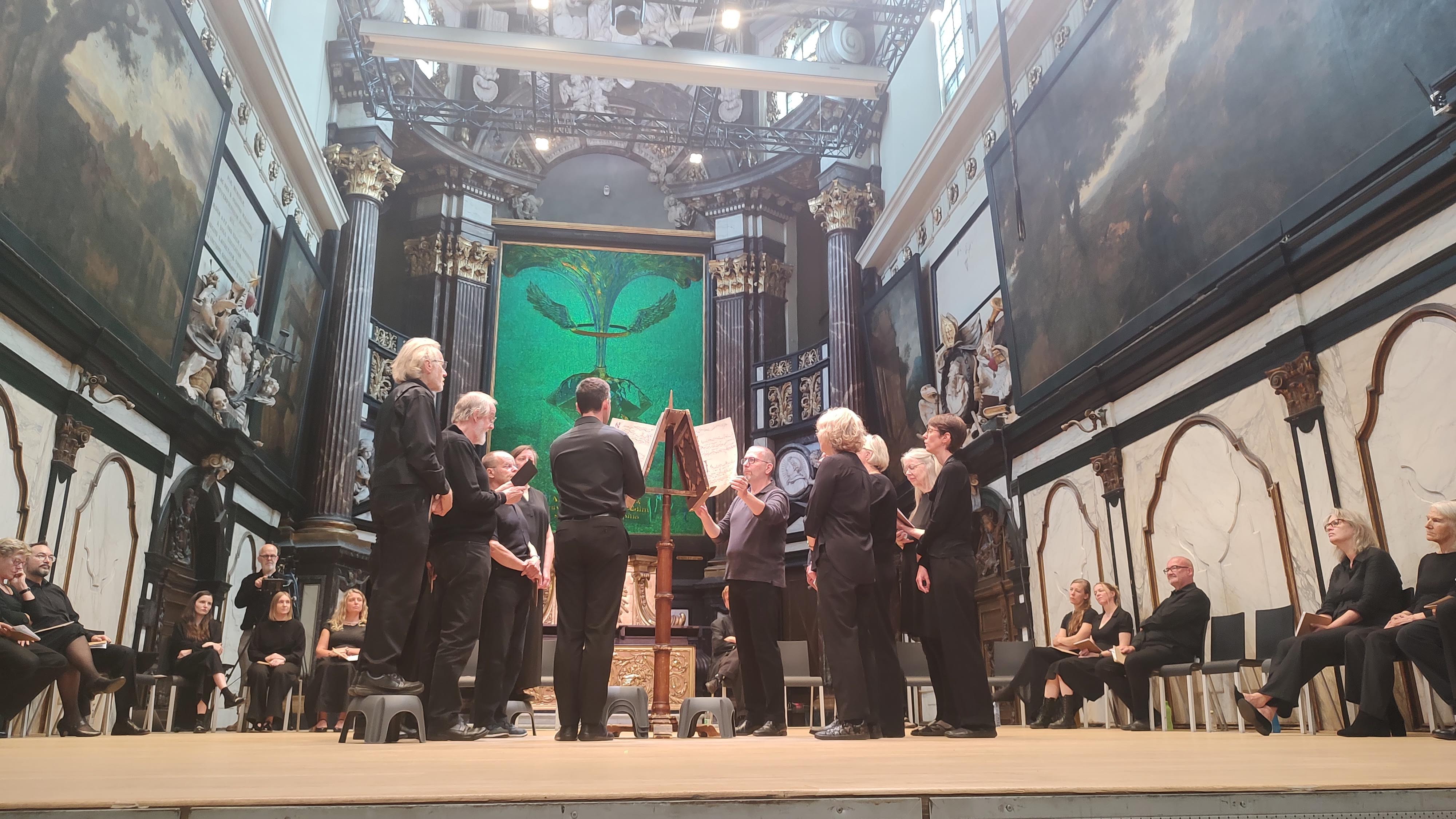 That engagement was audible from the first notes. The concert opened with Victoria's Vidi aquam, preceded by the Gregorian melody. Immediately the warm homogeneity of the ensemble stood out. The different voices often merged into one whole, without the individual lines losing their clarity. That was clearly worked on. The conductor also made an impression from the beginning with his natural and clear direction through simple hand movements.
In William Byrd's Kyrie and Gloria, the thoughtfully structured study programme became apparent. The music seems simple at first glance, but makes high demands on the performers. By varying the instrumentation and dividing parts of the work among different groups, the instructors managed to involve every participant actively in the performance.
Robert Fayrfax's complex motet, performed in two parts, was one of the most impressive moments of the morning. Especially the entry of the voices in the third verse testified to remarkable concentration. The high soprano line at the close developed into a particularly beautiful moment, after which the final chord seemed to sweep through the space of the former Sint-Augustinuskerk like a rolling mass of sound.
Also Ego sum qui diligentes me was performed with much finesse. The work began fragile, only to develop increasingly more color and movement. In various motets by Byrd, particularly careful text treatment stood out. The invocation O Domine struck with its simplicity and intensity, while in the Agnus Dei the dissonances and arcs of tension were worked out with great feeling.
However, the absolute highlight of the morning came for me right at the end. For Lassus' Ave Regina Caelorum, all the singers gathered around that one lectern with the original notation before them. That image alone expressed the essence of this Summer School: making music together from the source. The motet sounded monumental and at the same time remarkably clear. Particularly beautiful were the musical gestures with which meaningful words from the text were underscored. The focus was sharp, the sound convincing and the musical line remained in constant motion. Here hard work, a certain talent and emotion came together completely.
After the concert I spoke with one of the participants. She told me that she has been participating in the Summer School for years and that the closing concert always feels like a triumph once you have successfully made it through. After a week of intensive work, that special moment arises when everything comes together and you feel that the music has truly come to life. That description struck me as particularly apt. This concert was indeed a triumph.
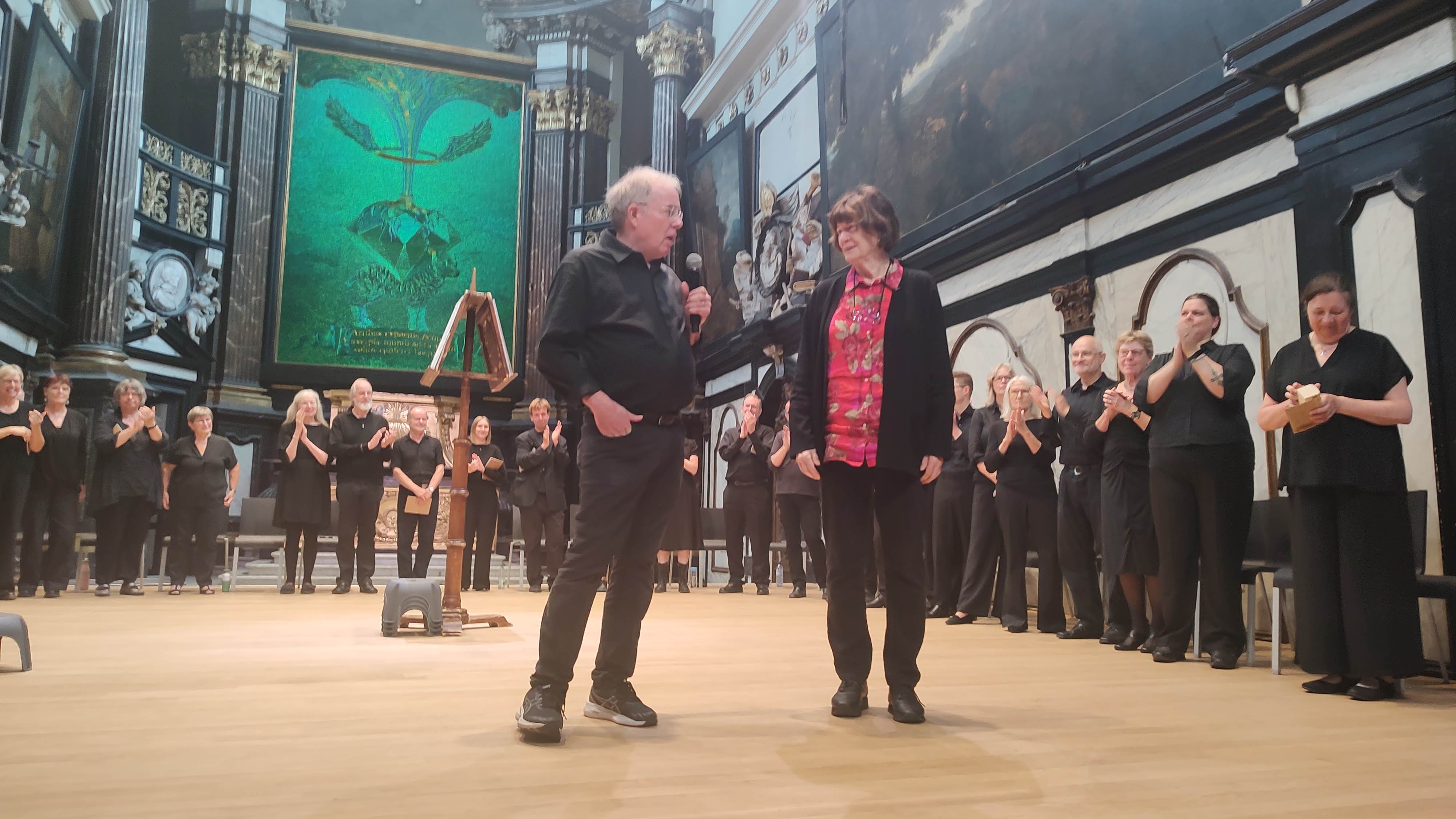 At the same time, there was also a sense of farewell in the hall. Two key figures of the Summer School took their leave after seventeen years: Valerie Horst, who played a crucial role in the transcriptions and the organization, and legend Stratton Bull, a familiar face of Cappella Pratensis and for many the heart of the Summer School.
Visibly moved, Bull looked back on a history that goes back to the nineties, when the Summer School was organized in, among other places, Alden Biesen. Later the project found a permanent home in AMUZ, where it has been a fixture for seventeen years now. He thanked the singers, his colleague teachers and the AMUZ team, but also emphasized that the future of the Summer School is secured thanks to a new generation of teachers. When he then handed the microphone to Valerie Horst, it became clear how much meaning both people have had for this project. The warm and prolonged applause that followed was nothing more than deserved.
The closing concert of the International Summer School of Cappella Pratensis was therefore much more than just a concert. It was a celebration of commitment, of musical curiosity and of the power of making music together. It proved that amateurism has nothing to do with mediocrity, but everything with passion. And that passion was audible throughout the entire concert. So I can proudly conclude: amateurs do not replace professionals, together they form the foundation of a rich, vibrant and sustainable musical life.
WHEN? WHERE? WHAT?
Saturday 29 August 2026 / Laus Polyphoniae 2026
11am AMUZ / Closing concert International Summerschool Cappella Pratensis