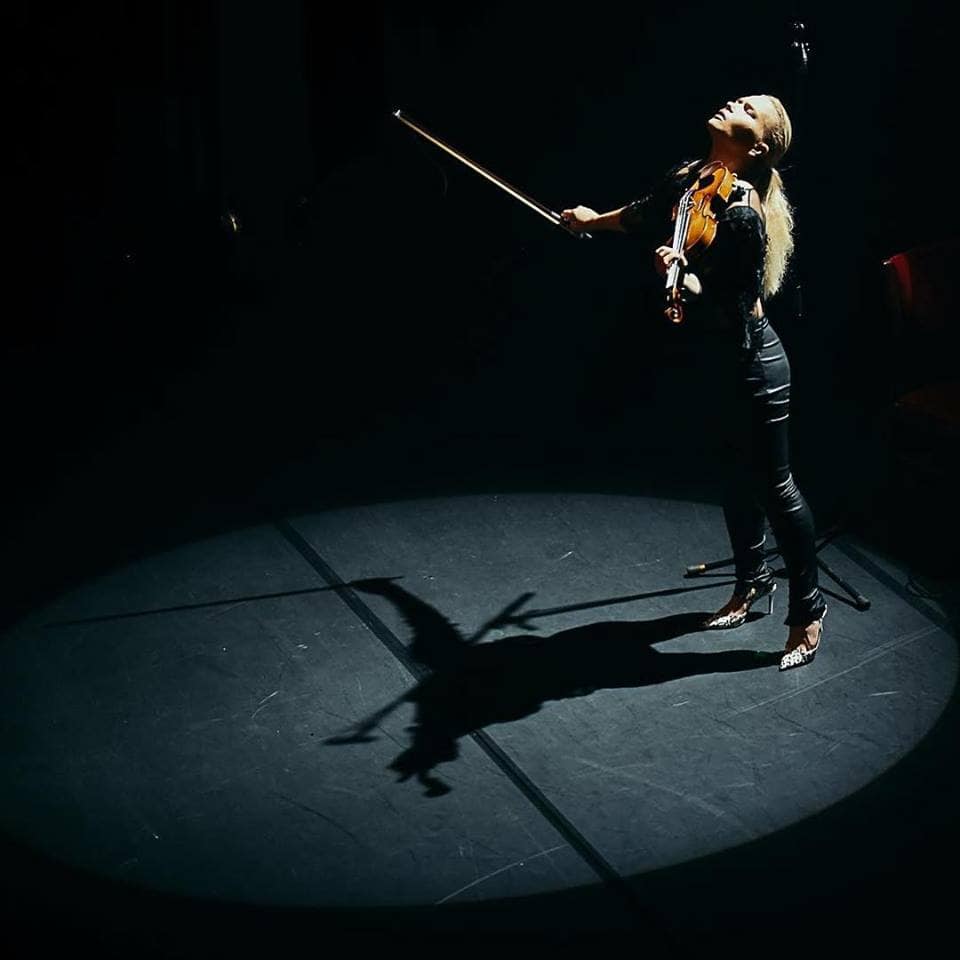
She is picture perfect, and can handle four strings with aplomb. What more does a meloman actually need to head to Hasselt? A varied playlist featuring not only Bach and Philip Glass but also Arvo Pärt, Uno Helmersson and a certain Peter Gregson certainly increases the intrigue. A chronicle of a timelapse between baroque and minimalism at the third edition of the Nordic night(s) festival.
Keeping classical music in the mix at the forefront of contemporary art: it is a noble endeavour that Norwegian violinist Mari Samuelsen is happy to support with her delicate shoulders. But how do you do that then? In the case of the Norwegian violinist by deliberately building a bridge to music from films and popular TV series and seeking inspiration from contemporary composers such as Ólafur Arnalds, Jóhann Jóhannsson and Max Richter. With a vague umbrella term, the musical meanderings of these gentlemen are classified as post-classical. Sparse strings, quasi-improvisational piano passages and a generous dose of electronics provide the ideal soundtrack for those seeking atmosphere and tranquillity. The album Nordic Noir that Samuelsen released last year on the Decca label fits perfectly into this picture. It was immediately catapulted to the top of the Norwegian charts. Recordings of classical music that do well with a broader audience: they are rare and therefore to be cherished.
On Nordic Noir, composers such as Uno Helmersson and Arvo Pärt feature, who also appeared on tonight's varied playlist. Yet the concert was far from an easy rehashing of what you and I could have listened to at home on CD. Of course, Helmersson's mesmerising Timelapse could not be missing. It is the hit of the album and according to Samuelsen herself also her favourite song. No wonder it was also played as an encore. But otherwise they were all pieces not to be found on the record. Samuelsen opened, with the bright spotlight on her alone, with the famous Chaconne by Bach. Talk about a quirky opener. Anyone who had prepared themselves for an hour and a half of easy listening was thus soon disappointed. Paradoxically, our graceful blonde made it all look so effortless. Her fingers danced magically across the strings. A carefully considered articulation never hindered the natural flow of the piece. And what to say about the sublime sonorous richness that Samuelsen managed to extract from her Duke of Edinburgh Stradivarius. Naked and yet oh so complex: this is baroque music that is worlds away from the minimalism that would follow.
Lonely Angel
Specifically for this third edition of Nordic night(s), a four-day multidisciplinary arts festival that wants to intensify the cultural dialogue between the North and our region, CCHA brought Mari Samuelsen into contact with Casco Phil. The Belgian chamber orchestra under the direction of Ben Haemhouts celebrated its tenth anniversary earlier this year and accompanied attentively, including delicate phrasing, a sense of expression and above all a good ear for dynamic nuance. An early highlight in this way was the hypnotic Echorus by Philip Glass (1995) – one of Samuelsen's favourite composers – in which she performed an increasingly compelling mating dance with both concertmaster Maximilian Lohse and the ensemble. A similar multi-vocal entanglement, albeit on a slightly more intimate scale, also occurred during the performance of Bach's fifth prelude and fugue from the first book of Das Wohltemperierte Klavier (BWV 850) and the subsequent Invention (BWV 784). But the first real goosebump moment had already passed. Credit for that goes to a certain Peter Gregson: a Scottish cellist in his early thirties who recently put Bach's suites in a daring new guise, but is also not averse to writing pieces himself. His Sequence (Four), in which Samuelsen remarkably took on the magnetising role of the synthesizer, stays in the memory through the heartfelt way in which Casco Phil made its entrance. While repetitive ambient sometimes comes across as cold and calculated by nature, that was certainly not the case here.
Scandinavians do not have a monopoly on Nordic music. "You can also hear the characteristic features in the work of composers from the Baltic states, for example […]". Samuelsen illustrated her words from the programme notes with work by Latvian Pēteris Vasks and Estonian Arvo Pärt. Lonely Angel (2006), Vasks' poetic meditation for violin and string orchestra, couples ghostly musing with timeless simplicity and was performed not only very restrainedly, but also accompanied with great subtlety. A similar spiritual detachment also sounded at times in Fratres (1977), although Pärt, through the gaussian design of his ingenious series of variations, explicitly urges the musicians to work towards an energetic climax. Through the combination of a smooth bow technique and a biting tone production, the tension was ratcheted up several times. It was equally fascinating to then observe how the ensemble gradually regained its serenity. "Fratres is a work I feel very close to. It's under my skin", Samuelsen testifies. And after this interpretation, likely also under that of many listeners.
The concert ended with Jóhann Jóhannsson's Good Night, Day: a melancholic finale and a poignant tribute to the Icelandic composer who unexpectedly passed away earlier this year. The audience thanked the musicians with a standing ovation. (Post-)classical music has a vibrant future. And an equally captivating past. So much is certain after this evening.
- WHAT: Nordic Noir + minimalistic baroque – works by, among others, Jóhann Jóhannsson (1969-2018), Philip Glass (°1937), Uno Helmersson (°1977), Peter Gregson (°1987) Arvo Pärt (°1935) and … Johann Sebastian Bach (1685-1750).
- WHO: Mari Samuelsen (violin) | Casco Phil conducted by Ben Haemhouts
- WHERE: Cultuurcentrum Hasselt (CCHA)
- WHEN: Friday, October 26, 2018 – as part of Nordic night(s), third edition of the multidisciplinary festival in honor and glory of the (High) North
- FOTORIGHT: © Kaja Bruskeland & Tom Herbots