


Strategy director by day, composer by night. Dutch composer Titus Tielens presents his new album Shades of Life together with pianist Mattias Spee.
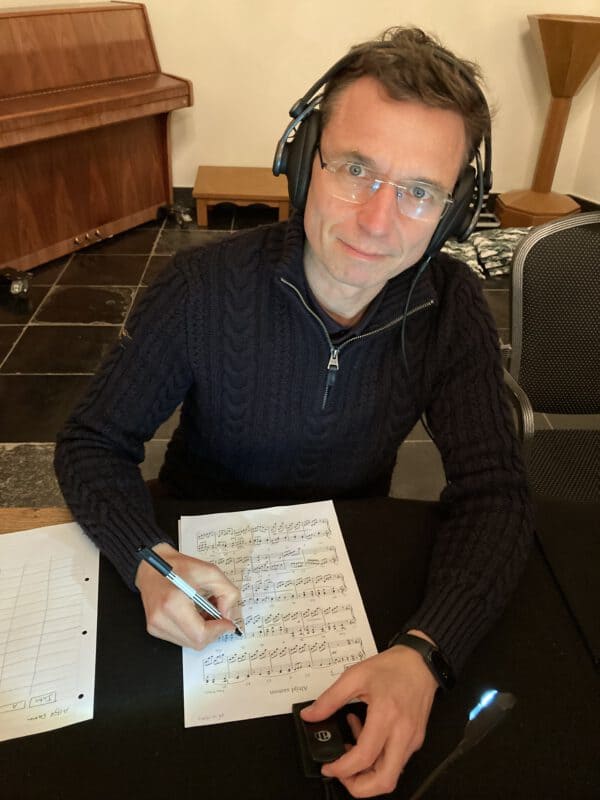
Titus Tielens (°1969) is a self-taught composer. As a musical storyteller, Titus enjoys improvising on the piano in classical style. In his piano music, he weaves traditional elements into fresh and new musical narratives that blend complexity and accessibility in equal measure. Thanks to a lifetime of listening to classical music and informal training in music theory, he has developed his own narrative style of composing. His musical journey led to his first album Es qui se probare vult in 2018, and to Shades of Life in 2022.
In 2021, Titus founded Kinyobi Music. It is a niche production company for emerging musicians and original piano music. He proudly presents Shades of Life as its first release.
Congratulations on founding your own label and releasing a first cd within such a short period. For this album, you have composed both new works and reworked older pieces. How did you compile the program for this special project?
I love just improvising at the piano. I am absolutely not a good pianist and cannot play my own pieces. Reproducing written music is not for me. That always goes wrong. But when I put the score aside and just start playing whatever comes to mind, something often emerges.
I play the musical idea a few times before I start developing it further. When I have a number of ideas in sequence, I start to see a story in them. They are not concrete stories but rather feelings that you can imagine something about. Those stories are plastic; each time I can fantasize something different about the music. But it is as if the music tells its own story. I hear the melody and then I feel how it should continue. That is how I string the different ideas together and it becomes a story.
I do this musical experimentation regularly. It takes me one to two months to compose such a piece. And at a certain point I had a number of such pieces, a number of musical stories. That is why the theme of telling stories through music is central to the album.
In the booklet there is an image of a score with all sorts of instructions written in and measures crossed out. This gives us a glimpse of your compositional process. Do you write things down as you improvise?
I used to have a digital piano and that gave me the enormous luxury of not having to worry about writing things down.
I usually start with a couple of glasses of wine. [laughs] Or very early in the morning. Then I just play whatever comes to mind and sometimes that leads to something. For me it usually starts with melodies. I play them a few times with small adjustments each time until I have something I want to write down. Very simple, sometimes just three measures, which I then continue with later. Eventually I have fragments of melodies for which I then look for harmony. First simple harmonies that are then altered to create a longer arc of tension. I think about that kind of progressions while cycling. Around that I then set up the structure, after which I fine-tune a bit. Once the schematic outlines of the melody are ready in a music notation program, I spend days playing with accompaniment patterns and refining the melody. At the end I add the phrasing and the dynamics.
That entire process takes about one to two months.
How did you then come up with the idea to name this compilation Shades of Life?
That was a special process and is the result of the whole team. I filled papers with title ideas, with well over 200 options. But the counterpoint to my creative thinking was sound technician Erik de Goederen. He is at home in many creative fields and is very critical. And that fine man rejected all those titles because he didn't like them. There were titles like Recollections but Erik wanted something more unique. At one point he suggested Shades of Life and the whole team loved it. And when everyone was a fan and I liked it too, we went with that title.
 It also fits perfectly with the album because it has multiple meanings. The word "shades" translates here less as shadow but as aspects, facets or hues. The title reflects the image on the album cover that we had already chosen. The image is an extreme close-up of a butterfly wing, a photo by Erik, where you can see the different facets that give the butterfly its colour. So everything came together under that title.
I think it's a beautifully chosen title for the dreamy music that goes its own way and follows its own thought pattern.
Thank you. You hit the nail on the head. I had an earlier cd where I followed traditional musical forms. I started a few years ago without formal training but as a self-taught musician. And the works on my first cd were, for example, a baroque study, a sonatina, a ballade and a sonata. All traditional forms with strict rules. I tried to use examples from great classical masters to rebuild a sonata completely using the same building blocks. What harmony and progressions do they use, how do they approach melody, etc.
With Shades of Life I didn't do that at all. Knowledge of harmony theory remained in the back of my mind, of course, but I completely abandoned the strict form rules. I let the music find its own way. This sometimes gives a dreamy or even unstable feeling.
It was a very organic process.
Yes, exactly. Composing much more by feel than based on structures.
You mentioned it already but also in the program booklet you refer to "the old masters". For Furioso [track 01] you explicitly refer to Beethoven. Do you process certain influences in other works as well?
The first piece really has something of that finale of the Tempest sonata. With other works, that link is not so direct. The work Altijd samen [track 04] has something Schubertian because of the major-minor contrast. That is the result of 40 years of listening to Schubert. Another composer who had an influence is Bach. Of course not to be avoided. [laughs] In some works I interweave one theme with another theme, as in Le Quotidien [track 09], but not according to the strict rules of a fugue or canon. Also for example in Joie de Vivre [track 08] there are baroque elements.
There is only one work that uses real quotations. The work Interview [track 05] is based on Godfried Bomans' 'interview' by Wim Sonneveld. It is a very humorous fragment.
Bomans is the 'maestro' and Sonneveld gets a 'masterclass' from him. They sit bickering with each other while sitting behind the piano. Every now and then they play small, improvised fragments. I combined a number of those little pieces and incorporated them into Interview.
Your compositions are performed by Mattias Spee. Had you worked together before?
No, that connection came about indirectly.
Every year on December 31st I take a long walk and take stock of the past year. On January 1st I take another long walk but look ahead to the future. I set myself all kinds of resolutions, which I usually don't fulfill. But in 2021 my resolution was to record a cd before the end of the year. And so the ball started rolling.
In the first half of 2021 I was enormously productive and wrote a lot of music. And then the search for a pianist began. Through existing relationships and via LinkedIn I started looking for possible candidates. Eventually seven pianists applied. But I was specifically looking for a young musician. Preferably someone who had just graduated or was about to graduate from the conservatory. Then Mattias was recommended to me by the head of Conservatorium van Amsterdam (CvA) with whom I was in contact through an acquaintance.
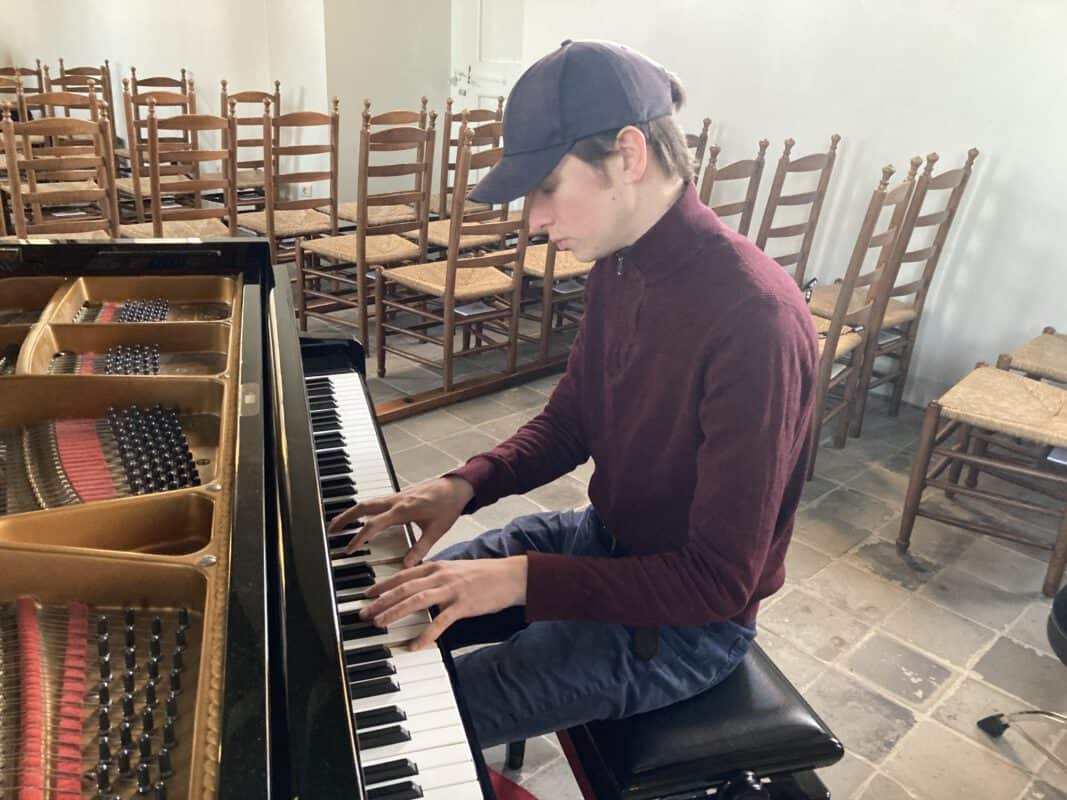
That's how the contact came about. During our first meeting we exchanged our ideas about music and it clicked immediately. Together we embarked on the project. He studied the pieces and I visited several times to hear them.
That was every time a magical moment. To hear your own compositions for the first time. It was partly what I expected and partly not. It was his interpretation that brought the music to life. He had quite a few suggestions for phrasing and dynamics. Even during the recordings. The transformation from notes on paper to sounding tones is a miraculous process.
For this album you set up your own label and released the final product in collaboration with Snakewood. How did that come about?
I only got to know Snakewood editions later. They have a different style and look for lesser-known baroque composers. They thought my music was good but it didn't fit with the baroque repertoire they normally release. So I decided to do it myself.
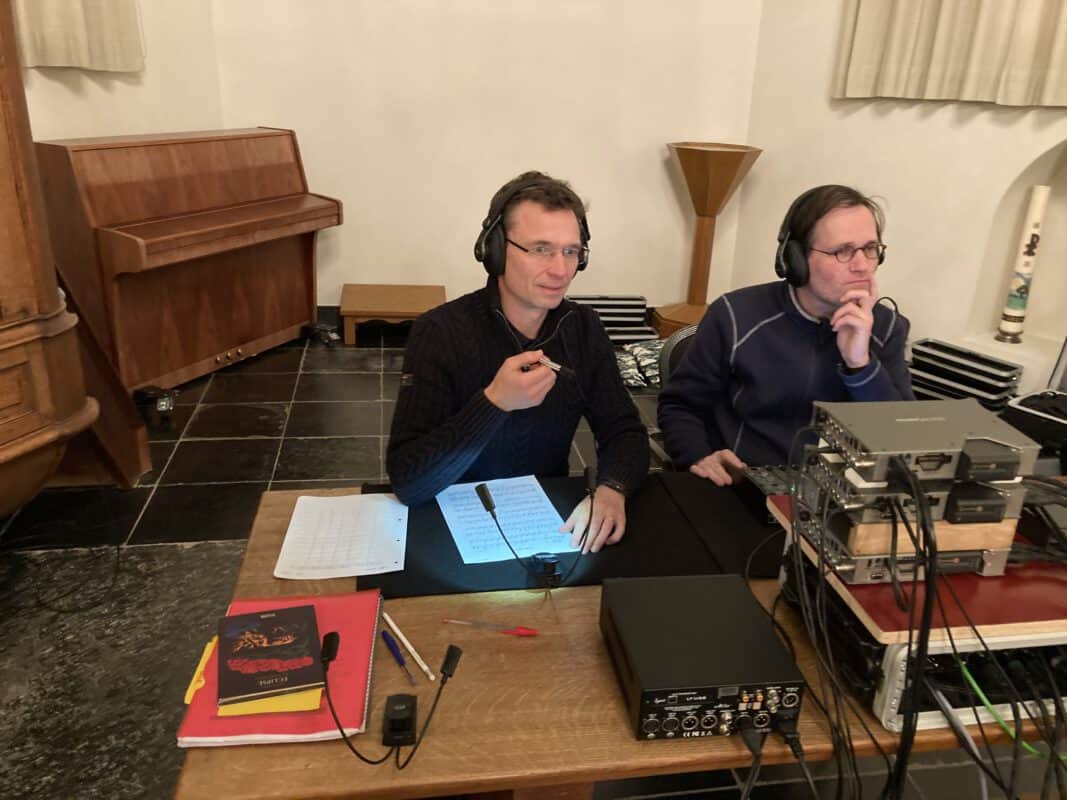
The collaboration with Erik, the sound technician, was essential in this. He has incredible creative and technical knowledge. He is a filmmaker, photographer and poet. With his collection of microphones, Erik designed the technical scheme for the recording. He also provided the location because of its acoustic qualities. It was also his suggestion to start a label ourselves.
So I set up the Kinyobi Music label and arranged and funded the entire production process. For one day we tested all sorts of pianos. Then we rented the church in Uitwijk (Brabant, Netherlands) and made the recordings at night. This step of the process was also wonderful. Between recordings we sat in the little tower of the church, ate vegan delicacies and exchanged ideas about art and politics.
Under the label, Erik also did the mixing and mastering of the cd. In collaboration with Snakewood, the programme booklet was also taken care of.
And is it possible to combine running a label with your job? Because I suspect there's more to it than just making music.
That's right. It can be challenging at times and involves a lot of evening work. But it's very rewarding to combine.
WHO: Mattias Spee [piano]
WHAT: Tielens: Shades of Life
RELEASED: Kinyobi Music
ORDER: from the artist