

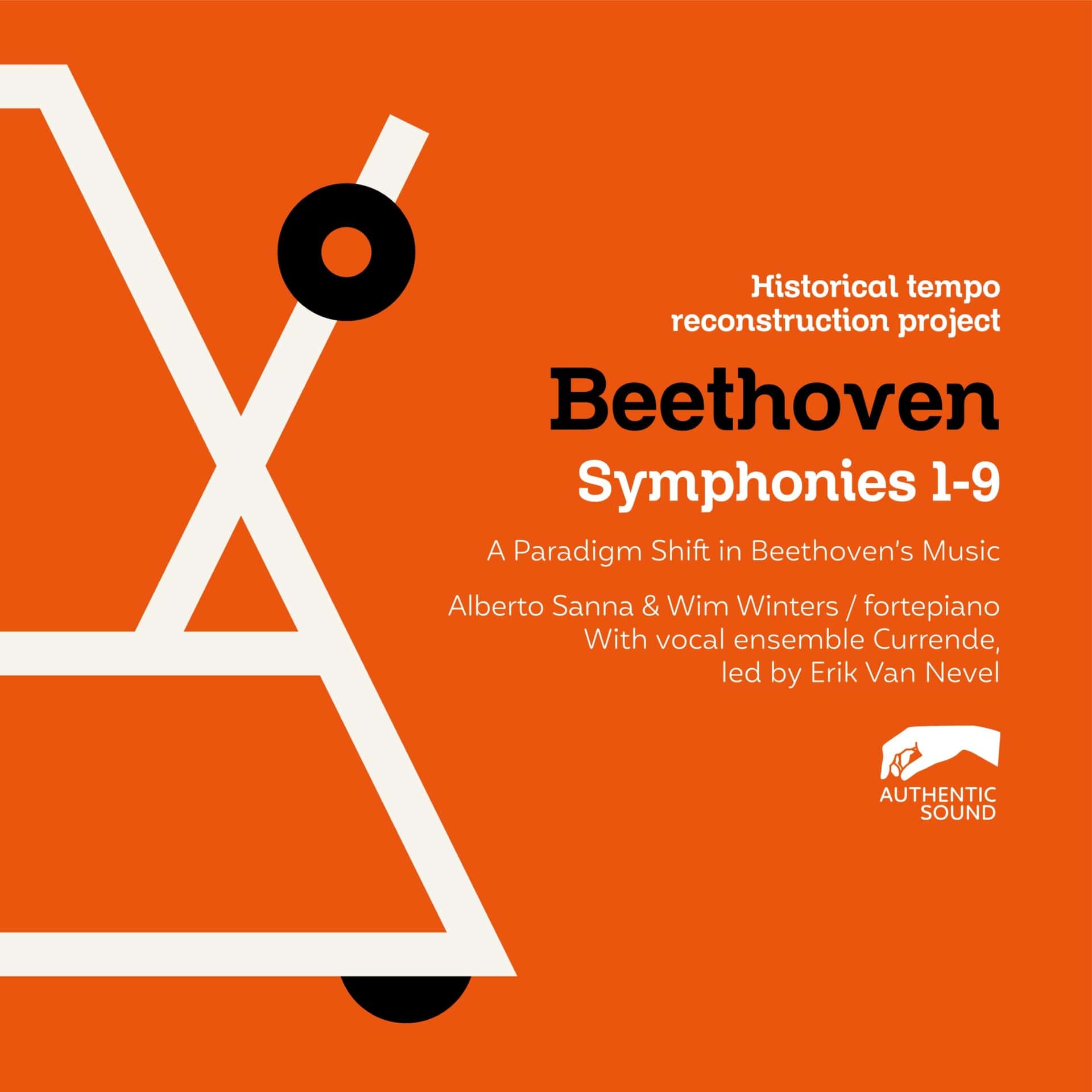
If you know Wim Winters, you know he has something to do with the slowness or is it the speed of performing music. Thus he let and lets himself be guided by Beethoven's metronome…
Since the 1980s, people have inconspicuously begun to play faster when performing many compositions. That would not only be a fashion phenomenon in itself – however historically some claim to perform – it is also something that would have been whispered to fit pieces just right on a cd without having to split them up as was the case with lp recordings 'back in those days' (and now again). Sometimes it can come across too fast, such that quite a few musical details and even entire lines threaten to be lost when listening. You can even get a sense of haste, rushed feeling from it. This set Wim Winters thinking and especially, to studying scores, the metronome markings and more.Taken at speed...
Winters discovered that his 'subjectively unpleasant feeling' from such hurried-sounding performances was correct after turning his attention to Beethoven. It is not widely known, but Beethoven and the metronome were inseparable. Just as he counted every morning the number of coffee beans that were allowed to be ground to make his cup of coffee, he was, as it were, maniacally attached to the metronome. And what did that teach Wim Winters and what do we learn from it? That the subjective unpleasant feeling is entirely justified because yes, in this period of history in which we all live, time and speed are so determining in so many ways. The saying "Haste and speed are seldom good" has been forgotten by mankind and so the masses suffer from time stress. Return with Wim Winters to Beethoven's metronome and discover that performing his rich compositions somewhat slower not only makes the listening experience itself more peaceful, but you discover so many more colours in the scores. By breathing more at a healthy tempo, you gain much greater insight.Could it be a bit slower please?
Wim Winters, whom most will know as an organist, also plays fortepiano like the best. After studying many scores – an angel's work that took years – and searching for and finding musicians whom he could convince, work was made of transcriptions of Beethoven's nine symphonies for pianoforte. These transcriptions, never before performed in their entirety, are by the hand of Carl Czerny (remember his finger exercise studies for piano), phenomenally orchestrated. Well, who would have taught him? Together with Italian pianist Alberto Sanna and conductor Erik Van Nevel with his Currende, Wim Winters recorded the nine symphonies and wrote a matching extensive treatise.It takes some getting used to, listening to a 'slower' Beethoven, but after a few minutes you are already convinced. This is it! You discover much more depth, colour, the breathing up and down, light and darkness and everything that makes Beethoven so great as, if it may be said and written, the Rubens of Music. What Winters does here, you can well compare with restoring such a painting by, for example, our Rubens that has been soiled by candle soot and many layers of varnish. Once all that darkness is removed from what you already found so incredibly beautiful, you discover with larger eyes than ever the enormous beauty of what the artist created. Open now your ears and hear what you never heard before despite those Beethoven symphonies taking your breath away so. It makes you silent.
Winters and Sanna play on a pianoforte built by Joris Potvlieghe after a Johan Fritz instrument from 1816.
We won't reveal more to you about this special and (still) unique recording. You really must listen to it and discover 'novelties' in Beethoven that were always there but were taken at speed. It may be slower, beautiful according to the only, true, real metronome markings of the ingenious composer himself, which no one can improve upon. Go for it, read the fascinating treatise (in English) and listen and… listen once more? Do you agree with Wim Winters? We certainly do!