

Few works from the Baroque repertoire enjoy a comparable canonical status as Georg Friedrich Händel's (1685-1759) oratorio Messiah. That status is both blessing and curse. Through frequent performance, the oratorio risks becoming a ritual in which recognition seems more important than meaning. The familiarity of individual choruses and arias often leads to the work being listened to fragmentarily, divorced from its internal logic and rhetorical coherence. A convincing performance must therefore not only be technically and stylistically correct, but also demonstrate anew why this work once made such a profound impression.
The creative moment of a masterpiece
In his book Sternstunden der Menschheit, Stefan Zweig (1881-1942) describes moments in which time seems to stand still: moments of intense concentration in which the course of history suddenly changes. He calls such moments "Sternstunden": dramatically charged hours in which "eine zeitüberdauernde Entscheidung auf ein einziges Datum, eine einzige Stunde und oft nur eine Minute zusammengedrängt ist". One of these miniatures, Georg Friedrich Händel's Auferstehung, deals with the genesis of Messiah in 1741 and sketches a composer who is old, sick and all but written off, but who through a sudden burst of inspiration creates a masterpiece. The creation of Messiah thus becomes a decisive moment in which human frailty, artistic genius and spiritual inspiration converge.
Zweig's literary-novellistic approach does not reconstruct facts like a chronicler. It dramatizes the creative process and lays bare its transcendent character. This creates a fruitful parallel with Messiah: prophecy, birth, suffering and redemption transform into a timeless, spiritual experience in which the human and the divine unite in a single, breathing moment. The work proves to be not only historically, but also musically and emotionally intensely felt.
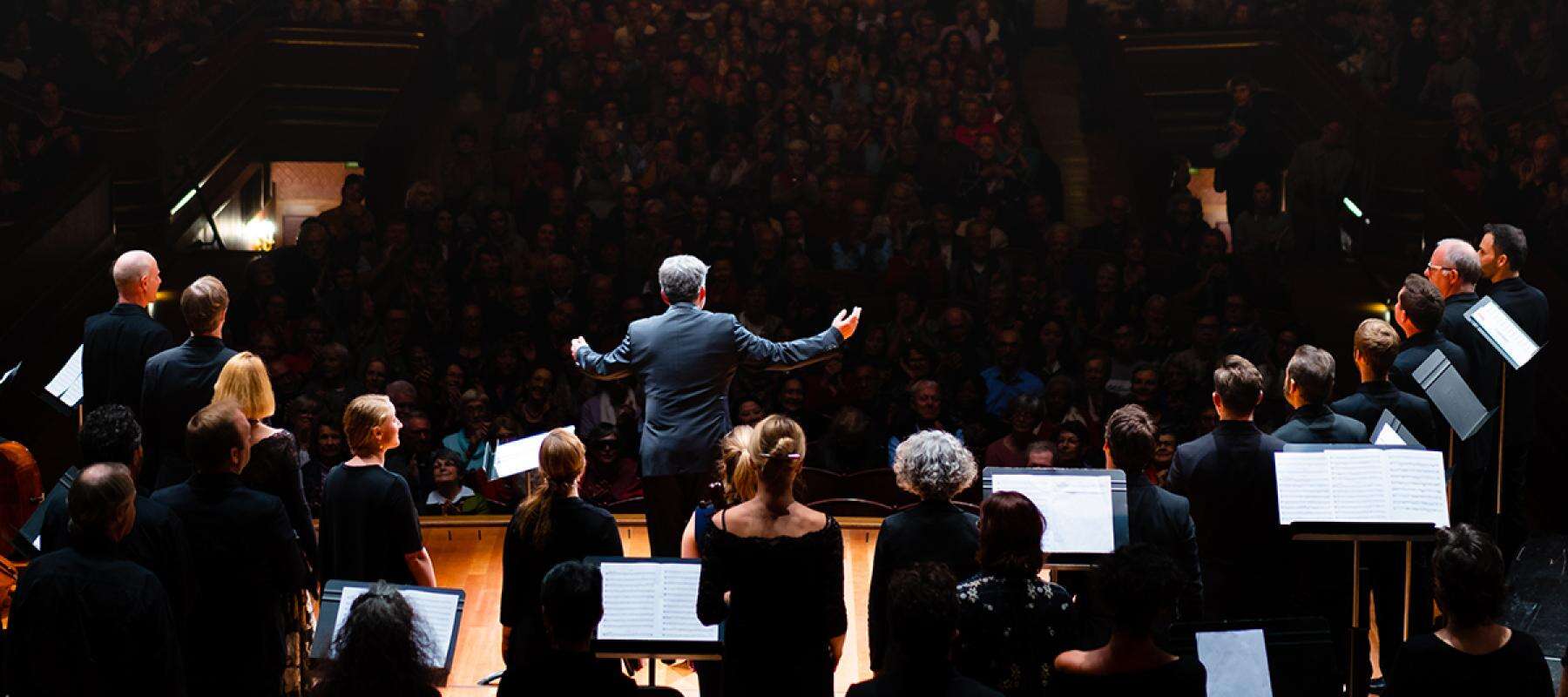
On Wednesday, December 17, BOZAR offered precisely such a "Sternstunde" with Gli Angeli Genève under Stephan MacLeod: not a mandatory Christmas tradition, but a coherent, compelling and spiritual whole in which music and text conducted a poignant dialogue that illuminated every emotional layer. From the opening measures it was palpable that this was no routine performance, but a message was being conveyed – carried, consciously and with complete dedication.
The Swiss ensemble Gli Angeli Genève is known for its transparent and expressively oriented performances of Baroque music, with a strong emphasis on textual understanding and rhetorical subtlety. The performance showed that historical performance practice need not be dogma. On the contrary: it can be a powerful means of conveying emotion, drama and content even more intensely. Thus their performance became a "Sternstunde": a moment of intense concentration and meaning in which every note, carried by transparent sound and subtle rhetoric, made visible the power of human creativity and the enduring brilliance of exceptional moments. What unfolded was a rare combination of intellectual clarity and joie de vivre that made listening as demanding as irresistible.
The rhetoric of music and word
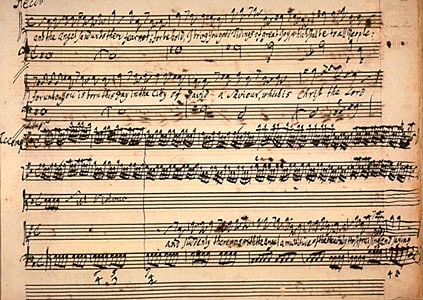
Händel's Messiah is essentially not a dramatic narrative, but a contemplative construction. Librettist Charles Jennens assembled exclusively Biblical texts, without characters or direct action. That choice makes the work exceptional within the eighteenth-century oratorio tradition, in which narrative clarity and personification typically take center stage. This shifts the focus to musical rhetoric: meaning emerges from orchestration, harmony, phrasing and contrast. Händel thinks here less in terms of opera and more in musical rhetoric. Each musical figure functions as an argument, each modulation as a nuance in a larger discourse on promise, suffering and redemption. This demands of performers a sharp insight into the relationship between text and music – precisely the starting point of this performance. Every singer knew not only what he sang, but also why he sang it; the outstanding English pronunciation and meticulous nuancing ensured that every word carried its full weight.
MacLeod did not opt for external dramatics, but for structural clarity. The three-part structure was clearly profiled: the first part as promise and expectation, the second as theological and emotional focal point, the third as reflection and affirmation. Within that architecture, tempi and dynamics were carefully employed to support the rhetorical function of each movement. Striking was the restraint MacLeod allowed: no haste in the recitatives, no over-accentuation of familiar moments, but a continuous arc of tension that took the work as a whole seriously. That approach lent even the most familiar passages a renewed naturalness. Transitions proceeded organically and never abruptly; the music was given time to breathe and unfold naturally.
The historically informed approach of Gli Angeli Genève contributed essentially to this reading. The light, transparent orchestral sound allowed Händel's counterpoint to speak clearly. Voice leading and harmonic movement remained constantly audible, so that the musical structure never succumbed to expressive excess. Strings articulated with sharpness but without dryness; the continuo functioned as a rhetorical foundation, not merely as harmonic filler. The choice for a flexible and alert basso continuo playing gave the recitatives an almost spoken quality. The orchestra supported the singing in an ideal way: not accompanying in the classical sense, but dialoguing, alert and continuously breathing with the text.
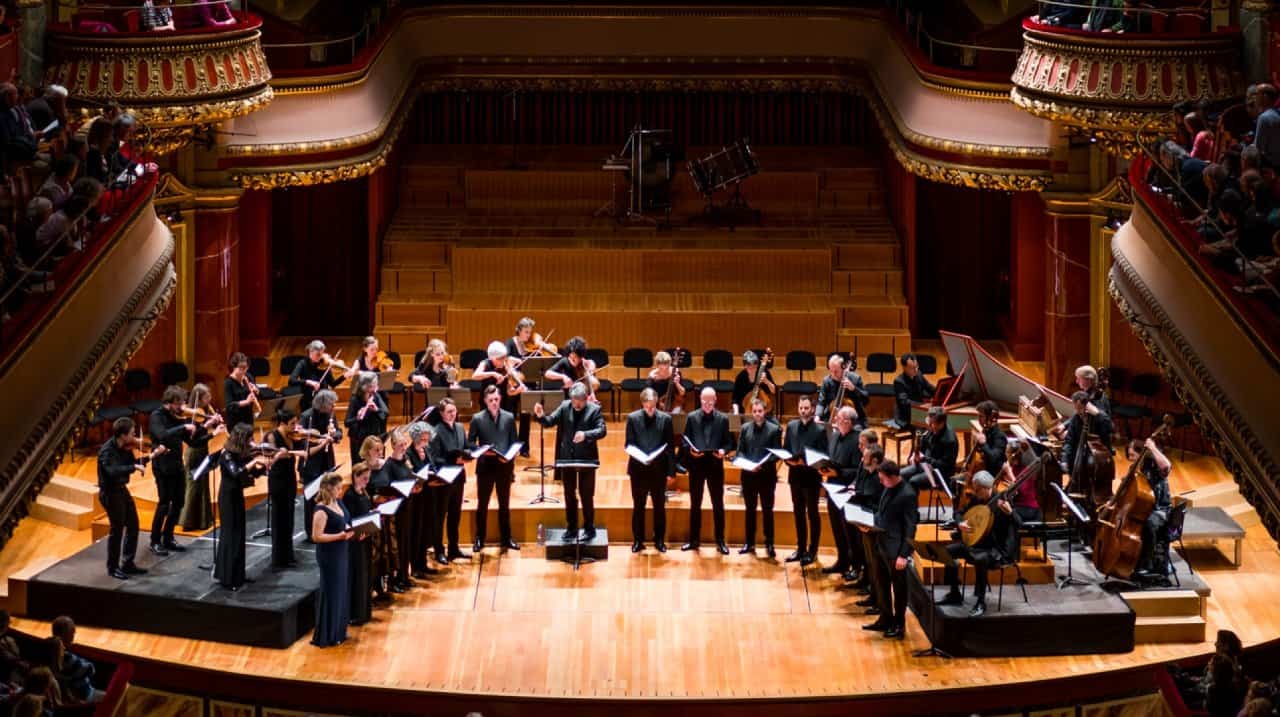
The soloists too were employed as bearers of meaning, not as autonomous voices. There was no question of vocal competition, but of a collective striving for textual clarity and expressive coherence. In accordance with eighteenth-century practice, the singers stood before the orchestra, and – with the exception of the soprano – the soloists also participated in the choir, which further strengthened the unity of voice and message.
Jeanine De Bique gave her soprano arias a pronounced text sensitivity. In Rejoice greatly, the joy sounded not triumphant, but expectant, sustained by flexible phrasing and a natural handling of ornamentation. Her singing remained always connected to the semantic content of the text, so that virtuosity never became an end in itself. Alex Potter approached the alto parts from introspection; his voice colour lent arias such as He was despised a hushed intensity that did not dramatize the suffering motif, but internalized it. His approach closely aligned with Händel's ability to unite pain and resignation in the same musical breath. The tenor of Samuel Boden excelled in clarity and articulation, with an Ev'ry valley that carefully followed the musical depiction of elevation and redemption. The precise text placement gave extra relief to Händel's word-painting, in which every leap and melisma carries meaning. Stephan MacLeod, as bass both conductor and soloist, gave his arias a pronounced rhetorical profile. The trumpet shall sound was not a bombastic climax, but a solemn proclamation, carried by a balanced dialogue between voice and trumpet. The emphasis lay on dignity and promise, not on spectacle. MacLeod conducted, sang and led the ensemble with contagious enthusiasm: now between his singers, then before them, always with an intense engagement that visibly inspired his musicians to the utmost.
The choirs formed the moral and musical focal point of the evening. Here Händel's masterful command of counterpoint and text expression came fully into its own. In For unto us a child is born, jubilation was built from rhythmic precision and polyphonic clarity, while choirs such as Surely He hath borne our griefs gained a rawer, almost confrontational sound. The sharp articulation and dynamic contrasts underscored the rhetorical function of the choir as collective witness. What stood out was the physical involvement of singers and orchestra members: in mime and body language, the surrender to the message became visible, which kept the listener on the edge of their seat from beginning to end. The famous Hallelujah was not sung divorced from context, but integrated as the conclusion of the second part, more affirmative than triumphant. It began restrained and gradually grew to a powerful climax, where the repeated "for ever" was not exclaimed, but solemnly declaimed – as a miniature of the whole concert.
The emotional impact lay in the accumulation of preceding tensions, not in volume or tempo. The final section, often underestimated, received particular attention in this performance. The Amen fugue grew into a logical and inevitable endpoint: no effect-seeking, but a gradual densification of voices and meaning, in which Händel's faith in musical order and redemption became palpable. The fugue was constructed with architectural precision, where each entry contributed to a sense of moral and musical completion. That effect was further strengthened by the singers positioning themselves at the front of the stage: the affirmative "Amen" thus sounded as a collective and unavoidable "so be it".
Messiah as spiritual and musical experience
What was distinctive about this performance lay in the coherence between soloists and ensemble. De Bique, Potter, Boden and MacLeod did not perform as individual stars, but as narrators within Händel's dramatic framework; their vocal character, phrasing and interaction with the choir reinforced the dramaturgy and allowed the emotional layers of the oratorio to come fully to life. Gli Angeli Genève proved that historically informed performance practice is not dogma, but a means to illuminate the essence of Messiah – emotionally, dramatically and substantively.
What made this performance so exceptional was the perfect synthesis of content and form. Händel's Messiah was not a Christmas tradition or decorative show, but an existential, spiritual meditation on human expectation, suffering, redemption and eternal hope. In this performance, text, sound and emotion flowed together into something timeless and universal. The tension, silence and breathing space between the notes created a contemplative space in which the ultimate Hallelujah of the evening revealed itself and grew into a living "Sternstunde" of music. For this listener, this was the reference performance, a standard against which future interpretations will inevitably be measured – perhaps even an experience that makes every subsequent listening of Messiah almost superfluous.
Through their sober, thoughtful and text-focused interpretation, Gli Angeli Genève offered a performance that did not seek to impress, but to convince – and thereby made a profound impression. It was a reading that did not intoxicate the listener, but activated them, and repositioned Messiah as a work of reflection, dialogue and lasting relevance, in which every note reminds us of the transcendence of the human and the divine. Whoever wanted to experience Händel's Messiah as a spiritual and dramatically coherent "Sternstunde" will have experienced this performance by Gli Angeli Genève as an unforgettable moment.