

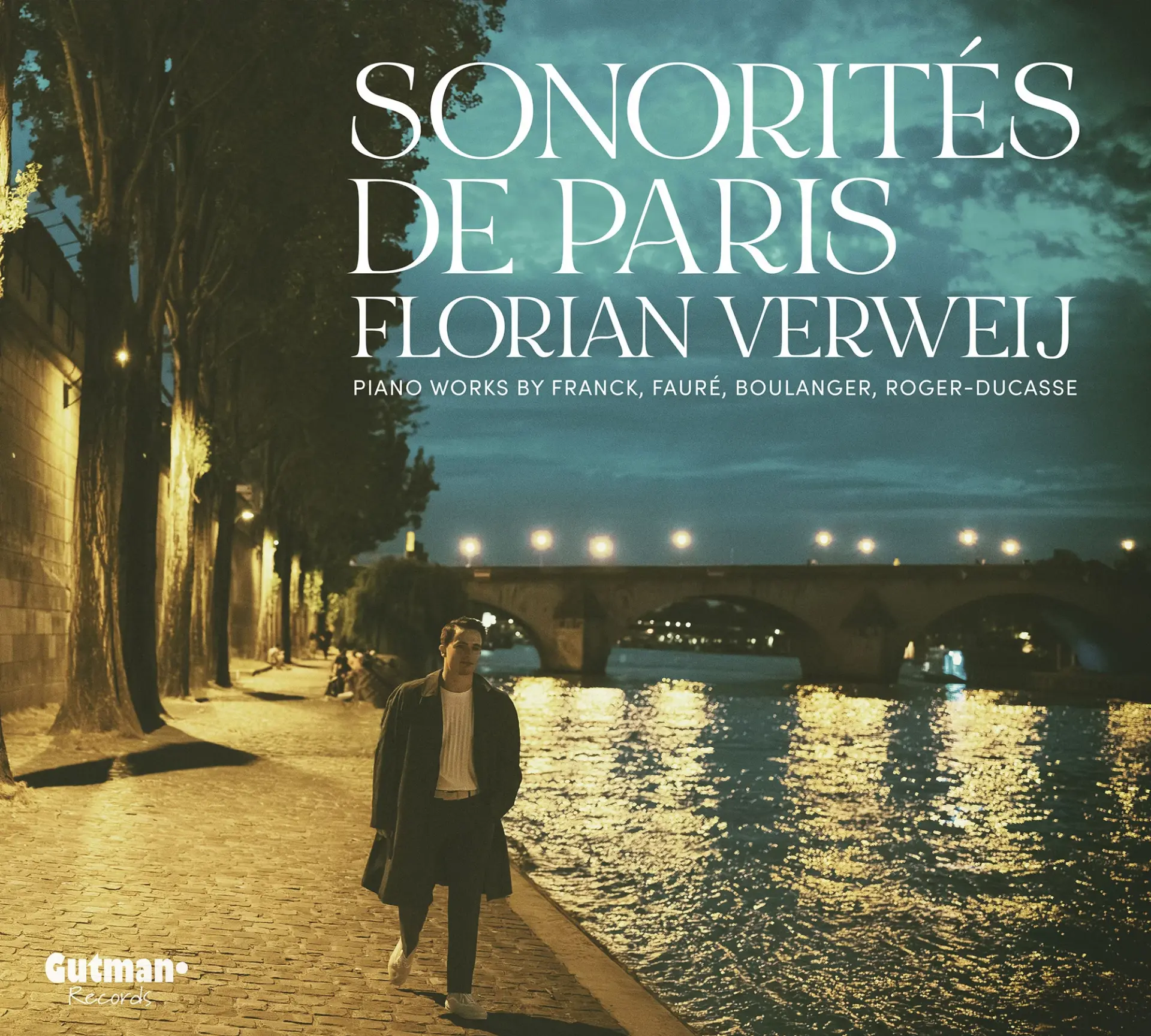
On 12 November the debut album of Dutch pianist Florian Verweij (26) was presented in the Kleine Zaal of the Amsterdam Concertgebouw. And what a debut, for Verweij's affinity with this repertoire is as overwhelming as the demonstration of technical mastery he displays in these pieces.
As fascinating as this piano playing is, so compelling is the chosen repertoire, for among the four composers represented on this album, Jean Roger-Ducasse (1873-1954) is surely the great unknown for most of us. In the most literal sense, incidentally, for 'great' certainly applies to the oeuvre unlocked here by Verweij. The album title is derived from 'Sonorités…', Ducasse's miniature on the third track of this cd.
Ducasse is represented with eleven pieces and in that sense they form the core of this sublime recital. And rightly so, for although he may have been forgotten as a composer, he certainly wrote beautiful music, this pupil of Gabriel Fauré and good friend of both Claude Debussy and Nadia Boulanger. Verweij: 'When I immersed myself in the Belle Époque for this album, the work of Roger-Ducasse hit like a bomb. He composed intense and intoxicating music with subtle, multicoloured harmonies in a very own style that cannot be easily categorized; a unique synthesis of impressionism, modernity and classical influences.'
That Verweij also chose works by Lili Boulanger (the early-deceased sister of Nadia), Fauré and César Franck is an obvious and striking choice. Roger-Ducasse visited the highly talented 24-year-old Lili on her deathbed. She left behind only a piano oeuvre of barely twenty minutes, including Thème et Variations which according to Verweij 'feels like an endless fever dream. The repeating theme, which is distorted like a prism in each variation, works hypnotically. The dark and cautiously modern harmonies give a revealing but moving feeling. This piece proves that Boulanger's composing career could have been very passionate had it not been cut short far too soon.'
Franck's Prélude, aria et final is an important repertoire piece for many pianists and thus also for Verweij: 'The polyphony, harmony and serenity go through the roof in this piece. In the Aria you feel the elusiveness of the hereafter. In the dialogue between right and left hand you hear something searching, as if you can catch a glimpse of the supernatural but cannot reach it. The ending feels as if an angel is sitting on your shoulder for a moment.'
The three Romances sans paroles seem intended by Fauré as a reference to (or, as Verweij puts it, a nod to) Mendelssohn's Lieder ohne Worte. Where in my view the three Romanzen op. 28 by Schumann should also be mentioned. This is music in which lyricism has the say.
In the cd booklet Verweij concludes his introduction with 'Savourez les sonorités… de Paris!' Not a word of that is exaggerated, for this is what this album guarantees: enjoying splendid music, performed by a true master pianist. The faceted and sonorous recording was in the hands of Guido Tichelman and Pim van der Lee. The illuminating 'liner notes' are by Loni and Florian Verweij.
'Florian Verweij is a poet of the piano,' according to a statement by Australian pianist, musicologist and composer Leslie Howard (also the only pianist to have recorded the complete piano oeuvre of Franz Liszt on cd). This debut album proves it.