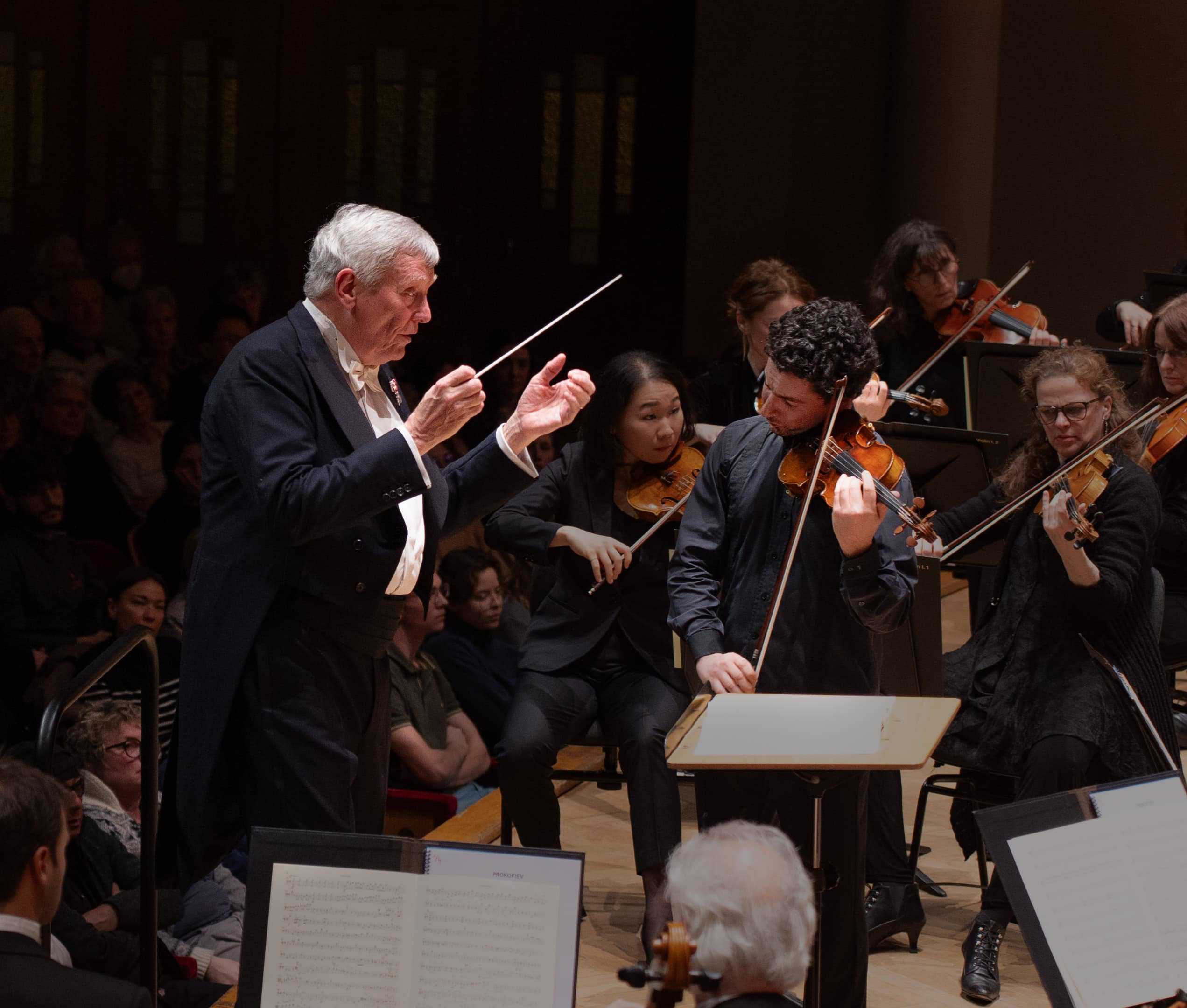
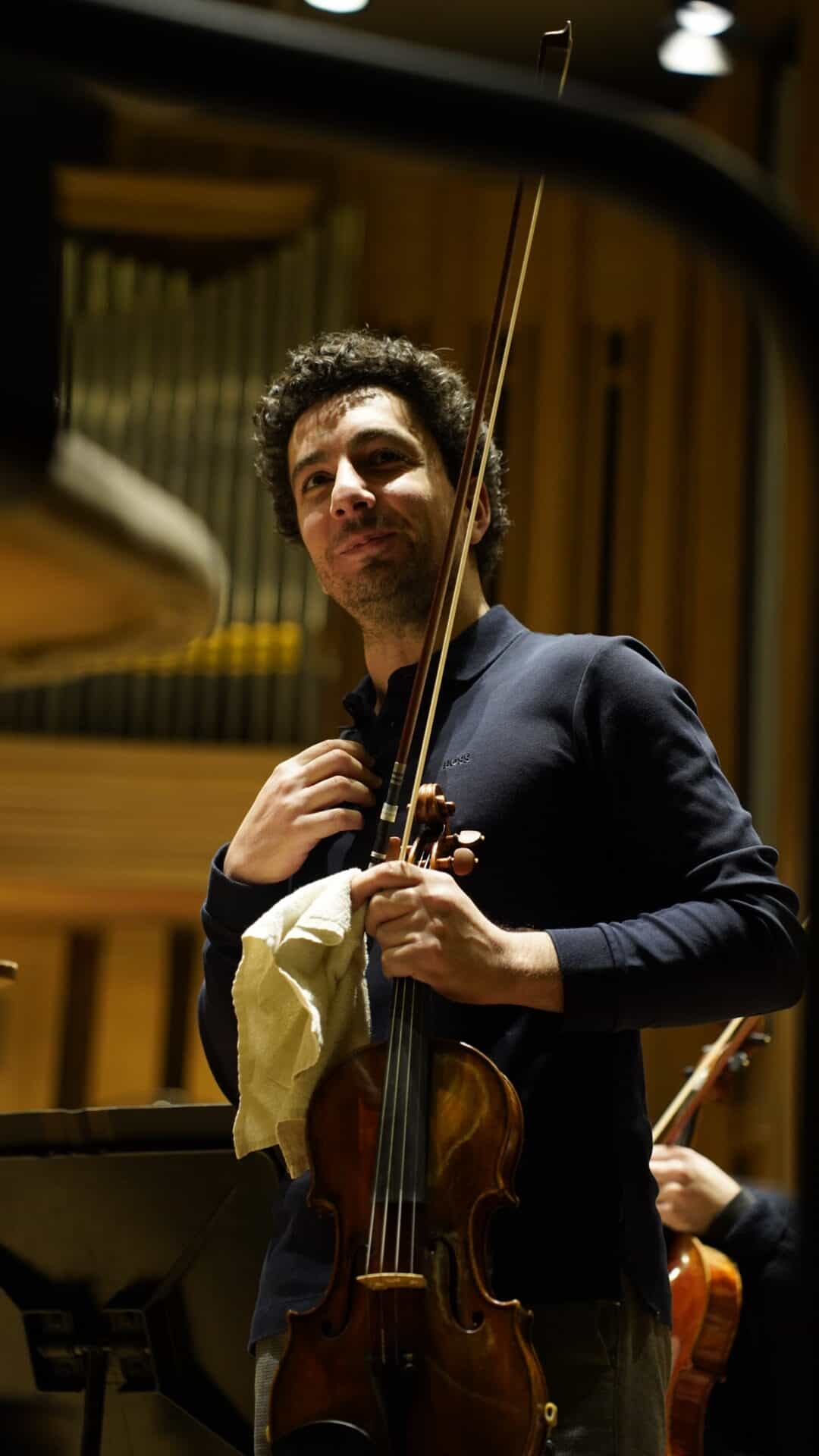
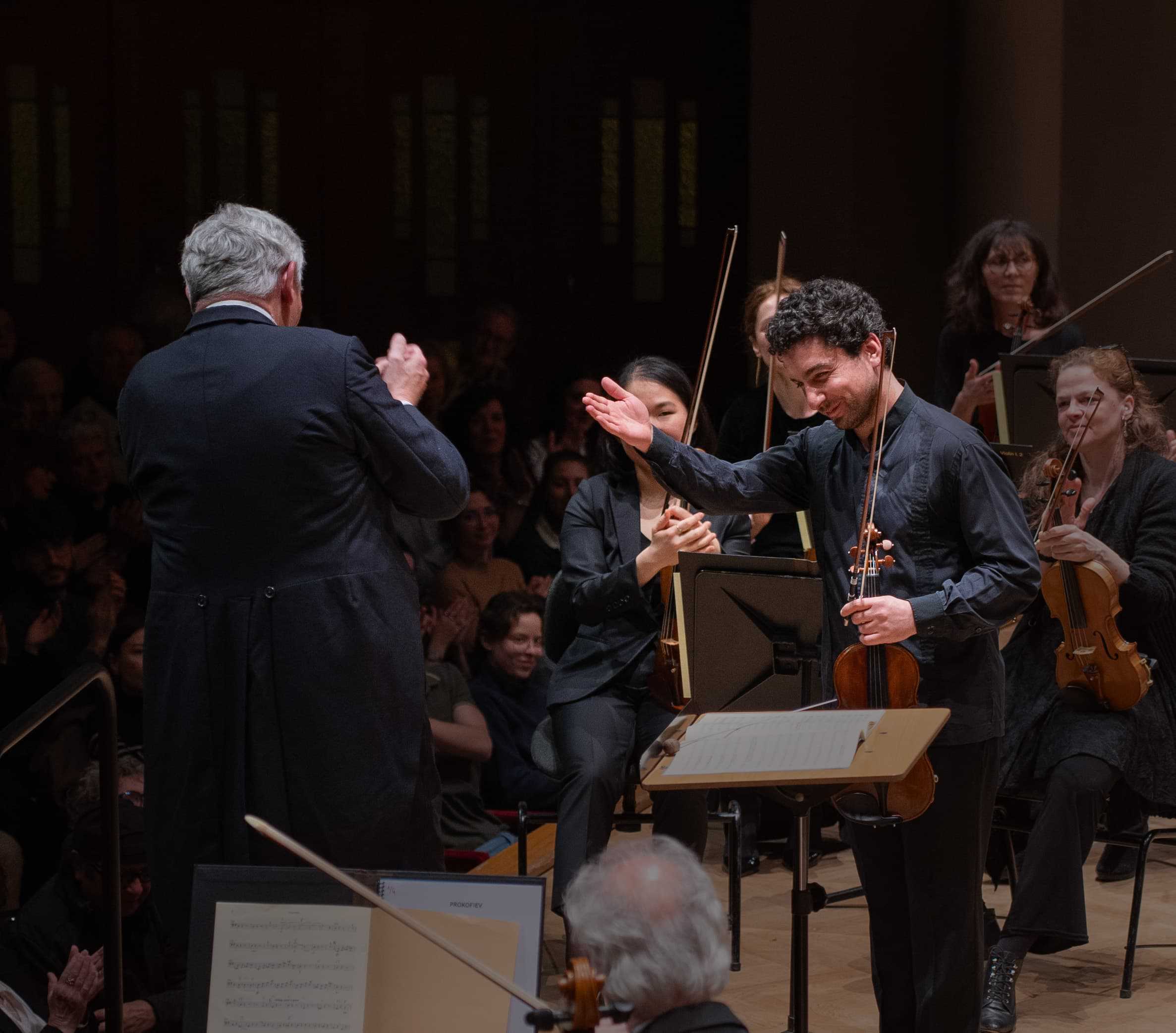
In its long history, the Queen Elisabeth Competition had one winner from Armenia. In 2005, Sergey Khachatryan won the competition at the age of twenty. He is one of the winners who have not been forgotten, after two decades. On March 29, he plays in a sold-out BOZAR together with the National Orchestra of Belgium the well-known first violin concerto by Max Bruch.Percussion
First, the orchestra performs under the baton of guest conductor Michael Schønwandt Das Gastmahl während der Pest (2006) by Sofia Gubaidulina. This now 92-year-old Russian composer became known in the West in the 1980s, among other things through the violin concerto Offertorium, which she wrote for Gidon Kremer. Das Gastmahl refers to the drama of the same name by Pushkin, a dynamic and contrasting piece in which especially the percussionists can let loose. Above the brass players all sorts of percussion instruments are arranged, where the four percussion virtuosos of the NOB tap, drum, roll and sometimes also bang very hard throughout the piece. As if to wake up the dozing listener.
The piece is quite extended and drawn out; with that material it could have been shorter and more compact. Whenever you think the end is coming, she takes up a motif or theme again. As if we are listening to a difficult birth of a baby that doesn't want to leave the mother's womb. I read that Sofia Gubaidulina was born on October 24, 1931. That is exactly the same day my still-living mother-in-law was born, also in the former Eastern Bloc. The piece reminds me of her. She was a midwife her whole life.
Max Bruch and Eugène Ysaÿe
Khachatryan plays with power and finesse. He also has much variation in his vibrato, which often sounds intensely shimmering. In this well-known concerto, he does something original here and there with bowing or dynamics. He plays with ease and maturity, as if he stands before the orchestra in a large concert hall every day. Especially in the slow section, I notice how refined, restrained yet intensely he plays. The strings of the NOB help him in this, because they sometimes sound very soft and even, a bed on which Khachatryan can then play very softly, almost intimately. Sometimes the slow section of this violin concerto is seen as an intermezzo between the virtuosic first and brilliant third movement. With Khachatryan, it is a full-fledged movement, full of intense lyricism.
After the last note of the virtuosic finale, applause breaks out. He plays a short encore and then intermission, everyone thinks. But we're not rid of him that quickly. Without saying anything, he puts the violin to his chin and begins with the soft, slow, low A from which the third solo sonata by Eugène Ysaÿe is born. A whole Ysaÿe sonata is rarely played as an encore. Tonight it has everything to do with his Ysaÿe project, which he has just completed and which is also presented after the concert during a meet and greet. What is special about it is that he has recorded the six solo sonatas by Ysaÿe on the Guarneri on which Ysaÿe himself played. He tells this after he takes the microphone following the stormy applause and begins his address. About how Brussels and this hall are dear to his heart, since his victory in 2005. He also tells about his project and the CD with the six solo sonatas played on Ysaÿe's violin.
Stradivarius
Is there anything after this long encore and the speech? Yes indeed, the first movement of Ysaÿe's fourth sonata. He has it in his fingers, of course, but ultimately the two encores and his address lasted almost as long as the entire Bruch concerto! I ask someone from the orchestra afterwards whether he also played this concert on that Guarneri violin. "No, it was a different violin." Too bad, I think. "But that other violin is a Stradivarius worth five million!" Khachatryan has something humble about him, which makes him all the more an upright musician. A name not soon to be forgotten.
After the intermission, the NOB performs excerpts from the suites based on Prokofiev's ballet Romeo and Juliet. Michael Schønwandt has a somewhat mannered way of conducting.
It is noticeable that he never straightens his arms; his elbows always form an angle. No large movements, as if he doesn't want to see the forest between the trees. Perhaps with more expansive gestures, the NOB would have a more open sound. But this is pure speculation; they play beautifully. Especially with the strings, the gift of an even, smooth tone stands out.
Violist Sergey Khachatryan won hearts this evening. After the concert, I buy his CD "My Armenia," with works by Aram Khachaturian and Armenian composers previously unknown to me. Just as at the Queen Elisabeth Competition in 2005, he plays on the CD together with his sister Lusine. "Dedicated to the 100th Commemoration of the Armenian Genocide" is written on the cover. Another people who had to pay for displacement and genocide in the first half of the twentieth century. Fortunately, the Armenian people have sent their best sons into the world, as we experienced this evening with Sergey Khachatryan.
We use necessary cookies to make the site work. With your consent we also measure visits anonymously (Google Analytics) to improve the site.
More in our cookie policy.