

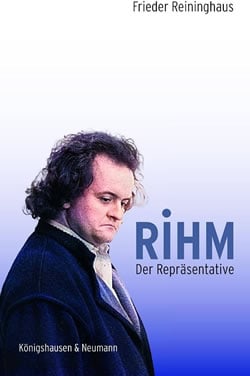
Frieder Reininghaus: Rihm - Der Repräsentative - Neue Musik in der Gesellschaft der Bundesrepublik Deutschland
Pub. Königshausen & Neumann, Würzburg (2021)
ISBN 978-3-8260-7445-5
307 pp., paperback, illustrated, with bibliography
Recently, German composer Wolfgang Rihm (1952-2024) died from the effects of cancer, the disease from which he had suffered for almost a decade and which gradually imposed increasingly severe limitations on him.

Wolfgang Rihm (2004)
Not only his death, but also his career as a composer has led to an innumerable number of publications. Among them are also those by himself in various media. The most comprehensive and in part also notable of these is the two-volume Ausgesprochen - Schrifte und Gespräche (1997/98), a full thousand pages. It is among others this publication from which Reininghaus quotes generously in his book.
German music critic and publicist Frieder Reininghaus (1949, Korntal), also professor at various West European universities, including most recently those in Vienna and Salzburg, has published a large number of works, including several devoted to Wolfgang Rihm. In 2021, his latest substantial contribution in this area appeared: Rihm. Der Räpresentative – Neue Musik in der Gesellschaft der Bundesrepublik Deutschland, published by Königshausen & Neumann in Würzburg.
In his recent contribution to the publicity machine about and surrounding Rihm, the author offers only a modest picture of the life and work of this extremely creative mastodont, who in his own country is regarded as the greatest post-war composer.
To improve readability (not illogical when dealing with a musical chameleon of such caliber), Reininghaus has chosen—quite logically, moreover—a division into seven time windows, beginning with Rihm's breakthrough as a composer (I), followed by the periods 1966-1978 (II), 1979-1985 (III), the eighties (IV), 1987-1989 (V), 1990-2005 (VI) and 2005-2021 (VII). The last three and a half years of Rihm's earthly existence are thus absent.
In the book, which appeared around the time of Rihm's seventieth birthday, the most famous German composer is designated as a classicist, universal genius, art titan, outstanding figure and seeker after beauty and knower of all things, alongside several other readily appealing qualifications. In doing so, Reininghaus comes quite close to the truth, though where contemporary practitioners of the fine arts are concerned, it is always the time still to come that will (ultimately) render the final judgment. In this regard, we should not fool ourselves.
Group journey towards Zermatt
Reininghaus deliberately chose neither a thorough analysis of Rihm's oeuvre (musical examples to support this are likewise absent) nor a detailed account of Rihm's circumstances as a creative artist. It has certainly not become a biography, but rather a monograph. The subtitle, Neue Musik in der Gesellschaft der Bundesrepublik Deutschland, unfortunately promises more than it delivers: the author does not go much further than touching on the contemporary periphery around Rihm (although there is fortunately adequate attention to the Ferienkurse in Darmstadt), which begins in Cologne in August 1979 with a 'Gruppenfahrt ins Abendrot', featuring as characters three editors of the magazine Spuren, composers Dieter Schnebel and Frederic Rzewski, and painter Georg Eisler. They are on a train with the Swiss Zermatt as the final destination for the first International Adorno Symposium.
Much old wine in new bottles
The author, on the other hand, has invested considerable effort in collecting and unearthing old reports, notably reviews of premieres, in newspapers, magazines and other publications (including a large number by himself), which serves a deliberately chosen purpose but makes rather a lazy impression. Although there is a positive 'catch', as many a quotation will undoubtedly prove elucidating for the reader less well versed in this rather complex matter. What Reininghaus quotes most from has already been mentioned: Ausgesprochen.
Rudimentary approach
What we are not presented with are analyses of the techniques, structures, textures, instrumentation and orchestration employed by Rihm. Instead, there are easily accessible and therefore not overly detailed work discussions with Rihm's compositions for music theater as the focal point. This seems to relate to what has given Reininghaus his reputation in Germany and also earned him recognition beyond his own country's borders: his role as opera critic and publicist. It is unfortunate, however, that the premiere reports included in the book say less about the music and more about the impressions gained. As a result, they contribute insufficiently to a better understanding of Rihm's colossal and at the same time complex works for music theater. What we are waiting for, therefore, is an author who sheds sufficient light on this. In book form, he will find himself in virtually uncharted territory in this respect.
Impossible Task
Can this be blamed on Reininghaus? The fact is that it is impossible to subject even just the principal works of Rihm (let alone the inherent arbitrary choice involved) to an in-depth description in a single book (even one of much larger scope). The oeuvre comprises over five hundred works and across all conceivable disciplines. Moreover, this hard worker possessed the creative ability to constantly change musical colour. He never felt bound by earlier insights and saw artistic freedom as the highest good; and so his work reflects that. For the future biographer, there is moreover a not insignificant flip side: Rihm's life was not rich in remarkable events, let alone spectacular occurrences or eccentricities. This in contrast to what he conceived as a composer at his desk.
Accomplished Networker
When Reininghaus ventures outside the musically ordered realm, gossip sometimes wins out over facts. As in Time Window IV, Gourmand, Gourmet und Revoluzzer, chapter 17: Marsch durch die Institutionen, in which the composer is portrayed as a refined, extremely accomplished networker and from which the connection is drawn to the numerous (secondary) positions Rihm held in German musical life, alongside the many 'pollinations' that would have resulted from that (if it were all taken as true, it would certainly be no less than what our then 'art pope' Reinbert de Leeuw achieved in this regard). Reininghaus proves to be more associative than eager for truth-finding here. Reininghaus wrongly attempts to strengthen his argument by citing Rihm's well-known statement: 'Ich will bewegen und bewegt sein'.

Lobby
Then there are the countless prizes, honours and accolades that befell the composer over the course of his brilliant career (Time Window VII, Komponist und Gesellschaft: Ehrungen, Unerschöpflichkeit und Lebensart). The list is unprecedented in length, whereby a knowing person need not even wait for the second half of the word. However, this does not apply to what Reininghaus also brings up: the stream of positive reviews the composer and his work receive. The author primarily links this to the lobby circuit that has had its effect since the 1980s. Numerous names come up: those of dramaturge and writer Nike Wagner (her contribution to the many festive speeches on the occasion of Rihm's sixtieth birthday is dismissed by Reininghaus as 'Wortschmiedekunst'), industrialist Adim Heidenreich (in Neue Zeitschrift für Musik), music critic and journalist Gerhard Koch associated with the Frankfurter Allgemeine Zeitung (he has a very important voice as a lobbyist in the chapter), and columnist and broadcaster Christine Lemke-Matwey, characterized by Reininghaus as 'Klatschkoluministin'. Then there is Julia Spinola, among other things author of Die grossen Dirigenten unserer Zeit, who is portrayed as 'Hymnologin' and no less important: Eleonore Büning, as music publicist and opera critic associated with—again—the Frankfurter Allgemeine. She is given the far from flattering stamp 'Ahnungslosigkeit' or 'Rankune', this 'lampenpoetster Lisa'. According to Reininghaus, they all form part of the 'Rihm-Tross', which does not, however, prevent him from making the greatest reproach to the composer himself: Rihm 'füttert freilich die Vielgefräßigkeit fortdauernd nach besten Kräften.' As if you as a composer are not allowed to stand up for your own work...
Stylistic World of Wonders
What actually drives Rihm as a composer? In any case, the pursuit of paths seemingly untrodden to eye and ear, towards the wholly unknown, the creation of entirely new experiences, first for himself, later for musicians and audience. Chiffre, Unbenannt, Ungemaltes Bild, work titles that speak for themselves in this context. Again and again there is the creation of a unique, stylistic world of wonders, each uniquely set to music, without predecessor or contemporary. The instrumental and vocal means are not new, but they are deployed in an unprecedented way. The texts used demonstrate Rihm's extensive erudition as convincingly as the words and concepts he chooses himself.
'Music Always Has Form'
Systemless. It is a well-known reproach that resonates. A less than thorough analysis already shows it: Rihm did not compose so 'systemlessly'.
In 1985, Rihm wrote in a letter to musicologist Hans Heinrich Eggebrecht (more about him later) that
'Musik immer Form hat, auch wenn der Komponist bewußt Form nicht komponiert; auf dem Zeitstrahl formt sich alles, erhält Form durch den einfachen Umstand, daß es beginnt und endet (vorgefaßte Form ist eigentlich tautologisch - Diskussionen und Formprobleme haben - so fürchte ich - immer herhalten müssen, die fehlende eigengesetzliche Kraft einer Musik zu verdecken. ihren fehlenden Sog [...]'
This calls for a continuation, because that 'lack of system' has become quite well-established over time. However, it is especially the fragmentation deliberately chosen by Rihm that is confused with 'lack of system', whereas that is precisely part of his formal concept. The fragment (broken, separated) is purely functional, acts as a suddenly appearing phenomenon, as an element of surprise. He has mentioned it often enough himself. For Rihm, fragmentation is much more than merely intended as part of various contrasting elements: with him it is precisely about juxtaposing blocks or small blocks that no longer have any relationship to each other. An identifiable beginning and end no longer emerges, what has appeared dissolves into something completely different. We find it in the Second String Quartet, Fragment für Andrea, Hölderlin-Fragmente, Lenz-Fragmente, Nietzsche-Fragmente, Fragment aus Tutuguri, Bildnis: Anakreon, Schwarzer und roter Tanz, all created in the late seventies and early eighties, with the exception of the Zwei Fragmente von Hölderlin nach Sophokles dating from 2008.

Wolfgang Rihm in February 1993 after the performance of the 'Hölderlin-Fragmente' by the Berliner Philharmoniker (photo Reinhard Friedrich)
Strolling...
In Time Window IV, chapter 18, Flanieren durch die Genusszonen, a lighter tone is struck and we are granted a fleeting glimpse of Rihm as a great lover of a good glass of wine, his preference for select wines and copious meals. This promptly reminded me of the biography of violinist Marc Daniel van Biemen discussed by me here. Rihm this time on the periphery of the everyday, stripped of the illustrious and special.
Digital Novice
The presentation of Rihm as a digital novice is also light in tone. He wanted nothing to do with computers; composing is literally handwork. He could only be reached by phone, letter or fax.
Rihm not only as a creative artist never wanted to use a computer. Anyone who wanted to contact him could do so exclusively by phone, letter or fax. When asked what composing as handwork meant to him, his answer was unequivocal: that in the art of composing it meant no more than a metaphor and only served to express what he wanted to achieve and represent in an adequate manner.
Rihm's aversion to the computer also had an impact on the creative level. When an interviewer remarked that media experts had already claimed since the eighties that script would soon be replaced by programming codes, his reaction was as simple as it was unequivocal: that those experts probably understood nothing about composing.
Rihm saw in the rapidly advancing computer in the creative process also the decline of the handwritten manuscript. Related to this was the problem of 'nicht mehr durcherlebte Zeit' during the compositional work process, which he illustrated with an example: the composition student who uses the computer as a tool. Rihm speaks from experience. Once this process is mastered, their pieces turn out to be approximately half as long because with the aid of the computer it is a breeze to extend textures that have already been fixed. Had that student been restricted to 'handwork' alone? Then he would have experienced that extension as very laborious, would have soon given it up.
Rihm saw it too during composition competitions: many of the scores submitted to him for judgment unmistakably bore the 'handwriting' of the computer (Otto Ketting once told me that he could immediately see that the computer had been involved in a composition).
Handwork
For Rihm there could be no doubt whatsoever: composing had to remain handwork. He himself worked out his scores exclusively by hand, he didn't even know a faster method: 'Ich kann nicht so schnell maschinell schreiben, wie ich mit der Hand schreibe.' (Reinhold Brinkmann/Wolfgang Rihm, Musik nachdenken, Regensburg 2001.)
For Rihm, 'mit der Hand schreiben' did not mean that he was fond of revising his handwritten scores by erasing, overwriting, pasting over, shortening or inserting. Traces of this can occasionally be found, but in general it holds that his manuscripts testify to a high degree of neatness and care.
Viennese conductor and composer Johannes Kalitzke pointed out another aspect of the handwritten score: that corrections or rejected passages leave their traces in it, however faint sometimes, but can later be helpful to both the composer and the interested musicologist, whereas that is not the case with computer-generated scores.
In Ausgesprochen it says:
'There is no improvement in art, at most: states, each different. The whole of life becomes script. Already, how I walk, stand in space, no envelope curve, my voice, temperature, color, my smell - everything is script, a set sign that describes me and at the same time gives me the means to write myself what is invisible, what no longer names me, yet is nevertheless my sign: Music.'
There is no doubt that Rihm, had he still lived now, would have ascribed little or no value to AI (artificial intelligence) as a creative source, possibly would have even despised it because this 'accomplishment' in his view ran counter to everything he stood for as a creative artist.
Music and Politics
Decidedly strange (if not outright a slip) is what Reininghaus broaches without any embarrassment: that the creative freedom so cherished by Rihm is associated with what the author has experienced relatively recently on the political stage. But why draw such a connection given that it was precisely Rihm who proved himself in his writings and interviews a warm advocate of absolute freedom in every conceivable artistic expression, independent of dictate, morality, or politics?
'Genius of Geniuses'
Also difficult to explain is what Reininghaus so readily attributes to Rihm: the 'quasi father of all writing battles'. That it must concern the 'genius of geniuses among music writers' with him. Because Rihm notes everything directly in final manuscript and prefers to write a new piece rather than subject himself to revision. Whereas composers like Beethoven and Bruckner had to take great pains to arrive at an 'Endfassung'. I cannot follow such reasoning, because only the result counts, not the path to it. Moreover: what a result!
Lacunae
In the field of instrumental music – and Rihm has certainly earned his spurs there too – not only do the string quartets (he wrote thirteen of them) come off short-changed and the highly important Chiffre cycle remains strongly underexposed. It is telling of the lack of overview (and perhaps also insight) that Reininghaus presents to the reader. The least the author could (should) have done was to do more than merely touch upon the most important orchestral and chamber music works within the given timeframes, thus also providing direction to Rihm's development as a composer.
But lacunae are also evident with regard to the theatrical works. Thus the opera Die Eroberung von Mexico (1992), a very substantial work comprising four acts, is dispatched in terms of content with 'he [Rihm] still draws his material from here and there'. The reader might well ask himself: what material? And what does 'here and there' imply?

Wolfgang Rihm and conductor Ingo Metzmacher during the Salzburger Festspiele 2015, where 'Die Eroberung von Mexico' was performed. (Photo Manfred Siebinger)
Of course, an oeuvre consisting of more than five hundred works in all conceivable genres and without a 'continuous' system makes comprehensive exploration extremely difficult, if not impossible, from the outset. It is logical, therefore, that choices must be made. Which immediately raises the question: but which choices? Reininghaus has unfortunately not succeeded sufficiently in this regard. For anyone wishing to understand even remotely the compositional processes that Rihm employed – if only in outline – cannot do so without some insight into a series of compositions over a longer period. Although I realize that the approach Reininghaus followed makes it impossible to highlight a particular genre. As Joachim Brügge does in Wolfgang Rihms Streichquartette. Aspekte zu Analyse, Ästhetiek und Gattungstheorie des modernern Streichquartetts (2004) (ISBN 3-89727-261).
No Break
After reading, it is not clear to me why Reininghaus devoted relatively little attention to the progressive development of Rihm as a young composer in the second half of the nineteen seventies. At that time, after all, he already felt the need to break new ground, albeit – logically enough – from the rich arsenal of compositional techniques he had absorbed and applied in the preceding years of study: variation technique, A-B-A form, motif, twelve-tone series, palindrome, symmetry, etc. What he had not yet learned at that time was composing without system and without prior planning. As he himself said: 'Education based on systems from both the distant and most recent past opens the unique utopian possibility of composing without system.'

Wolfgang Rihm at home in Karlsruhe (2002)
Did this constitute a break? Not in Rihm's eyes, who even in 2002 railed against 'Systemzwang' and would have nothing to do with any such break. For 'I consider everything I make as a continuous process.' At the same time, he disavowed 'Zusammenhang', preferring instead all manner of experiments ('Versuche' and 'Suche'). With reference to his Sixth String Quartet (Blaubuch) from 1984 (the piece can match Beethoven's op. 131 in duration), he noted that he was fully aware that the piece's creation amounted to his quest ('Suche') for a quartet. 'The attempt is the goal,' thus the composer, with reference to La musique creuse le ciel for two pianos and orchestra, completed in 1979.
The Young Composer
In 1967, when he was seventeen, he accosted his composition teacher Eugen Werner Velte in the streetcar in his native Karlsruhe, asking if he might show him something of his. Velte must have been impressed, for shortly thereafter he saw to it that Rihm, still a gymnasium student at the time, was admitted to the local conservatory. Did he gain much there? It was mainly Rihm's intention to acquaint Velte with as much of his newly composed music as possible. That could not have worked better or more easily than in Velte's composition class at the conservatory. Around the same time, Rihm also kept a 'Werkverzeichnis', with the three Orgelfantasien being the first pieces entered in it.
Imagine the fifteen-year-old Rihm, sitting at the organ console, fully improvising and drawing the most wonderful sounds from the instrument. Whoever listens to his organ compositions written until his twenties will recognize in them all that was yet to come: the immense, highly expressive, eruptive, but also the 'sotto voce', charming, tender. It is music from which Rihm never wanted to distance himself. A sign of things to come, a prescient vision that would later take its own course more than five hundred times.
But not only the organ and Velte were influential during that period; his role as a choir member was also important for Rihm's musical and social development. Rihm: 'Ich gehe nachts von einer Chorprobe nach Hause (Januar 1968 muss das gewesen sein) und gehe durch die Eisenlohrstraße in der Karlsruher Weststadt und höre meinen Schritt immer wieder durch die Hauseingänge "verhallt"und weiß ganz genau: Ein vielgliedriges Orgelstück muß jetzt geschrieben werden, frenetischen Endes. In März schrieb ich das Stück [de Fantasie für Orgel], dann in drei Tagen, schulversäumnisreich.' He recorded it in Ausgesprochen.
Although an amateur choir, the bar was indeed set high. It was a typical oratorio choir, led by Erich Werner, which was regularly invited both domestically and abroad. There was much travel, including to Paris in 1966 (Rihm was there), to perform Bach's Magnificat under Charles Münch in the Salle Pleyel. Rihm took the opportunity then, but also later, to absorb the sound of the Cavaillé-Coll organ in the various churches.
In the late sixties, Rihm was also impressed by the poetry of Georg Trakl, the Austrian Expressionist poet, whose texts were mainly directed at transience and death, with the corresponding metaphors of autumn and winter, alongside his relationship with God.
We encounter Trakl in Rihm's op. 1, Gesänge für Stimme und Klavier, his Untergang fraternally alongside texts by Hölderlin, Loerke, Stramm, George, Büchler and Rilke.
The orchestral song Abendland is exclusively tailored to Trakl's poem of the same name: , which I reproduce in full below:
1
Mund, als träte ein Totes
Aus blauer Höhle,
Und es fallen der Bluten
Viele über den Felsenpfad.
Silbern weint ein Krankes
Am Abendweiher,
Auf schwarzem Kahn
Hinüberstarben Liebende.
Oder es läuten die Schritte
Elis' durch den Hain
Den hyazinthenen
Wieder verhallend unter Eichen.
O des Knaben Gestalt
Geformt aus kristallenen Tränen,
Nächtigen Schatten.
Zackige Blitze erhellen die Schläfe
Die immerkühle,
Wenn am grünenden Hügel
Frühlingsgewitter ertönt.
2
So leise sind die grünen Wälder
Unsrer Heimat,
Die kristallene Woge
Hinsterbend an verfallner Mauer
Und wir haben im Schlaf geweint;
Wandern mit zögernden Schritten
An der dornigen Hecke hin Singende
im Abendsommer, In heiliger Ruh
Des fern verstrahlenden Weinbergs;
Schatten nun im kühlen Schoß
Der Nacht, trauernde Adler.
So leise schließt ein mondener Strahl
Die purpurnen Male der Schwermut.
3
Ihr großen Städte
Steinern aufgebaut
In der Ebene! So sprachlos folgt
Der Heimatlose
Mit dunbler Stirne dem Wind,
Kahlen Bäumen am Hügel.
Ihr weithin dämmernden Ströme!
Gewaltig ängstet
Schaurige Abendröte
Im Sturmgewölk.
Ihr sterbenden Völker!
Bleiche Woge
Zerschellend am Strande der Nacht,
Fallende Sterne.
The poem reflects a dark state of mind that Rihm has shaped in equally dark coloring and symphonic lyricism. And this from a seventeen-year-old who spent hours glued to the radio station France musique. We will see it in many variants later.
Stockhausen in view
In 1972 Rihm completed his gymnasium studies and took the (state) exam in composition and music theory at the Karlsruhe conservatory. After which he set his sights on one of the 'focal points' of new music: Cologne. There he made contact with Karlheinz Stockhausen, who, however, did not promptly admit Rihm as a 'Meisterschüler'. He did have the final diploma from the conservatory, but Stockhausen was not impressed by that. Before Rihm would be allowed to become one of his (gifted!) students, Rihm first had to show a score of his own. That became Morphonie for string quartet and orchestra, with which Rihm, two years later, in 1974, would create great admiration at the premiere during the Donaueschingen music festival. But Stockhausen drew a different conclusion: after examining the score, he advised against a course of study under his guidance. Rihm was not discouraged and continued to seek out Stockhausen, moving in his proximity and aura. Whether Rihm truly felt at home on Stockhausen's estate, and in his 'Hof' in Kürten, set up as a work studio? Stockhausen worked there for almost 25 years, in the district of Kettenberg, where his grave is also found.

Karlheinz Stockhausen teaches in Darmstadt (1957)
Possibly Rihm eventually came to resent it: Stockhausen's endless promoting of his own work that was supposed to serve as an example for everyone. Not that he distanced himself from it, that he had no 'feeling' for Stockhausen's instinctive approach to music and his electronic experiments, but a close relationship between teacher and student never materialized. Stockhausen, for his part, could do little else than advise the self-assured Rihm to choose his own path entirely, to rely solely on his own inner 'voice' and to remain true to it. Which is what happened.
To Freiburg im Breisgau
In 1973, Freiburg im Breisgau, the capital of Südbaden, became Rihm's new base. There his composition teacher Klaus Huber awaited him. Almost simultaneously, Rihm took supplementary musicology seminars with Hans Heinrich Eggebrecht. By the end of this period of study, it is now 1975, Rihm considers the way clear for a series of large-scale orchestral works that would mean his international breakthrough: Sub-Kontur (1975), Second Symphony (1975), followed fairly shortly thereafter by Lichtzwang (1976) and Third Symphony (1977).
Another important figure in Freiburg was Wolfgang Fortner, who, like Eggebrecht, was affiliated with the Hochschule für Musik located there. He taught composition there from 1957 until his retirement in 1973.
Fortner, ex-Nazi
No less difficult to digest is Reininghaus's attempt to link Rihm with the age-old National Socialist camp, with Wolfgang Fortner as the evil genius within it, the founder of the Heidelberger Kammerorchester (1936) and as conductor of the orchestra of the Hitlerjugend, also based in Heidelberg. To join as a 'Sanitätssoldat' in the Wehrmacht in 1940. Fortner was a member of the NSDAP and in 1941 was the initiator of the Heidelberger Liederbuch für den genesenden Soldaten. In the Singebuch für Frauenchor, one of his compositions is included: Setzt ihr euren Helden Steine. The Nazi seizure of power inspired him to compose Wer zur Fahne rennt, wenn die Fahne brennt.

Wolfgang Fortner
After the war he was merely registered as a fellow traveler, but serious in itself, which nevertheless did not prevent him from being involved in the founding of the Kranichsteiner Ferienkurse für Neue Musik, later converted into Internationale Ferienkurse für Neue Musik Darmstadt. It fit with what he—and not only he—had in mind: 'die Vergangenheit ruhen lassen.'
In 1954 he was appointed as a composition teacher at the conservatory in Detmold and from 1957 until his retirement in 1973 in the same position at the conservatory in Freiburg (im Breisgau). In that farewell year Rihm came to Freiburg as a student for the first time, so he received little or no lessons from Fortner (although his name does appear in the list of students). But apart from that, Reininghaus had no reason or argument whatsoever to link Rihm with Fortner's dubious history during the Nazi period. Because of this it seems more like unmotivated backbiting than sense of reality.
It should not go unmentioned that Fortner had a large number of students under him during his time teaching in Freiburg; and certainly not the least of them, such as Hans Werner Henze, Ton de Kruyf, Henk Stam, Bernd Alois Zimmermann, Diether de la Motte, Rolf Schweizer, Rolf Riehm, Hans Zender, Peter Westergaard, Arturo Tamayo and publicist Hans Wollfschläger. Would they all have had Nazi sympathies? Of course not. Fortner was an authority in the field of new music, he composed (Schott publishes his music) and knew Arnold Schoenberg personally. Fortner is documented as one of the most important postwar German composition teachers. His influence on the young generation of composers at the time was great.
Eggebrecht, ex-Nazi
Then there was Hans-Heinrich Eggebrecht, the distinguished musicologist and teacher under whom Rihm—as already noted—briefly studied and who in September 2009 was confronted with a report issued by Boris van Haken to the Gesellschaft für Musikforschung in Freiburg regarding Eggebrecht's involvement with a military police unit that had wreaked havoc in the Crimea and in December 1941 was responsible for the murder of 14,000 Jews from Simferopol. Eggebrecht must have been almost twenty-three years old at the time (he was born January 5, 1919).
It led to fierce controversies in the musical world, which even extended to the conference held under the auspices of the American Musicological Society in November 2010, which was entirely devoted to the Eggebrecht question.

Hans-Heinrich Eggebrecht
Extensive research was conducted after the war into the events on the Crimea. This produced no evidence that Eggebert - like all 'Feldgendarmen' in general - was actually involved as a shooter in the 'Sonderaktion'. However, it cannot be ruled out with certainty that he did serve as a guard at the assembly and staging areas, during transports and at the enclosures. This also applies to what took place on the Crimea at the beginning of 1942, when 'Feldgendarmen', part of the field gendarmerie unit 683/FK810 led by Rudolf Pallmann, did participate in the direct murder of partisans, commissars and Jews who had so far managed to escape the death march, but were now brought before the firing squad. After the war, Pallmann was sentenced to life imprisonment for proven war crimes. It must be assumed that Rihm in 1985 knew nothing of this entire history: for Eggebert there was no reason whatsoever to publicize his wartime past.
Unjustified
Following the actual history, Reininghaus wrongly sought to draw a connection between Rihm and the Nazi past of Fortner and Eggebrecht. This also continued in Reininghaus' linking of Rihm's great admiration for the work of Jean Sibelius and the 'honour' bestowed on the Finnish composer in 1942 with the establishment of the Deutsche Sibelius-Gesellschaft, in which Nazi propaganda minister Joseph Goebbels is said to have had a firm hand. Which - it need not even be explained - is completely separate from Rihm's admiration for the Finn. Once again a rather odd slip-up by Reininghaus.
To Darmstadt
The student uprisings in Paris (Sorbonne) and Amsterdam (VU) in the late sixties also did not pass by the famous Ferienkurse in Darmstadt, although things were considerably calmer there. In 1972, the continued call for democratization (the administration had taken the first steps somewhat reluctantly) led to the exclusion of a handful of vigorously rebellious composers and journalists who had joined in.
In Amsterdam there was also ferment, with the first signs appearing on 17 November 1969: a group of activists disrupted a concert by the Concertgebouworkest. They demanded public discussion about what they saw (and heard!) as the decayed music policy with its conventional and one-sided programming. The Aktie Notenkraker was born.
In Darmstadt, the Ferienkurse Neue Musik provided ideal ground for critical activists. Their main demand: that space be made for (more) progressive teachers. Where in Amsterdam the call for Bruno Maderna as conductor of the Concertgebouworkest alongside Bernard Haitink grew ever louder, it was in Darmstadt the names of Iannis Xenakis, Frederic Rzewski and Mauricio Kagel that were not only sung in the corridors. The breach between the progressives who wanted to change course and the old guard was a fact. The 'old guard' had to go. Theodor W. Adorno (he died in 1969), René Leibowitz, Heinz-Klaus Metzger, later Carl Dahlhaus (who had nothing to do with the merger of music with politics) and Rudolf Stephan.
It was the creators of new music who, according to the students, should take the lead, progressive forces such as John Cage, Karlheinz Stockhausen, Luigi Nono and Pierre Boulez. Only they were thought capable of giving direction and guidance to a new, radical way of creative thinking. The ground was there, with around 1970 a generation of composers writing new music with the help of new or experimental techniques. This of course came with a price tag: both creating and performing required considerable financial resources, but these were provided by both the public broadcaster interested in new developments and a number of institutions involved in new music.
Wolfgang Rihm was eighteen when he first registered in Darmstadt in 1970. His impression at the time was that in the many discussions it was more about hierarchy than about topicality.

Wolfgang Rihm (ca. 1970)
For Rihm, Darmstadt was not a musical place of pilgrimage, but the place where he could satisfy his curiosity and hunger for knowledge. The seminars were pretty much what he had expected: inspiring and topical. In an interview with the Süddeutsche Zeitung in 2018, he looked back on his experiences in Darmstadt and sketched, among other things, the dogmatism that others adhered to and which he saw rather as evidence of weakness, whereas he himself was conscious of 'Stärke' and 'Fülle'. Although that perhaps sounded somewhat presumptuous. Anyone who could not accept limitations would automatically lose their significance. A free spirit subjected to restrictions would produce nothing, he believed.
Rihm would return to Darmstadt in 1978, but now in his role as a teacher. It is an experience that he takes with him three years later to the Musikhochschule in Munich and then in 1985 to that in Karlsruhe
Teacher in Karlsruhe
The Musikhochschule in Karlsruhe: both an extremely fascinating curriculum and stimulating venue for new compositions. Students who developed into composers and teachers, which moreover says something about that fertile creative environment that has endured for no less than half a century and whose end – fortunately! – seems far from sight. Fertile also in the sense of safeguarding traditions alongside exploring and developing new musical role models, embedded in innovative language and aesthetics, but also the pursuit of the highest possible level of pedagogy in order to pave the way for new generations of composers. And in which Rihm played a fundamental role as successor to Eugen Werner Velte. Idealistic, generous, open-minded: these were not only the core concepts at the beginning of his adventure, but they are also upheld with full conviction today. For Velte also as a composer his life's work, for Rihm a continuous source of inspiration but also cross-pollination. Teaching and composing, in what concerns Rihm a timeless vacuum.
Timeless
Once himself a young composer, he described the timelessness of composing:
'Let's not fool ourselves: Art is ageless. Art production is too. When composing I even leap through biological time. Once I am eighty-nine, then four, then fifty-three, then twenty-six and a half, then seventy-three, then dead - that is, I currently fulfill the clichés of age. Of course I will never grow up; that belongs to it too - so I can't accept it either.'
That offers incidentally little or no room for a chronologically compiled biography or monograph. Or for deepening a creative process that encompasses (largely presumed) life or stylistic stages. For in Rihm's view there is no graspable ordering according to creation and time, but rather an indefinable vacuum in which absolute freedom reigns.
Creative Periods
Josef Häusler (he died in 2010), artistic director of the Donaueschinger Musiktage from 1976 to 1991 and head of the contemporary music department of the Südwestrundfunk, deserves the honor of being the first to attempt – a phenomenon in itself certainly not new – to divide Rihm's work into various creative periods. He did this not in book form, but in a lecture during the international summer academy of the Mozarteum in Salzburg.
From the outset a rather precarious undertaking because we know from, for example, Beethoven that the three creative periods accepted by musicology overlap in places, and there is no question of seamless succession. It should also be noted that a creative, creative artist does not think or work this way either. Not even with knowledge and experience in retrospect.
In Rihm's case, moreover, he worked on many pieces multiple times, often so drastically that it led to something entirely new. There is little or no cyclical process, but rather a high degree of continuity. Thus in the 1980s Chiffre emerged (the seventh part was completed in 1985), and Rihm worked during the same period on Zeichen I – Doubles. The eighth part of Chiffre was completed in March 1988 when he was already several rounds further with Zeichen, but now under the new title Klangbeschreibung. 'Work in progress' means something different for Rihm than for Boulez: Rihm used old material to design entirely new structures and textures.
Häusler's 'classification' may therefore be called arbitrary in a certain sense, to which is added that he completely left out Rihm's early period. The organ works alone that emerged in the second half of the 1960s – roughly between Rihm's fifteenth and nineteenth year of life - would certainly have deserved critical consideration. Even then there was already a matter of the later so overwhelming sound eruptions, the almost spontaneous-seeming expression and the magical 'sotto voce', elements that we hear again in Rihm's later work. With the added connotation that Rihm never brushed aside these 'young' organ works as 'unimportant'. Not much later (1975) an important orchestral work such as Sub-Kontur emerged, also early in his career as a composer.
Häusler defines Rihm's second creative period as follows:
'In the course of the 1980s, the narrative and proliferating traits gradually recede and give way to a linguistic attitude of increasing laconicism; metaphorically speaking: the place of concreteness is taken by sign-like character. The individual sound, the sound object, moves to the foreground; in the context of the trias Klangbeschreibung, Rihm speaks of the departure from figuration, that every sound is the sculpture of itself. […] Sound haptics in its purest form.'
Madness Artistically Modeled
Reininghaus rightly devotes more than passing attention to what has fascinated Rihm almost throughout his creative life: that of 'dargestellter Wahnsinn' (portrayed madness). It exercised a particular attraction on him, the surrealist-absurdist texts, drawings and paintings. No wonder, then, that it casts long shadows in his work. In Rihm's words: 'Only, what else should a musical stage work be about?'
From an early age, Rihm developed a weakness for the 'poètes maudits', the 'cursed (or damned) poems'. This led him to the Artaud and Tardieu whom he so admired, but also to Hölderlin and Nietzsche. Then there were the texts of schizophrenic poets such as Ernst Herbeck and Adolf Wölfli that prompted Rihm to compose song cycles, alongside the whimsical concert arias for mezzo-soprano and large orchestra: Telepsychogramm, (1975), with the text of a telegram from the eccentric and confused King Ludwig II of Bavaria to Richard Wagner.
The central theme that binds them all: the fragile borderline between genius and madness, but also mental illness, institutionalization, decay, death.

Drawing of the deceased Wolfgang Rihm by Verena Rihm (July 27, 2024)
From an artistic perspective, it seems to have fashionable features, all that attention not only to mental decay, but also to its surrealist and absurdist characteristics. Thus, Swiss composer, oboist and conductor Heinz Holliger created his Scardanelli-Zyklus between 1975 and 1991 for solo flute, chamber orchestra, mixed choir and (pre-recorded) tape. Scardanelli was one of the names used by Hölderlin, who was gradually going mad, to sign his poems. Although the texts set to music by Holliger do not seem to come from a poet who had lost his mental faculties, they are, however, distinctly obsessive. Like Rihm in Jakob Lenz, Holliger added instrumental interludes.
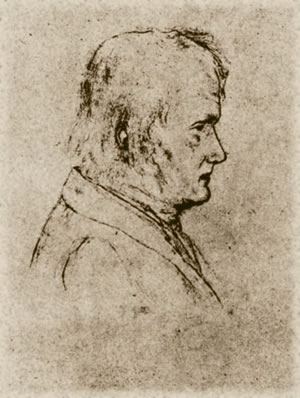
What became of Friedrich Hölderlin (1770-1843), this contemporary of Goethe? In his case too, the mind went out like a candle in the wind, falling prey to madness. In 1807, after his stay in a psychiatric clinic, he was taken in and cared for by a simple carpenter in Tübingen, who had read Hölderlin's Hyperion with great admiration. In a tower room specially prepared for him, he spent his days in solitude, no fewer than 36 years, until his death in 1843. The poet spent his time reading, reciting and playing piano. What he ultimately left behind was a seemingly endless amount of scribbles that made no sense, interrupted only occasionally by a poem that was both complete and lucid.
Friedrich Hölderlin
Skull Circumference...
In 1977, as part of the Baden-Württembergische Theatertage, the premiere takes place of Faust und Yorick, also recorded as Thinking of Busoni, in Rihm's revised version 'Chamber Opera no. 3'. The libretto is by Frithjof Haas in the German translation by Manfred Fusten.
Contrary to what the title of this chamber opera promises, the piece has little to do with Goethe and Shakespeare. The name and title of the work completed in 1976 – I follow here the explanation by Günther Roth in the program booklet of the Staatstheater in Hannover – are nothing more than associative allusions, the concept virtually timeless by placing the indecisive Hamlet figure and an actor, masked as a Faustian scholar completely consumed by his scientific research, diametrically opposed to each other.
It turns out to be a continuous struggle with time constantly slipping away, while the character of the hero ignores the most basic human emotions, his mother, wife, daughter, children and grandchildren becoming insignificant sacrifices in his attempt to subject the human brain to his obsessive research.
He even lives to see scientific institutions that had previously completely ignored his work finally recognize him, he is showered with distinctions, prizes and medals, but then he dies quite unexpectedly. His students open his skull only to discover that he himself had the biggest brain of all, something he had vainly sought in others. What a macabre, grotesque joke!
The surrealism brought to the stage by Rihm has its origins in the absurdist text by Jean Tardieu, the pseudonym of Daniël Trevoux (1903-1995). From the fifties onwards, this author from the Jura devoted himself mainly to plays, usually one-act plays, with a surrealist-absurdist character, after he had begun publishing poetry collections twenty years earlier.

Daniel Trevoux
Tardieu's Faust figure is entirely different from Goethe's. Around the mid-sixties, Tardieu positioned the world-famous magician and scholar against the backdrop of his own experiences and the skull measurements carried out by the University of Strasbourg in the context of Nazi doctrine and the associated racial craze on camp prisoners. The scientific but at the same time brutal, carried out by 'model physicians' who in their investigations proved willing to literally step over corpses.
For many a composer, theatre maker and choreographer, the Faust figure has also served as an important source of inspiration in the second half of the twentieth century and even into the millennium. In this regard, I will mention only Henri Pousseur's Votre Faust (1969), Konrad Boehmer's Doktor Faustus (1985), Alfred Schnittke's Faust (1995), Friedrich Schenker's Faustus (2004) and Pascal Dusapin's Faustus, The Last Night (2006).
Rihm oriented his work mainly on Doktor Faust by Ferruccio Busoni. He began it in 1914 on his own libretto and worked on it until his death in 1924, leaving the work incomplete. His student Philipp Jarnach completed it).
For Rihm, Busoni's opera must have served as a model example through emotions that never exceeded good taste and skillfully developed architecture. Rihm adds what Faust lacks as a human being: sensuality, but at the same time he has stripped his vocalists of their individuality: the Scholar (baritone), the Mother (alto), the Daughter (mezzo), the Woman (mezzo), the Reporter (tenor) and the four Students (soprano, alto, tenor and bass).
The instrumentation can be called very varied: flute (also piccolo), oboe (also alto oboe), clarinet (also bass clarinet), bassoon (also contrabassoon), two trumpets, trombone, extensive percussion (including vibraphone, xylophone, cymbals and tam-tam), harp, piano, celesta, harpsichord, electric organ, two violins, viola, cello and double bass.
Arnulf Rainer
Rihm's development as a composer underwent a rather sudden metamorphosis in the eighties, possibly as a reaction to criticism (especially from colleagues) of his work as it appeared in the second half of the seventies. But undoubtedly something else and perhaps of even greater importance played a role: his encounter with the works of Arnulf Rainer (*1929), a painter and collector of artworks ('Outsider Art') by psychopaths, schizophrenics and other mentally ill people. He acquires them through his wife, a psychiatrist by training, from institutions in among other places Czechia, Poland and Hungary. In Vienna, Rainer also befriended Leo Navratil, who works as a psychiatrist in a hospital for the mentally ill in Klosterneuburg near Vienna. There this treating physician gives artistically talented patients the opportunity to stimulate them to focus on creating art. Also in this institution (the later Guggin) Rainer acquires drawings and paintings. Navratil in turn organizes exhibitions and has Rainer give lectures at international medical congresses.
Rainer himself puts the matter to the test in the early sixties by engaging with drugs and alcohol to thus evoke a 'special state of mind'. He succeeds, achieving both a state of madness and euphoria, and in that state he makes multiple drawings.

Arnulf Rainer
From December 17, 2005 to March 12, 2006, a special exhibition devoted to Rainer's work was held in the Haag Kunstmuseum. From the explanation provided by the museum:
'In the early sixties Rainer, through experiments with drugs and alcohol that put him in a state of madness, produces various drawings. He also becomes interested in 'catatonic phenomena' - the arbitrary assumption of bizarre postures - which can be associated with schizophrenia. Despite the fact that the influence of the 'Outsiders' is difficult to deny, Rainer has never explicitly commented on the connection between his work and theirs. In the exhibition at the Gemeentemuseum, alongside the rich collection of 'Outsider Art', Rainer's Face Farces can be seen among other things, as well as various overpaintings of photographs of Messerschmidt's eighteenth-century sculpted expressive heads. Particularly striking is that Rainer in the nineties not only reworks drawings and paintings by 'Outsiders', but also has some of them paint over his work.'

Arnulf Rainer: 'Wunden'
1979 - A Special Year
The second theatrical work created under Rihm's creative hands was the chamber opera Jakob Lenz, which experienced its first performance on March 8, 1979 at the Staatsoper in Hamburg. This work too is based on Rihm's (lifelong) fascination with so-called 'madness literature'. This time it concerns the work of Georg Büchner (1813-1837), the author of Lenz, which recounts the 'Winterreise' in Alsace in the 1770s of the young writer Jakob Michael Reinhold Lenz driven by fear of going insane: 'At first it pressed in his chest, but increasingly pressed in his head'). Friedrich Nietzsche, Friedrich Hölderlin, Antonin Artaud and Adolf Wölfli would also play an important role in Rihm's further creative life.
In between, Rihm had still found time to compose a number of charming waltzes for piano four-hands, alongside a number of organ pieces, Klavierstück VII (for which Karlheinz Stockhausen served as a model) and a string quartet, the fourth by now in what would become a long series.

Wolfgang Rihm: String Quartet No. 5, measures 1-16 (autograph)
It was also in that year that American-French harpsichordist William Christie founded the baroque ensemble Les Arts Florissants and György Kurtág in Budapest paid his tribute to the work of his Italian colleague and contemporary with Omaggio a Luigi Nono, a choral work on texts by Anna Achmatova. Then there was the American John Cage who with his Recent Ruins and Paragraphs of Fresh Air (where even four 'machinists' had to be involved who could also play an instrument!) caused quite a stir, not for the first time. At the Deutsche Oper in Berlin, Untergang der Titantic by Dieter Siebert was the talk of the day. On 24 November (1979) the Staatsoper in Dresden presented for the first time Leonce und Lena by Paul Dessau, modelled after the 'Lustspiel' by…Georg Büchner. In our country, the music theatre piece Maulwerke by Dieter Schnebel was heard during the Holland Festival of 1979, in co-production with the Goethe-Institut, the Berliner Festwochen and the Berliner Hochschule der Künste.
Büchner and Lenz
The name of the progressive and strongly socially committed German author Georg Büchner and in particular his Lenz (the title incidentally is not by the author), first published in 1839 in the journal Telegraph für Deutschland, can be directly linked to the period after the First World War, when the pioneers of modernity produced a number of librettos based on his work. In 1926, Wozzeck by Manfred Gurlitt premiered in Bremen, a year earlier in Berlin preceded by Alban Berg's equally named opera. But only after the end of the Second World War, after the yoke of what the Nazis called 'Entartete Kunst' had been thrown off, did a much broader reception take place. This was particularly initiated in 1947, during the Salzburger Festspiele, with Dantons Tod by Gottfried von Einem, in the adaptation of Büchner's drama by composer Boris Blacher.

Georg Büchner
Much attention was also drawn later to the multimedia spectacle Die Soldaten by Bernd Alois Zimmermann, begun in 1958 and – at intervals – completed in 1964, based on the like-named play by Jakob Lenz dating from 1776. With this we find ourselves in a fatalistic world where injustice and chaos reign and man is powerless to bring about change. Human existence which through Lenz's eyes has completely lost all meaning (Nietzsche would later elaborate this theme considerably more differentiated). Lenz ultimately became a victim of his own ideas: after his break with Goethe he fell into psychological decline and subsequently into the gutter.

Jakob Lenz 1751-1792)
The history of the soldier
The genre of 'Kammeroper' brought on the one hand creative challenges and on the other was born out of economic necessity but also because of other circumstances (such as the Spanish flu raging wildly between 1918 and 1920). THE example that would prove to be groundbreaking was Igor Stravinsky's L'Histoire du Soldat, a melodrama 'to be read, played and sung' for narrator, two actors, a dancer and seven instrumentalists, composed in 1918 in the Swiss town of Morges. It was intended as a performance within the limitations of travelling theatre ('théâtre ambulant'), also proposed as 'Briefkastenschlüsselwerk', which would later serve as a model for many a 'Kammeroper'. Everything was combined in the piece: the refined dramaturgy, the instrumentation worked out to the finest detail, the condensed form and the rounded-off numbers. The libretto was written by Charles Ferdinand Ramuz. Even in our country it caught on: Martinus Nijhoff made an appropriate translation of it in 1930: Geschiedenis van de soldaat.
In that sense, L'Histoire du Soldat meant at least a provisional farewell to the opulent opera orchestra with the lavish stage trappings that went with it. Stravinsky could make do in his Histoire with a violin, double bass, clarinet, bassoon, trumpet, trombone and a percussionist. On stage, for the text nothing more was needed than a speaker who explained the action step by step. The scenic conventions that had previously prevailed and still dated from the previous century were swept aside in one fell swoop. Also remarkable was the composer's instruction to perform the work on a stage divided into three areas, with the narrator on one side and the instrumental ensemble on the other, with the dancer and the two actors in the middle. Thus the piece went ahead on 28 September 1918 at the Théâtre Municipal de Lausanne under the direction of Ernest Ansermet.

Announcement of the première
No longer of this time
The 'small' theatre brought new creative dimensions after World War II, particularly in the German-speaking regions. Large-scale theatre was no longer considered 'zeitgemäss' and there was a lack of the innovation deemed so necessary. Thus Mauricio Kagel found in the mid-seventies that two solo voices (countertenor and baritone) were sufficient for his Mare nostrum, with only flute (also piccolo and alto flute), oboe (also alto oboe), guitar (also mandolin and lute), harp, cello and…the countertenor and baritone also as percussionists. Whereas the subject matter he had chosen was by contrast colossal: the conquest of South America. Compared to this, Reconstructie, the opera by Louis Andriessen, Reinbert de Leeuw, Misha Mengelberg, Peter Schat and Jan van Vlijmen performed during the Holland Festival in 1969 on a libretto by Hugo Claus and Harry Mulisch was a true 'monster project'. In this opera too, South America was central, in the person of Argentine freedom fighter Che Guevara.
Lenz-orkest
Rihm's 'Lenz-orkest' also fitted the spirit of the times, was considerably streamlined, with only three cellos, two oboes (also alto oboe), clarinet (also bass clarinet), bassoon (also contrabassoon), trumpet, trombone and harpsichord, but with expanded percussion, including tam-tam, tom-tom and whip. Alongside the three protagonists (Lenz, Oberlin and Kaufmann), the whole is vocally carried by two children's and six professional voices. There are no secondary roles, no choir is present.
According to Florian Lutz in Die letzten Opernhelden der westlichen Welt, included in Reininghaus/Scheinders, Handbuch Experimentelles Musik- und Tanztheater (Laaber 2004), Rihm's chamber opera Jakob Lenz moved
'harmonically […] constantly between free atonality and tonal contexts; distinct echoes of Alban Berg's Wozzeck are evident. In terms of compositional technique, Rihm draws on traditional musical forms such as Ländler and Sarabande and employs proven aria forms to some extent. The musical complexity and multifacetedness of the figure Lenz contrasts with the one-dimensional characterization of the two friends (they are 'simple people'). Lenz, however, to whom a tritone with a minor second is assigned, is constantly accompanied by the sextet of his inner voices, mocked, tormented; thus he stands alone and yet simultaneously in a multifaceted, subtle network of relationships with his surroundings.'
The structure of the opera is cast in thirteen scenes, interrupted by instrumental interludes, in an unceasing struggle between layering, condensation and transparency, in accordance with the extremely volatile emotional states to which the poet is subject. Rihm composes here from a psychiatric mixture of imagination and reality, at times opaque, confused and impassioned. In stylistic terms, a difficult-to-unravel tangle that carries a high dose of unpredictability and lack of direction and in that sense is both groundbreaking and markedly different from Berg's Wozzeck.
Mexico...
Then there was Rihm's fascination with the no less radical Antonin Artaud (1896-1948), the founder of absurdist theatre, emerging from what also clung so deeply to Nietzsche and Hölderlin: that extremely narrow borderline between genius and madness.

Antonin Artaud
In Rihm's oeuvre, the work of Artaud has left deep traces: his 'poème dansé' Tutuguri (1980), modelled on the recipe of Debussy's Jeux, and inspired by Artaud's radio play Pour en finir avec le jugement de dieu, the symphony Séraphin nach Artaud, but also in the opera Die Eroberung von Mexiko, completed in 1991 and surrounded by much (natural) violence, (based on Artaud's La conquète de Mexique, alongside a poem by Octavio Paz and Indian lyrics.
Die Eroberung von Mexico actually connected with what Artaud had already undertaken in the thirties: a journey of discovery to Mexico, where he became acquainted with 'peyote', a plant-based drug that brought him to 'other spheres', stripped of reason and consciousness. In short, a psychedelic adventure that certainly had its effect and fitted seamlessly into what Artaud had long been propagating: that it was the task of art to enchant, to leave reason behind and precisely to awaken the primitive, dark, unconscious and irrational in man. He was not alone in this...
Wölfli-Liederbuch
An equally striking example is the Swiss draughtsman and painter, composer and writer Adolf Wölfli (1864-1930). He had a rough time of it from his youth onwards, with a father addicted to alcohol, a mother who died young and a trail of psychological and sexual abuse. In 1890, when he was 26, he had to serve two years in prison following two attempted rapes of a five- and fourteen-year-old girl. Three years after his release, things went wrong again and on the orders of the judge he was admitted to a psychiatric institution, where he was diagnosed as schizophrenic. He committed a similar crime again and ended up in a psychiatric institution in Waldau near Bern. Wölfli hallucinated, was often confused and was so difficult to handle that he frequently ended up in solitary confinement. From 1895 until the end of his life he remained in the clinic in Waldau, in his seven square metre room. There he remained active as an artist despite his illness. He left behind almost just over three thousand drawings and collages, and as many as twenty-five thousand pages of notes, stories, poems and compositions. In 1921, his therapist, psychiatrist Walter Morgenthaler, published Ein Geisteskranker als Künstler.

Adolf Wölfli
In the institution he took up pen and brush, resulting in no fewer than 1460 drawings and 1560 collages. In addition, he filled 25000 pages with poems, stories and compositions. His work is swept by the harsh wind of 'horror vacui', the fear of emptiness. Not by chance, he used every bit of space on the canvas.

Adolf Wölfli: 'Heilanstalt Waldau' (1921)
Wölfli owes his first fame, albeit unfortunately posthumously, to French painter Jean Dubuffet, who organized a special exhibition of Wölfli's work in 1948.
Georg Friedrich Haas designed a chamber opera dedicated to Wölfli in 1981. With a performance time of less than half an hour and only one soloist, a baritone, it was not in that sense a direct competitor to Rihm's Jakob Lenz, but rather with his Wölfli-Liederbuch completed in 1980. The instrumental scoring was likewise greatly reduced, with only oboe, cor anglais, bass clarinet, bassoon, prepared piano, two violins, viola, cello and double bass.
Rihm completed his Wölfli-Liederbuch in 1981 for baritone and piano, not by chance with a (nearly) Schumann quotation at the beginning: 'Ich habe dich geliebet', from 'Ich habe im Traum geweinet' from Schumann's Dichterliebe. For Schumann too ended up miserably in a psychiatric clinic after his gradually advancing mental deterioration.
Nietzsche
Throughout his creative life, Rihm has been concerned with the work and person of Friedrich Wilhelm Nietzsche (1844-1900). It is no longer possible to say exactly when, but at the latest it began in the late seventies, connected with the great success that Rihm's opera Jakob Lenz had enjoyed, when the great German philosopher, philologist, poet, cultural critic and composer came into Rihm's view.
In January 1889, with the new year barely begun, Nietzsche's mental collapse was a fact. He was in Turin at that moment. He had been suffering for some time from severe migraine attacks and severely deteriorated eyesight, which seriously hindered his work as a professor in Basel. Ten years earlier he had been forced to give up that position.

Friedrich Nietzsche and his sister (1899)
There had been ominous signs earlier, including the many cryptic notes he sent from Turin that made little or no sense. They have gone down in history as 'delusion letters'.
After he was found naked in the street and even threatened to kill German Kaiser Wilhelm, the time seemed to have come to subject him to an extensive psychiatric examination in Basel. This resulted in his admission to a psychiatric clinic, but despite the treatment administered, his condition gradually worsened. Eventually he no longer recognized his loved ones, suffered from delusions and lost all interest in his surroundings. He could no longer care for himself and wrote not a single word more. Further treatment proved futile, after which his mother and sister cared for him until his death. He died in Weimar on 25 August 1900, fifty-five years old.
Rihm dedicated several works to what was in a sense his idol: three of the five Abgesangszenen, the Third Symphony, the Nietzsche-Fragmente (Umhergetrieben, aufgewirbelt), Umsungen, Sechs Gedichte von Friedrich Nietzsche, the Dionysos-Dithyramben, the opera Dionysos.
Nietzsche and Rihm, they had something in common, 'künstlerische Subjektivität', according to the already mentioned Nike Wagner:
'Throughout all philosophy and aesthetics, Nietzsche's "I-saying" resonates, but both Zarathustra and the late fragments reveal the identity of this I-sayer with the figure of the solitary, wounded, disturbed. Nietzsche and Lenz and Hölderlin belong together, but also Artaud and Celan, the poets between and after two world wars, whom Rihm set to music. Nietzsche discovered the wild, archaic, anti-classical antiquity.' (Drin-Sein als Rettung vor dem In-Sein, München 2004).
It fits 'reibungslos' into what has given Rihm's music theater so much content: presenting title figures as solitary, wounded and disturbed lives. Connected with this - as in Dionysos - the word analysis and deconstruction, followed by new compositions and with a 'satz'-structure that makes Dionysos perfectly connect to the monodrama Proserpina. The opera premiered at the (then) Dutch Opera in June 2011.
The reviews were, incidentally, not mild, including from colleague Paul Korenhof. Strong criticism was also heard in July 2011 in Salzburg (Festpiele), a year later in Berlin (Staatsoper) and in 2013 in Heidelberg. That the chosen direction also played a significant role in this is self-evident.
Psychopathology
With Rihm's 'dargestellter Wahnsinn' as music theater we have reached psychopathology. Certainly not a 'cheerful' world, psychology and psychiatry bundled together in the domain of mental illnesses, but also of patients who were mentally still in contention, as creators found the way to the visual arts, literature or music.
...as theater
So (also) as theater. As in Rihm's Jakob Lenz, it is in Rihm's work inspired by Nietzsche the mentally weak, the maladjusted human in the new era, who is unable to make good connections with his immediate surroundings. Their psyche is dark, alienating, hopeless, but at the same time subject of great artistic scope. Jakob Lenz as the protagonist is everywhere, there are hundreds of thousands of them, registered or not as patients. Within the walls of the theater it can be reported in stylized form, possibly also reflected on that fragile border between madness and genius. The many alter egos of Georg Büchner's Lenz on stage: Rihm made full use of them. And not only him. Thus there was Thomas Bernhard's play Der Ignorant und der Wahnsinnige which, after its performance at the Salzburger Festspiele of 1972, even caused a great scandal. Botho Strauß fared little better in Hamburg with the play Die Hypochonder (Bekannte Gesichter, gemischte Gefühle). A difficult subject, much is at least certain...
In conclusion
Reininghaus' book lacks objectivity by nature and design, but - no less importantly - also the (felt by the reader) identification with the man and composer Wolfgang Rihm. An important cause of this is the excessive use of quotations, resulting in text-in-text. Such a procedure puts the protagonist at a distance from the outset.
In the Literatur und Quellennachweise I counted no fewer than twenty-one publications by Reininghaus. No less than 70 percent - it is no more than a rough estimate - of the book's content consists of previously published texts. This seems like a disadvantage, but relativization is in order here, since the majority of classical music lovers will know little or nothing of Rihm's work, let alone the person. Anyone who has a reasonable command of the German language can, however, draw considerable inspiration from Reininghaus' book for further exploration (especially of the music itself).
Those who want to dig deeper can do well with the already mentioned Joachim Brügge. Even deeper - then it is more specialist literature - is also possible: with Yves Knockaert and his A Chiffre - The 1980s and beyond, although this book only deals with the eponymous cycle (I hope to discuss it later). With increasing knowledge, understanding will grow for a tone poet who, at least in his own country, is regarded as the greatest postwar German composer and whose reputation extends far beyond his own borders.
After reading Reininghaus' Rihm. Der Räpresentative there will still be many questions remaining. Also regarding the title, for whom did Rihm actually represent? It can at most, and even then with a pinch of salt, relate to certain organizations or institutions. Certainly not composers and just as little his music, which represents no particular other movement. The latter is also what Reininghaus writes in his introduction: 'Das begreift und inszeniert sich als das eines Neuerers aus – followed by a Rihm quotation – "innerer Notwendigkeit" und ein Kämpfers für – again quoting - "die Idee einer Art integralen Kunstwerks".'
The photographs printed in the book are mostly by Hans Kumpf, including one photograph - also printed on the front flap - in which Rihm presents himself physiognomically as strongly resembling Beethoven. It is a striking likeness, no manipulation, for Rihm did indeed present himself like this during the Donaueschinger Musiktage in 1987. Just so you know...
Rihm's works are published by Universal Edition.
